

Products


1mm Pure Zinc Plate For Battery Anode Substrate
Optimal thickness for multi-format electrode stacking
Mechanical integrity for long-cycle life
Hydrophilic surface for low charge-transfer resistance
Send Inquiry
Product Introduction
1mm Pure Zinc Plate for Battery Anode Substrate achieves ≥99.9% purity with high theoretical capacity of 820 mAh/g and true density of 7.14 g/cm³, delivering low-resistivity conductivity(1.7×10⁷ S/m) for reversible Zn²⁺ plating/stripping in aqueous electrolytes. Cold rolling and precision-annealing eliminate internal stress while stabilizing native hydrophilic surface that moderates electrolyte wetting against HER (hydrogen evolution reaction). Thickness tolerance held within ±0.05 mm prevents current density maldistribution that triggers Zn dendrite propagation across separators. The 1mm gauge resists bending fatigue during electrode stacking while remaining shearable into custom geometries. Symmetric cell testing demonstrates extended cycle stability under controlled DOD (depth of discharge), with refined grain structure and reduced dislocation density lowering overpotential at the anode/electrolyte interface.

1mm Pure Zinc Plate for Battery Anode Substrate functions as the negative electrode substrate in Zn–air batteries, primary dry cells(Leclanché type), and rechargeable aqueous Zn–ion systems(AZIBs). The plate's solid metallic architecture delivers higher coulombic efficiency than zinc powder or gel formulations in high-rate discharge scenarios by minimizing contact resistance between active material and current collector. When deployed as sacrificial anode within alkaline Zn–air flow configurations, the plate maintains stable open-circuit potential and corrosion behavior without polarity reversal at elevated temperatures. For grid-scale storage applications, the 1mm format combines mechanical robustness for electrode stacking with sufficient zinc inventory to achieve extended cycle life before replacement.
Products Specifications

- Material: 99.9% Zinc
- Size: 90*50mm
- Thickness: 1mm, 1.5mm
Products Features

High purity for stable electrochemistry
With ≥99.9% Zn (traceable certification), the plate minimizes impurities that trigger localized corrosion, H₂ evolution, and internal short circuits. This purity ensures stable open-circuit potential and high Coulombic efficiency under continuous cycling.

Optimal thickness for multi-format electrode stacking
The 1mm gauge balances rigidity (no curling) with areal capacity. At 1mm thickness, the electrode delivers ~70mAh/cm², which reduces the number of plates needed per cell while maintaining handling flexibility in prismatic, coin, and stacked-cell architectures.

Mechanical integrity for long-cycle life
Cold-rolled and stress-relieved (150–200°C annealed) to eliminate rolling-induced dislocations, the plate resists deformation from repeated Zn²⁺ plating/stripping. This preserves low-resistivity pathways across the anode–electrolyte interface and suppresses dendrite initiation at grain boundaries.

Hydrophilic surface for low charge-transfer resistance
A native oxide/hydroxide layer (ZnO/Zn(OH)₂) ensures uniform electrolyte wetting and low charge-transfer resistance without HF-based etching. This reduces initial activation overpotential and yields stable polarization curves from cycle 1 to 1000+.
Products Applications
Rechargeable aqueous zinc-ion batteries (AZIBs) for laboratory R&D. The 1mm plate functions as the negative electrode in AZIBs, which rely on Zn²⁺ stripping and plating in mild acidic electrolytes (e.g., ZnSO₄ + MnSO₄). The 1mm thickness balances areal capacity with manageable Zn utilization rates (typically 10-30% in symmetric Zn||Zn cells). Researchers use the plate as a baseline Zn metal anode for evaluating artificial protective layers (APLs) that suppress dendrite propagation and hydrogen evolution reaction (HER). The plate's precise thickness tolerance of ±0.05 mm ensures uniform current density distribution during cycling-a prerequisite for reproducible electrochemical impedance spectroscopy (EIS) data. Zn||Zn symmetric cells with 1mm anodes achieve cycle stability exceeding 800 cycles at 2 mA·cm⁻²/2 mAh·cm⁻² under optimized electrolyte conditions.
Grid-scale energy storage demonstration systems. The 1mm Zn plate integrates into alkaline Zn//Ni flow-assisted battery stacks without membrane separators, offering a cost-effective pathway to long-duration storage. A grid-scale 25 kWh string comprising thirty 833 Wh cells, each equipped with 1mm zinc anodes, demonstrated >1,000 cycles with round-trip energy efficiency above 80%. The 1mm plate geometry withstands electrolyte flow shear stress (up to 100 mL·min⁻¹) without mechanical deformation or particulate shedding-failures often observed with zinc powder beds.
Rechargeable Zn//MnO₂ full cells for consumer electronics. The 1mm plate serves as the Zn metal anode in mild acidic Zn//MnO₂ batteries, with the MnO₂-coated carbon nanotube cathode maintaining capacity through self-healing electrodeposition. The plate's high purity (≥99.995% Zn) minimizes parasitic Zn corrosion and MnO₂ cathode contamination, extending cycle life to >300 cycles at 1 mA·cm⁻². The mechanical robustness of the 1mm format supports automatic electrode stacking in prismatic cell assembly for portable power banks and wearable electronics.
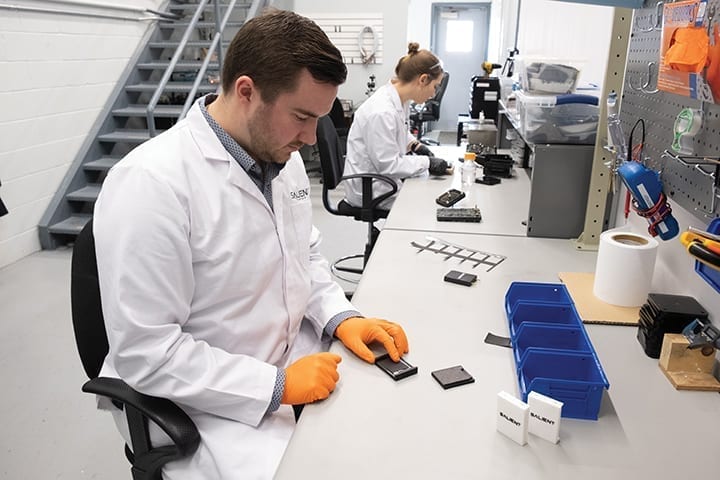
Battery-grade separator and electrolyte compatibility testing. The 1mm plate acts as a standard planar electrode for investigating separator wetting, ionic conductivity, and zincate ion diffusion across glass fiber, polyolefin, or cellulose membranes. The plate's flat surface eliminates variables from electrode curvature or porosity, enabling reproducible measurements of electrolyte breakdown voltage, Zn²⁺ transference number, and interfacial charge-transfer resistance. Laboratory protocols typically pair the 1mm plate with 1M ZnSO₄ or 6M KOH electrolyte at room temperature, with galvanostatic cycling data directly comparable across different separator materials.
Customizable electrode for proprietary battery chemistries. The 1mm Pure Zinc Plate for Battery Anode Substrate can be laser-cut, die-stamped, or waterjet-machined into custom shapes and sizes (circles, squares, strips) without burr formation or edge delamination. This flexibility accommodates proprietary electrode designs in coin cells (Φ16-Φ20 mm), pouch cells (25 mm × 25 mm to 100 mm × 100 mm), and cylindrical formats. High-purity Zn grade (99.995%) provides consistent electrochemical potential (−0.763 V vs. SHE) and corrosion resistance across a wide range of commercially available electrolytes.
Contact us

Tel: 0917-3873009

Phone: +86 18992731201

Email: zhangjixia@bjygti.com

Fax: 0917-3873009

Address: No. 195, Gaoxin Avenue, High-tech Development Zone, Baoji City, Shaanxi, China

WhatsApp: +86 18992731201
Hot Tags: 1mm pure zinc plate for battery anode substrate, China, suppliers, manufacturers, customized, usage, pricelist, for sale, in stock, free sample, porous material, custom high purity molybdenum plate, high purity graphite crucible, Pure tungsten metal plate, sintered wire mesh filter, tungsten crucible element, wholesale high purity molybdemun plate sheet
Send Inquiry
You Might Also Like
-
![0.2mm Thickness SS316L Perforated Sheet For Fine Liquid Filtration]() 0.2mm Thickness SS316L Perforated Sheet For Fine Liquid F...view more>
0.2mm Thickness SS316L Perforated Sheet For Fine Liquid F...view more> -
![120-140 Mesh Sintered Copper Powder Sensor Protection Cover]() 120-140 Mesh Sintered Copper Powder Sensor Protection Coverview more>
120-140 Mesh Sintered Copper Powder Sensor Protection Coverview more> -
![3X6mm Hole Size Pure Nickel Expanded Mesh For Hydrogen Production]() 3X6mm Hole Size Pure Nickel Expanded Mesh For Hydrogen Pr...view more>
3X6mm Hole Size Pure Nickel Expanded Mesh For Hydrogen Pr...view more> -
![50-80% Pure Nickel Fiber Felt For Fuel Cell]() 50-80% Pure Nickel Fiber Felt For Fuel Cellview more>
50-80% Pure Nickel Fiber Felt For Fuel Cellview more> -
![1 Micron Customized Sintered SS Wire Mesh Filter Disc]() 1 Micron Customized Sintered SS Wire Mesh Filter Discview more>
1 Micron Customized Sintered SS Wire Mesh Filter Discview more> -
![Stainless Steel Mesh Filter With Various Interface]() Stainless Steel Mesh Filter With Various Interfaceview more>
Stainless Steel Mesh Filter With Various Interfaceview more>


