

Titanium pipe fittings exposed to elevated temperatures develop a hard, oxygen-rich surface layer known universally as alpha-case. This contamination zone forms when oxygen diffuses into the metal lattice at temperatures exceeding approximately 540°C (1000°F), stabilizing the hexagonal close-packed alpha phase and creating a brittle, low-ductility shell. Alpha-case thickness rarely exceeds a few tenths of a millimeter in normal fabrication cycles, yet even a shallow contaminated layer acts as a crack initiation site under tensile or cyclic load. Complete, uniform removal restores surface integrity, fracture toughness, and corrosion resistance, and prevents the delayed failures often misdiagnosed as material defects.
Three techniques dominate alpha-case and oxide scale removal in titanium pipe fabrication: mechanical grinding, acid pickling, and chemical milling. Each method claims a place in production depending on geometry, batch size, and acceptance criteria. The question of efficiency, however, cannot be reduced to stock removal rate alone. True efficiency balances removal uniformity, dimensional tolerance, hydrogen pick-up risk, and rework rate on complex internal surfaces typical of elbows, reducers, and branch outlets.


mechanical grinding
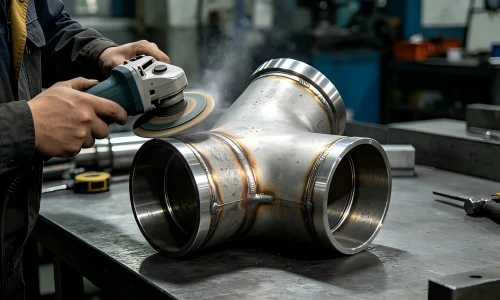
Mechanical grinding employs abrasive belts, flap wheels, or carbide burrs to physically strip the contaminated layer. On straight pipe exteriors or flange faces, this method offers immediate visibility. Operators can blend out discoloration and check progress by dye penetrant inspection. However, titanium's low thermal conductivity concentrates frictional heat in the grinding zone. If local temperatures exceed the 540°C oxidation threshold again, a new oxygen-enriched layer can form beneath the freshly exposed metal. Also, manual grinding rarely produces a uniform thickness removal; residual alpha-case often remains inside crevices, root-pass weld toes, and tight-radius bends where the wheel cannot reach. For a 3D pipe fitting like a tee with backside gussets, mechanical grinding fails to guarantee complete contamination removal. It is labor-intensive, geometry-limited, and can embed aluminum oxide or silicon carbide fragments into the titanium surface-an unacceptable outcome for semiconductor-grade or aerospace fluid systems.
Acid pickling
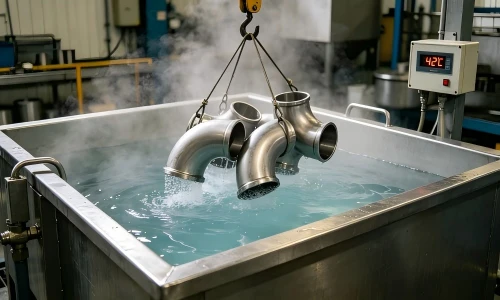
Acid pickling uses a nitric-hydrofluoric acid mixture, typically 20–40% HNO₃ and 1–5% HF, at controlled temperatures between 25°C and 50°C. The HF dissolves the oxide and some titanium metal, while HNO₃ prevents excessive hydrogen absorption by maintaining a passivating oxidizing potential. Pickling rates can exceed 0.02 mm per minute, quickly eliminating alpha-case and heat tint on accessible surfaces. The process also removes tramp iron and other smeared contaminants. The major pitfall is hydrogen uptake. When the HNO₃:HF ratio falls too low, or bath temperature spikes, atomic hydrogen diffuses into the titanium, embrittling the lattice. Even a well-controlled pickling bath can introduce hydrogen above the 0.015% mass limit if immersion time is prolonged. Post-pickling vacuum annealing is often mandatory to diffuse hydrogen back out, adding a complete thermal cycle. Additionally, acid pickling attacks all exposed metal uniformly only in the line of sight; shadowed internal passages or threaded connections may emerge under-pickled or dimensionally thinned. Waste acid management and titanium ion contamination limits add environmental handling costs.
Chemical milling
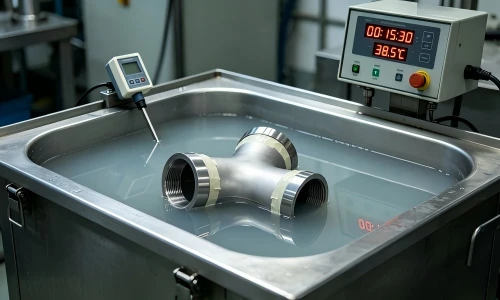
Chemical milling-sometimes called chem milling or controlled chemical machining-offers a fundamentally different mechanism. Rather than aggressive etching, it uses formulated pastes or lower-activity solutions applied with precise maskants and timed immersion to remove a pre-calculated metal thickness. This technique is standard in aerospace titanium pressure vessels and airframe skins where alpha-case removal depths must be certified via coupon monitoring. Chemical milling removes metal uniformly even from complex internal geometries and blind cavities, provided solution flow can reach them. Modern titanium chemical milling solutions are often nitrate-based with fluoride additions and proprietary inhibitors that buffer the metal dissolution rate while cathodically limiting hydrogen formation. The rate is slower than raw acid pickling, typically 0.01–0.03 mm per hour, but the removal is isotropic and dimensionally stable. Hydrogen absorption is minimized by maintaining an electrochemical potential in the passive region; post-milling hydrogen content generally remains below 0.005% if solution control is exact. The main engineering cost is maskant application and removal, plus analytical maintenance of the bath chemistry. For critical titanium pipe fittings with small-bore internal radii, chemical milling is the only process that can reliably remove 100% of alpha-case without mechanically compromising the thin wall or leaving a fatigue-prone notch profile.
Comparing efficiency strictly by time-on-part favors acid pickling. A pickling bath strips general alpha-case from a weld elbow in 15–30 minutes, while chemical milling may require several hours. But when efficiency factors include scrap rate, rework, additional vacuum degassing, and long-term service reliability, chemical milling consistently outperforms. Mechanical grinding ranks lowest for any fitting containing internal contours or requiring traceable process control. It remains useful for cosmetic repair of large, simple components after which thickness verification by ultrasonic gaging can substantiate contamination removal.
Process selection depends on the acceptance standard. AMS 2700, ISO 8080, and ASTM B600 all provide guidance on titanium chemical removal and passivation. An efficient operation defines pass/fail not by the disappearance of discoloration but by confirmation that the brittle alpha-case layer is replaced by sound metal with less than 200 ppm incremental hydrogen increase. For applications demanding full alpha-case clearance on all surfaces-high-cycle fatigue aerospace lines, subsea actuators, or medical isotope transfer piping-chemical milling stands as the most reliable, verifiable, and material-safe choice. The bath chemistry, temperature, and solution analysis must remain under strict statistical process control, and a post-milling humidity-bake cycle is recommended to drive off any adsorbed hydrogen. Under these conditions, chemical milling delivers the highest overall process efficiency: uniform surface quality, tight hydrogen control, and zero need for subsequent mechanical blend repair.