
This article will discuss how to Understand True Pore Size Control and Bubble Point Testing.
In the procurement and application of powder sintered filter elements, one of the most common yet overlooked problems is:
Nominal rating ≠ actual filtration precision.
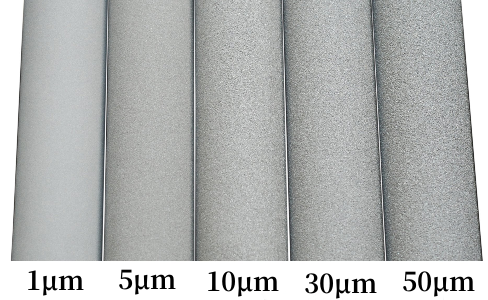
Many users report that even though they bought a "5 μm" sintered stainless steel filter, visible particles still appear downstream, or the pressure drop is far higher than expected. Worse still, critical processes suffer from product non-conformance, equipment clogging, or even shutdowns.
Where does the problem lie? The answer often lies in two concepts: absolute rating and bubble point testing.
Why Does "5 μm" Become "20 μm" in Practice?
Many manufacturers mark "5 μm" as a nominal rating.
Nominal rating is loosely defined - it typically means the media can capture most (e.g., 90–98%) of particles of a given size, but not all.
What truly determines filtration performance is the absolute rating, generally defined as the particle diameter that is retained with ≥99.9% efficiency.
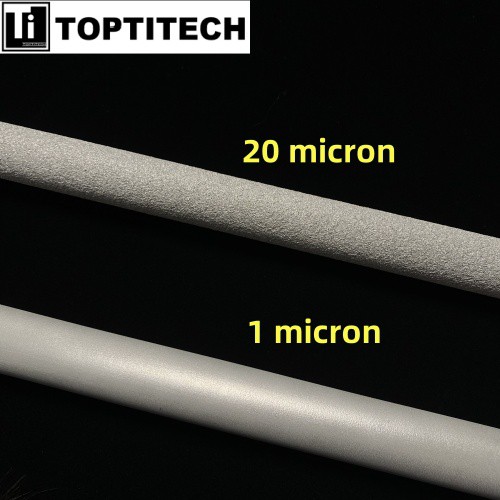
Powder sintered filters are made by compacting and high-temperature sintering metal powders (e.g., 316L, Ti). Their pore structure consists of 3D irregular tortuous channels. Poor sintering control can lead to:
●Wide powder size distribution → coexistence of fine and coarse pores
●Improper sintering temperature or time → local over-sintering or under-sintering
●Non-uniform compaction density → uneven porosity distribution
The result: a filter marked as 5 μm may actually have a maximum pore size up to 20 μm.
| Type | Definition Standard | Retention Efficiency | Representative Test Method | Actual Value When Marked 5 μm |
| Nominal Rating | Vague (varies by manufacturer) | 90–98% | No unified standard | 10–20 μm |
| Absolute Rating | Rigorous (≥99.9%) | ≥99.9% | Bubble Point / Challenge Bacteria |
5–7 μm |
Typical Differences Between Nominal and Absolute Ratings
How to Accurately Determine True Pore Size? - Bubble Point Test
The most mature and intuitive non-destructive method in the industry is the bubble point test.
It is based on capillary phenomena and the Young-Laplace equation:
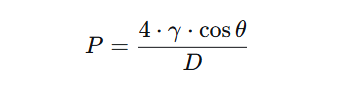
Where:
P = minimum pressure to push gas through the largest pore (bubble point pressure)
γ = surface tension of the test liquid
θ = contact angle
D = maximum pore diameter
Procedure:
Fully wet the filter element with a liquid of known surface tension. Gradually increase the gas pressure. Record the pressure when the first steady stream of bubbles appears.
Then, calculate the maximum pore size to determine if the element meets the absolute rating requirement.
Common Test Liquid Parameters (20°C)
| Test Liquid | Surface Tension (mN/m) | Compatible Materials | Characteristics |
| Isopropyl Alcohol (IPA) | 21.7 | Stainless steel, Ti, Ni | Fast drying, widely used |
| Perfluorinated liquid (e.g., FC-40) | 16–18 | All metal sintered materials | Non-residue, low corrosion |
| DI water + 0.1% wetting agent | ~30 | Stainless steel | Safe, low cost |
Qualified vs. Unqualified Filter: Data Comparison
Measured Bubble Point Data for Two 5 μm Absolute-Rated Sintered SS Filters
| Parameter | Qualified (Manufacturer A) | Unqualified (Manufacturer B) |
| Claimed rating | 5 μm (Absolute) | 5 μm (Nominal) |
| Bubble point pressure (IPA) | 1≥4.5 kPa | 1.2 kPa |
| Calculated maximum pore size | ≤6.2 μm | ≈21.8 μm |
| Actual retention efficiency (5 μm particles) | 99.95% | ~93% |
| Downstream particle condition | Pass | Visible contaminants |
Note: IPA surface tension = 21.7 mN/m, contact angle assumed 0°.
Maximum pore size formula: D=4γ/P
Schematic description (can be plotted manually):
◆Figure 1: Bubble point curve of qualified filter - a clear inflection point in the pressure-flow curve at ~4.5 kPa.
◆Figure 2: Bubble point curve of unqualified filter - airflow starts at 1.2 kPa, curve rises gradually, indicating a high fraction of large pores.
Three Practical Suggestions for Procurement & Engineering Teams
 Specify the rating definition in your contract
Require the supplier to clearly state whether the rating is nominal or absolute, and agree on an acceptance bubble point value.
Request bubble point test reports
Each batch or individual filter should come with a measured bubble point pressure, not just a claimed pore size.
Perform a quick on-site verification
Wet the filter with IPA, slowly apply gas pressure, and observe the bubble point pressure. If it deviates >30% from the supplier's claim, use with caution.
Conclusion
The core value of powder sintered filter elements lies in a stable, controllable pore structure.
"5 μm" does not mean 5 μm - unless verified by a bubble point test.
As a professional manufacturer, we do not just provide filter elements; we deliver measurable and verifiable filtration precision.
If you are struggling with filter selection or quality complaints, feel free to contact us for bubble point testing guidance or a free sample evaluation service.