

Products

0.1mm Thick Titanium Fiber Paper for Proton Exchange Membrane Electrolysis Cell
Optimized Porosity 70% for Superior Mass Transfer
High-Purity Grade 1 Titanium Construction for Exceptional Corrosion Resistance
Excellent Electrical Conductivity with Uniform Current Distribution Performance
Send Inquiry
Product Introduction
0.1mm Thick Titanium Fiber Paper for Proton Exchange Membrane Electrolysis Cell serves as a core porous material for PEM water electrolysis systems. This professional material upgrades the efficiency and durability of hydrogen production work. It adopts high-purity Grade 1 titanium fiber as the raw material. It uses mature vacuum sintering technology for processing. It has a uniform porous structure and a fine pore size distribution. It realizes stable gas and liquid mass transfer inside electrolysis equipment. It maintains low electrical resistance. These core features effectively raise the overall energy efficiency of standard PEM electrolyzers.


0.1mm Thick Titanium Fiber Paper for Proton Exchange Membrane Electrolysis Cell meets the strict working requirements of electrolysis scenarios. It works as a vital porous transport layer and gas diffusion substrate in PEM electrolyzer stacks. It achieves fast transfer of hydrogen and oxygen gas. It prevents the internal proton exchange membrane from dehydration. It supports stable equipment operation under high current density. It has outstanding corrosion resistance. It withstands erosion from acidic electrolytes and oxidative working environments. It stops material damage and aging during long-term use. Its thin 0.1mm structure cuts down ohmic loss. It reduces power use and daily operating costs for large-scale hydrogen production projects.
Products Specifications

- Material: Pure titanium fiber
- Size: 100*100*0.1mm
- Porosity: 70%
- Technique: Sintered
Pure titanium
Products Features

01
Ultra-Thin 0.1mm Structure for Minimal Ohmic Loss
0.1mm Thick Titanium Fiber Paper for Proton Exchange Membrane Electrolysis Cell features an ultra-thin 0.1mm thickness. This thin structure cuts internal resistance inside PEM electrolyzer stacks. The slim size reduces ohmic heat generation. It raises the overall energy utilization rate. It supports stable operation under high current density. It improves the comprehensive working performance of hydrogen production equipment.
02
Optimized Porosity 70% for Superior Mass Transfer
0.1mm Thick Titanium Fiber Paper for Proton Exchange Membrane Electrolysis Cell keeps a stable porosity rate of 70%. This fixed porosity brings reliable gas and liquid transfer ability. It distributes water evenly inside electrolysis devices. It discharges hydrogen and oxygen quickly after production. It stops membrane electrode assemblies from flooding or drying out. It keeps PEM electrolyzer stacks running stably for a long time.
03
High-Purity Grade 1 Titanium Construction for Exceptional Corrosion Resistance
0.1mm Thick Titanium Fiber Paper for Proton Exchange Membrane Electrolysis Cell uses high-purity Grade 1 titanium as raw material. It adopts precise vacuum sintering technology for production. The finished material has strong corrosion resistance. It adapts to strong acidic and oxidative working conditions of PEM electrolysis. It never degrade or rust in daily use. It does not produce fiber shedding. It extends the service life of all electrolysis core parts.
04
Excellent Electrical Conductivity with Uniform Current Distribution Performance
0.1mm Thick Titanium Fiber Paper for Proton Exchange Membrane Electrolysis Cell forms a complete three-dimensional fiber network. This network delivers stable electrical conductivity. It spreads current evenly on the whole electrode surface. It improves the efficiency of electrode catalytic reactions. It avoids local overheating spots. It boosts the overall stability and durability of PEM electrolysis systems.
3.
Products Applications
High-Purity Grade 1 Titanium Construction for Exceptional Corrosion Resista
1. Porous Transport Layer (PTL)
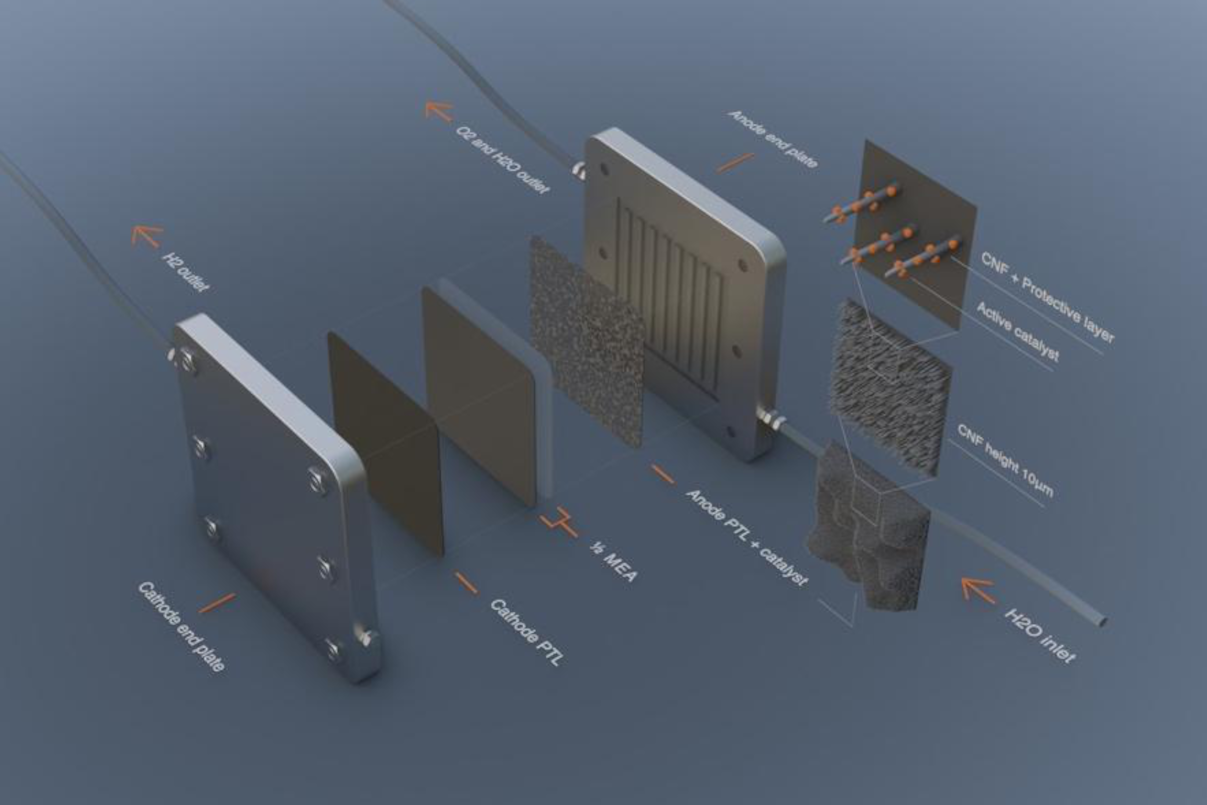
Titanium felt serves as a key functional component in PEM electrolyzer stacks. It acts as a vital Porous Transport Layer (PTL). Users install this material between the electrode catalyst layer and the bipolar plate.
Efficient Mass Transfer: Titanium felt pushes liquid water to reaction zones at a fast speed. It expels hydrogen and oxygen gases generated from electrolysis reactions in real time. This material effectively solves membrane flooding and membrane dehydration issues in daily operation.
Uniform Current Distribution: Titanium felt features excellent electrical conductivity. It delivers even current across the whole electrode surface. It boosts the working efficiency of electrolytic reactions. It also eliminates localized overheating spots on electrodes.
Mechanical Support: Titanium felt maintains solid structural stability inside electrolyzer equipment. It withstands extreme working environments with high pressure and high temperature.
2. Catalyst Support Substrate
Titanium felt is a reliable catalyst carrier with a large surface area. It loads common precious metal catalysts on both anode and cathode surfaces. These mainstream catalysts cover iridium, ruthenium and platinum.
Maximized Catalyst Utilization: Titanium felt owns a three-dimensional interconnected porous structure. This structure creates a broad specific surface area for reaction contact. It exposes all loaded catalysts to electrolyte and reaction substances completely. It helps users make full use of catalyst materials and reduce waste.
Enhanced Durability: Standard Grade 1 titanium delivers outstanding corrosion resistance. It locks the catalyst layer tightly on its surface. It stops catalyst particles from peeling off during long-term operation. It keeps catalyst performance stable in harsh acidic and oxidative working conditions.
3. Gas Diffusion Layer (GDL)
Titanium felt works as a high-precision Gas Diffusion Layer (GDL). Manufacturers integrate this material into the Membrane Electrode Assembly (MEA) for high-current-density PEM electrolysis equipment.
Uniform Dispersion: Titanium felt evenly distributes inlet water and outlet gas inside the electrolyzer. It lowers local concentration differences on electrode surfaces. It improves the overall production efficiency of hydrogen gas.
Dynamic Adaptability: Titanium felt has good flexible properties. It adapts to different pressure levels during equipment assembly. It sustains stable contact inside the MEA structure. It guarantees consistent and smooth gas-liquid exchange in all working states.
degradation during long-term operation in harsh acidic/oxidative environments.
Package and shipment


Contact us

Tel: 0917-3873009

Phone: +86 18992731201

Email: zhangjixia@bjygti.com

Fax: 0917-3873009

Address: No. 195, Gaoxin Avenue, High-tech Development Zone, Baoji City, Shaanxi, China

Whatsapp: +86 18992731201
Hot Tags: 0.1mm Thick Titanium Fiber Paper for Proton Exchange Membrane Electrolysis Cell, China, suppliers, manufacturers, customized, usage, pricelist, for sale, in stock, free sample, porous material, Stainless Steel Porous Mesh Sinter Metal Filter Disc, MMO titanium tubular anodes electrodes for Cathode protection, Titanium Mesh Sheet Perforated Plate Expanded Mesh with Corrosion Resistance, Metal microporous metal powder sintered filter element for air dust removal, bronze brass copper powder sintering air filter elements, Custom Industrial Microporous Sintered Stainless Steel Filter Discs for Filtration System
Send Inquiry
You Might Also Like
-
![20um Porous SS316L Filter Tube With 1/4" Tube Socket Weld Union]() 20um Porous SS316L Filter Tube With 1/4" Tube Socket Weld...view more>
20um Porous SS316L Filter Tube With 1/4" Tube Socket Weld...view more> -
![M20 15um Sintered Metal Porous Titanium Gas Sparger/Diffuser]() M20 15um Sintered Metal Porous Titanium Gas Sparger/Diffuserview more>
M20 15um Sintered Metal Porous Titanium Gas Sparger/Diffuserview more> -
![5um Porous Parts Sintered Copper Filter Disc]() 5um Porous Parts Sintered Copper Filter Discview more>
5um Porous Parts Sintered Copper Filter Discview more> -
![Titanium Porous Fiber Felt For PEM FuelCell]() Titanium Porous Fiber Felt For PEM FuelCellview more>
Titanium Porous Fiber Felt For PEM FuelCellview more> -
![Stainless Steel Microporous Filter Disks]() Stainless Steel Microporous Filter Disksview more>
Stainless Steel Microporous Filter Disksview more> -
![Titanium Felt]() Titanium Feltview more>
Titanium Feltview more>


