
Titanium has spent most of its industrial life in places where material performance matters more than material cost. Aircraft structures, engine components and medical implants all rely on titanium for the same basic reasons: low density, high strength and excellent resistance to corrosion.
That set of demands is something titanium has seen before. Structural parts in a robot see repeated loads. They have to hold position accurately over time. And they need to stay light. Titanium fits that set of demands as naturally as it fits an airframe.
These are the kinds of conditions titanium was developed for in the first place.
A humanoid robot may look like an electronic product from the outside, but its mechanical structure determines much of its real-world capability. Frames, joint supports, connecting parts and actuator housings are exposed to continuous movement during operation. Every step and reach and twist puts stress into the structure-stress that builds up over time.
This makes the choice of structural material especially important.

Why Titanium Attracts Attention in Robotic Structures
Weight reduction gets talked about constantly in mobile systems, and for good reason. Push a heavier structure through a walking cycle and you need more power from the motors, more capacity from the batteries, more torque from the joints. Steel has strength and availability going for it-that keeps it everywhere. Aluminum saves weight and that makes it popular. But when you need all three-low weight, high strength, and fatigue resistance-the list of candidates gets short.
Titanium sits at a density about sixty percent of steel. Strength comes in close to many high-strength steels. That combination lets you drop weight off a component without losing mechanical performance. Joints, support brackets, moving linkages-parts that see repeated loading-benefit from this directly.
Cut mass from one part and the rest of the system feels it. Less inertia means less force for acceleration and deceleration. Motors draw less current. Transmissions run with less strain. Run the same robot through thousands of motion cycles and those small per-cycle savings start to add up-better efficiency, longer component life.
Design tools have moved past the era of simple machined shapes. Modern simulation software maps load paths through a part. You can see where forces enter and where they exit. That tells you where to keep material and where you can cut it away.
Titanium's strength-to-weight ratio changes what you can do with geometry. You can run thinner walls, open up hollow sections, shape forms that would not work in aluminum or steel-and still have a part that stays rigid.
For robotic applications, this approach can be used in structural frames, joint components, actuator supports and other precision parts where weight and strength need to be balanced.

Manufacturing Technology Is Expanding Titanium Applications

Titanium's technical advantages have never been in question. The barrier has always been processing. Compare it to steel or aluminum and the difference is clear. Titanium runs hotter at the cutting edge. Tools wear faster. Production moves slower.
That is changing, though. Additive manufacturing opened up new ways to produce titanium components with internal structures that machining could never create-lattice designs, integrated supports, parts that combine functions that used to require assembly. Robotics applications demand compact designs that still hold up under load. Additive manufacturing with titanium gets you closer to meeting both of those requirements at once.
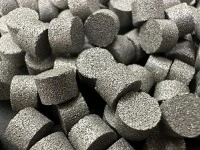
For smaller precision parts, Metal Injection Molding offers a different path forward. When production runs get larger and dimensions need to stay consistent from part to part, MIM starts to make more sense than machining each piece.

Robots end up in applications where they run day and night, week after week. The mechanical structure sees continuous loading. Temperature swings. Humidity. Dirt.
Titanium handles these conditions well. The surface layer that forms naturally in air is stable. Damage the surface and the oxide layer reforms on its own. No coatings. No touch-ups.
Aerospace and medical industries have relied on this for years-applications where you cannot afford corrosion failures. Robots in factories, warehouses, or outdoor sites have the same concern.
Fatigue performance matters too. A joint in a walking robot sees stress every time the foot lands. Over the life of the machine, that adds up to millions of cycles. Titanium handles it.
No one expects titanium to become the default material for every part of a humanoid robot. Steel and aluminum will stay in use where they make sense-cost, manufacturability, specific performance requirements. But for certain components, titanium offers a combination of properties that other materials don't match.
There are applications where low weight, high strength, and durability all have to be addressed together. In those cases, titanium gives engineers an option that other materials do not provide. Humanoid robotics is giving titanium a new arena. As designs get more sophisticated and manufacturing continues to improve, titanium will find its way into more structural and precision roles.
This is not about titanium taking over. It is about titanium showing up in the right places.