
Achieving and maintaining ultra-high vacuum (UHV) is critical for the performance and longevity of advanced electronic devices, from satellite TWTs to medical X-ray tubes. At the heart of this challenge lies a sophisticated component: the evaporable barium getter, where titanium plays a far more pivotal role than a simple ingredient. This article delves into the core technological mechanisms by which titanium transforms a standard gettering process into a high-performance, reliable solution for UHV environments. We analyze how titanium contributes to structural optimization, thermal management, material stabilization, and process integration, collectively enabling the key breakthroughs in vacuum integrity that modern technology demands.
Ultra-high vacuum (typically below 10⁻⁷ Pa) is essential to minimize gas-particle collisions, suppress unwanted discharges, and protect sensitive surfaces in vacuum electronic devices. While pumps establish the initial vacuum, only non-evaporable getters (NEGs) and evaporable getters can actively clean up residual and desorbed gases during a device's operational life. Among them, evaporable barium getters are renowned for their high sorption capacity and speed for active gases (N₂, O₂, CO, CO₂, H₂). The breakthrough in their performance and reliability is fundamentally linked to the strategic integration of titanium.
1. Structural Architect: Titanium's Role in Forming the High-Surface-Area Sorption Matrix
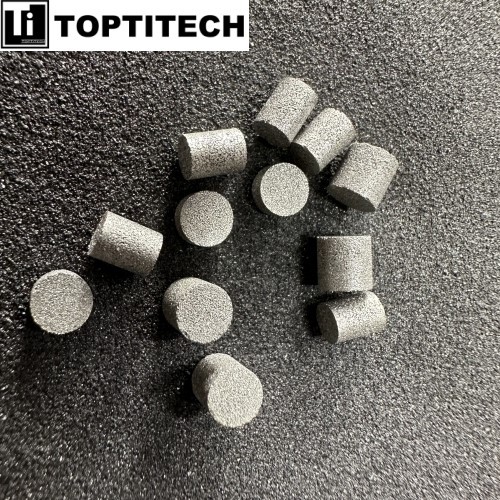
The core function of a getter is to irreversibly adsorb gas molecules. This capacity is directly proportional to the available active surface area. Upon activation through resistive heating, the getter pellet releases barium, which condenses on cooler surfaces to form a mirror.
- Key Mechanism: Titanium, present in the initial Ba-Al-Ti-Fe alloy, co-evaporates or influences the morphology of the deposited film. It promotes the formation of a nanocrystalline, porous barium film rather than a dense, flat layer. This structure can exhibit a real surface area hundreds of times greater than its geometric area.
- Performance Impact: This titanium-enhanced porous architecture maximizes the number of available barium sites for gas chemisorption. The result is a dramatically increased initial sorption speed (e.g., for N₂, speeds can exceed 10 cm³/s per cm² of mirror) and a higher total gas intake capacity, which is the first critical step toward achieving and holding UHV.
2. Thermal Dynamics Engineer: Optimizing the Activation Energy Profile
The traditional Ba-Al alloy requires significant external heat to decompose and release barium. The introduction of titanium, alongside iron oxide (Fe₂O₃), revolutionizes this process through the Ba-Ti-Fe thermochemical reaction.

- Key Mechanism: During heating, an exothermic solid-state reduction reaction occurs between BaO (in the alloy) and Ti, with Fe₂O₃ acting as a reaction promoter. This internal exothermic heat source provides a substantial portion of the energy required for barium reduction and evaporation.
- Performance Impact: This reduces the required external heater power, minimizes thermal stress on the surrounding device components, and enables a more rapid and self-sustaining evaporation pulse. The process becomes more controllable and reproducible, leading to consistent mirror quality and getter performance across millions of units-a necessity for mass production.
3. Material Stabilizer: Enhancing Mechanical and Thermal Resilience
Getter integrity under mechanical vibration and thermal cycling is non-negotiable for applications in aerospace, mobile communications, and high-power devices.
- Sintering Aid: During the manufacturing of the getter pellet, titanium acts as an activation sintering aid. It facilitates diffusion and bonding between metal powder particles at lower temperatures, creating a mechanically robust pellet with high density. This enhances the pellet's resistance to vibration and shock, preventing catastrophic failure.
- Formation of High-Temperature Phases: Titanium reacts with aluminum in the alloy to form intermetallic compounds like TiAl₃ and TiAl. These phases have significantly higher evaporation temperatures than pure aluminum.
- Performance Impact: 1) The robust pellet ensures physical integrity. 2) The formation of Ti-Al compounds significantly suppresses the undesirable co-evaporation of aluminum, which could otherwise form insulating or conductive layers on critical electrodes. This stabilization is crucial for long-term device reliability and consistent electrical performance under UHV.
4. Process Integrator: Enabling Versatile and Reliable Manufacturing
The final test of any core technology is its manufacturability. Titanium enables versatile integration of the active getter material onto various substrates.
- Key Mechanism: Titanium powder is a key component in specially formulated getter pastes and bonding agents (e.g., a classic dry paste: 60% alloy powder + 40% binder containing 65% Ti). Titanium's chemical activity and sintering properties ensure excellent adhesion between the getter pellet and diverse substrates like nickel, molybdenum, or stainless steel.
- Performance Impact: This allows for flexible getter designs-rings, strips, custom shapes-that can be securely mounted in optimal locations within a vacuum package. A secure, thermally conductive bond is essential for efficient activation and effective heat dissipation during operation, completing the chain from manufacturable component to reliable in-situ performance.
The pursuit of ultra-high vacuum is not solved by a single material but through intelligent material synergy. In evaporable getters, titanium is the multifunctional enabler. It engineers a superior sorption structure, masters the thermal dynamics of activation, fortifies the material against operational hazards, and bridges the gap between laboratory performance and rugged, manufacturable components.
Understanding this core technology-the quadruple role of titanium-is essential for device designers and vacuum engineers aiming to push the boundaries of performance. Future breakthroughs in miniaturization and extreme environment electronics will further rely on the nuanced optimization of this Ti-Ba-Al-Fe system, solidifying its status as the unsung hero within the vacuum that powers our connected world.