A Century of Racket Materials
The history of the racket is, in many ways, a compact history of modern materials engineering. Frames in the nineteenth century were made of wood: warm in feel and inexpensive to produce, yet heavy, prone to warping in damp air, and quick to lose their stiffness as the fibres tired. In the mid twentieth century, aluminium frames arrived lighter and stiffer, and for the first time swing speed improved noticeably. Carbon fibre then took over the mainstream, its very high specific strength and designability pushing racket weight into new territory. Yet carbon fibre is not flawless. It is anisotropic, and its impact and fatigue behaviour has boundaries. Titanium alloy entered the design conversation precisely because it balances strength, toughness, damping and corrosion resistance within a single material, and it has since found a place in frames, joints and weighting structures.

What is Titanium? Elements spanning from aerospace to consumer products

Titanium has the chemical symbol Ti and the atomic number 22. It is a silver-white metal. Titanium is not a rare material. It ranks among the top ten most abundant elements in the earth's crust. It takes up about 0.6 percent of crust materials. The real challenge of titanium use lies in its extraction and processing. This is why people first used titanium in aerospace and military equipment. Titanium has a density of 4.5 g/cm³. This number is only 57 percent of steel's density. The most widely used titanium alloy is Ti-6Al-4V. People also call it TC4 or Grade 5. Its density is about 4.43 g/cm³. Its tensile strength reaches around 950 MPa. It has higher strength per unit weight than most common structural metals. Its light weight and high strength make titanium popular. People now use it in rockets, fighter jets and daily products. These daily products include sports rackets, bicycles, glasses frames and medical implants.
Four Performance Dimensions--Why it is suitable for making rackets?
Specific Strength
Lighter at the same strength level, offering both frame rigidity and swing speed.
Vibration Damping
Low elastic modulus; absorbs high-frequency vibrations from ball impact; offers a solid, stable feel.
Fatigue Resistance
Resistant to alternating loads and crack propagation; stable performance during long-term use.
Corrosion Resistance
Self-healing dense oxide film-impervious to sweat, rain, and salt spray.
- Specific strength
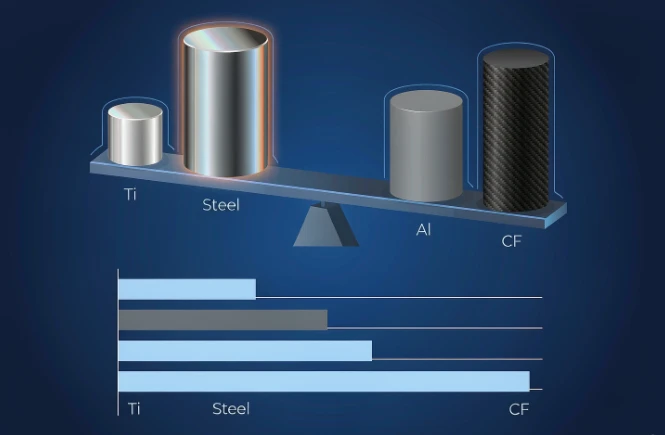
Specific strength means the ratio of a material's strength to its density. Ti-6Al-4V has a density of 4.43 g/cm³ and a tensile strength of 950 MPa. It is 40 percent lighter than steel with the same strength level. Titanium alloy racket frames keep firm and stable. They also reduce overall weight effectively. This is the key reason why titanium alloy is a top choice for high-performance lightweight sports equipment.
- Vibration Damping
Titanium has an elastic modulus of 110 GPa. Steel has an elastic modulus of 200 GPa. Titanium's elastic modulus is half of steel's. Titanium material bends slightly under impact and releases extra energy. It quickly reduces high-frequency vibration caused by ball hits. Players get a soft and stable ball-touch feeling. Their wrists and forearms feel less tired after long training sessions.
- Fatigue Resistance
A racket faces tens of thousands of repeated impacts in one sports season. Titanium alloy has strong fatigue resistance. It stops crack expansion effectively. Titanium alloy rackets keep stable performance for a long time. Their quality does not drop fast with use. This advantage makes titanium alloy ideal for load-bearing racket parts.
-
Corrosion Resistance
Titanium forms a tight and stable oxide film on its surface naturally. It works well in humid environments. It resists damage from human sweat and salty air. It never gets rusty easily. Titanium alloy rackets stay reliable for both indoor and outdoor sports use.
How Titanium Rackets Are Made
- Forging
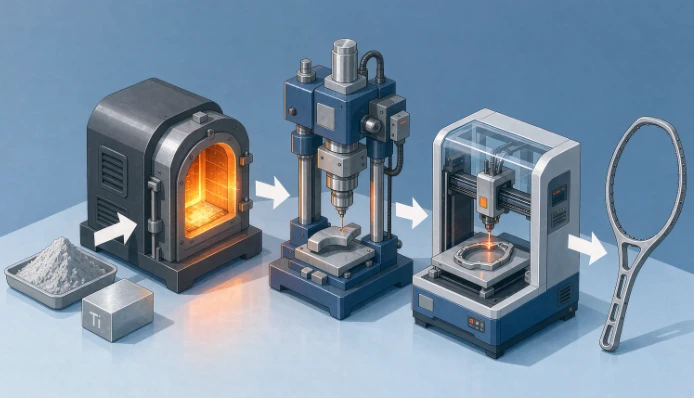
Workers heat titanium raw materials and shape them under high pressure. Forged titanium parts have compact internal structures and stable mechanical properties. Manufacturers use this method to make load-bearing racket frames and connecting parts. Forging always produces titanium parts with solid and reliable strength.
- Powder Metallurgy and Sintering
Workers press titanium or titanium alloy powder into fixed shapes. They then heat the shaped powder at high temperature to form solid parts. This method lets workers control material composition and internal gaps accurately. It fits the production of porous titanium parts well. The internal gaps cut down racket weight and reduce vibration. This method is a common choice for racket vibration reduction design.
- Hot Isostatic Pressing
This technology uses inert gas to create even high pressure at high temperature. It removes tiny internal gaps and flaws in titanium parts. It improves part density and service life. It is a key processing step for high-standard titanium racket components.
- Additive Manufacturing
Laser or electron beam equipment melts titanium powder layer by layer. It builds complex racket structures directly. This method breaks the limits of traditional production tools. It supports structural optimization, hollow grid design and integrated forming. It creates more possibilities for customized and lightweight titanium rackets.
Beyond Rackets
Titanium alloy has wide uses beyond sports rackets. Golf club heads use its high specific strength. They can form thinner walls and larger hitting areas. Bicycle frames use its vibration reduction and rust resistance. They achieve longer service life. Ski connection parts need stable performance in cold environments and under repeated impact. Titanium alloy has good toughness at low temperatures and fits this need perfectly. Diving knives and mountain climbing gear rely on its seawater rust resistance and light high-strength features. In general, titanium alloy is the preferred material for products that need light weight, high strength and long durability at the same time.