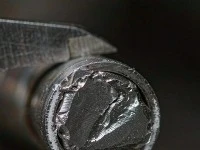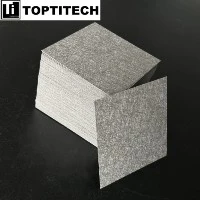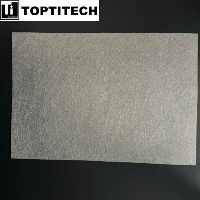

In pharmaceutical, fine chemical and polysilicon plants, the sintered titanium filter cartridge - sometimes called a titanium powder filter or porous titanium rod filter - shows up wherever filtration gets difficult. It looks like a rough metal tube. Under a microscope, it is something more interesting: a three-dimensional skeleton built from titanium powder, one sintering neck at a time. This guide covers how the filter actually works and the exact sequence of steps that turns raw titanium sponge into a finished cartridge.
What Is a Sintered Titanium Filter Cartridge?
A titanium cartridge is a porous metal filter made by powder metallurgy. High-purity industrial titanium powder (TA1, the Chinese equivalent of Grade 1) is pressed into a tubular "green" compact, then sintered in a high-temperature vacuum furnace. The finished part keeps 30–50% of its volume as interconnected pores: fluid passes through the maze of channels, solids stay behind.

Why titanium instead of something cheaper? Four practical reasons:
Corrosion resistance. Titanium grows a dense TiO₂ oxide film on its surface, so it handles pH 1–14 with ease - seawater, wet chlorine and hypochlorite solutions that eat stainless steel barely touch it.
Temperature. Continuous service up to 280–300 °C, well beyond what any polymer cartridge survives.
No shedding, fully regenerable. The sintered body is strong enough that no fibers or particles break loose into the filtrate - a GMP and food-grade requirement. When it clogs, backflushing and ultrasonic cleaning bring it back.
Strength. It withstands high differential pressure without a support cage, for both pressure filtration and suction filtration.
How a Sintered Titanium Filter Actually Works
The Micro View: Where the Pores Come From
Everything hinges on sintering. After compaction, the powder particles only touch each other mechanically - the green compact crumbles if you squeeze it. Heated to 1100–1300 °C in vacuum (far below titanium's 1668 °C melting point), atoms at the contact surfaces start to move, and solid-state diffusion grows "sintering necks" between neighboring particles. The particles weld together at their contact points without ever melting.
Get the temperature and hold time right and the necks grow just far enough: the particles form a continuous 3-D skeleton while the gaps between them survive as open, interconnected pores. Sinter too little and the element is fragile; sinter too long and the pores close up, choking the flow rate. Porous powder metallurgy is always a trade-off between strength and porosity - the process window is where you find the balance.

The Filter View: How Particles Get Caught
The pores are not straight capillaries. They form a tortuous, interlocking maze, and contaminants get caught by four mechanisms working at the same time:
Sieving: particles larger than the pore openings are stopped right at the surface - surface filtration;
Inertial impaction: fast-moving particles can't follow the turns and slam into the pore walls;
Brownian diffusion: the finest particles jitter randomly until they touch a wall and stick;
Bridging: early arrivals link up, narrowing the channels further, so capture efficiency climbs over time.
Surface and depth filtration happening together is exactly why these cartridges combine fine ratings, high dirt-holding capacity and a slow rise in differential pressure.


From Titanium Sponge to Finished Cartridge: The Ten-Step Process
Making the Powder: HDH vs. Gas Atomization
Hydride–dehydride (HDH)
Gas atomization
Classifying and Blending
Forming: Pressing the Powder into a Tube
Vacuum Sintering: The Heat That Decides Everything

Machining and Welding
Cleaning and Passivation
Testing and Release

Where These Cartridges Earn Their Keep
Pharmaceutical and biotech: API carbon removal, prefiltration of injections, fermenter air lines - all under GMP hygiene rules;
Chemical and petrochemical: titanium tetrachloride, sulfuric acid, molten sulfur, catalyst recovery - corrosive and hot media;
Polysilicon and chlor-alkali: distillation column feed filtration, hydrogen chloride gas dust removal;
Food and beverage: syrups, wine, drinking water polishing;
Gas systems: compressed-air oil removal, aeration spargers, fluidized-bed gas distributors;
Beyond: fuel cells and aerospace high-pressure fuel filtration.
Practical Tips on Selection and Regeneration
Don't jump straight to a fine rating. Use 20–50 μm for prefiltration and 1–10 μm for final polishing. A fine cartridge doing a coarse cartridge's job clogs fast and costs more over a year.
Balance porosity against strength. Above roughly 40% porosity flow looks great but strength drops noticeably; for high differential pressure, 30–35% is the safer pick.
Service life is managed, not given. Routine backflushing plus periodic ultrasonic or chemical cleaning keeps a cartridge alive for years; the more regular the pore network (spherical powder), the better the recovery after each wash.
Watch flow direction and differential pressure. Know whether the element is outside-in or inside-out, and backflush accordingly. When the pressure drop doubles, schedule a cleaning.
Frequently Asked Questions
FAQ

01. Sintered titanium vs. sintered stainless steel - which one should I choose?
02. What do I do when a titanium filter clogs?
03. Is the nominal rating the same as the pore size?
04. How long does a sintered titanium cartridge last?
The value of a sintered titanium filter cartridge isn't the material itself - it's the process window. Powder size, compaction density and the sintering curve together determine the shape of the pore network, and the pore network determines the rating, the flow and the service life. Once you understand the chain from powder to finished element, most selection, acceptance and maintenance questions answer themselves.