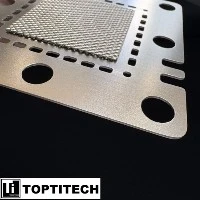

 In the sintered metal industry, cutting quality is crucial for the final product's performance. Among various cutting methods, laser cutting stands out for its high precision, non-contact nature, and flexibility.
However, when cutting porous metal materials such as titanium or nickel felt, traditional continuous-wave lasers are prone to excessive heat input, leading to edge melting, recast layer formation, and even pore blockage. This severely compromises the material's permeability, catalytic activity, or filtration efficiency.
This article delves into advanced laser processes and technologies that fundamentally address this challenge.
1. Root Cause: Why Does Edge Melting Occur?
Understanding the cause is key to finding a solution. The essence of edge melting is "overheating."
Heat Accumulation Effect: Metal felt consists of interconnected fibers. Although its thermal conductivity is better than polymer felt, its three-dimensional porous structure results in discontinuous heat conduction paths and lower heat capacity compared to solid metal sheets. The continuous energy input from a CW laser causes heat to accumulate rapidly in the cutting zone-exceeding the material's melting point-before it can diffuse into the bulk material.
 Material Characteristics: Titanium and nickel are both reactive metals, with titanium having a high affinity for oxygen and nitrogen. At high temperatures, the cut edges undergo oxidation and nitridation, forming hard and brittle compound layers. This is accompanied by re-solidification of molten material, which destroys the original fiber structure and porosity.
2. The Solution: Technological Leap from "Continuous" to "Pulsed"
The core principle is to reduce the total heat input and provide sufficient "cooling time" for the material. This is primarily achieved through two key technologies:
►1. Adopting Pulsed Fiber Lasers – The Core Solution
Unlike continuous-wave lasers, pulsed lasers emit "laser pulses" at very high frequencies and extremely short durations (nanosecond, picosecond, or even femtosecond levels). Each pulse creates a tiny point of ablation or vaporization, while during the interval between pulses, the material cools sufficiently.
►2. Optimizing Assist Gas – An Indispensable Synergistic Element
Assist gas plays a dual role in laser cutting: ejecting molten material and participating in chemical reactions. The choice of gas is particularly critical for oxidation-prone materials like titanium and nickel felt.
Preferred Choice: High-Purity Inert Gases (e.g., Argon, Ar)
Function: Creates a protective atmosphere, effectively isolating the cut edge from oxygen and nitrogen to prevent chemical reactions at high temperatures. Simultaneously, the high-speed gas flow promptly removes vaporized or minimally molten material from the kerf, preventing its re-deposition and solidification on the fiber edges.
Use with Caution: Oxygen/Compressed Air
While oxygen cutting of carbon steel increases speed through an exothermic reaction, for titanium and nickel, it causes severe oxidation of the cut edge, forming a thick, brittle oxide layer accompanied by significant melting, and should be strictly avoided.

3. Key Process Parameter Control: Achieving Precision "Microsurgery"
Even with a pulsed laser and inert gas, parameter settings are the final step determining success.
►Peak Power & Pulse Frequency: Higher peak power ensures effective material vaporization, while a suitable pulse frequency (not necessarily higher is better) must match the cutting speed to ensure sufficient cooling time for each pulse.
►Cutting Speed: Too slow speed leads to excessive heat input; too fast may result in incomplete cuts or rough edges. The goal is to use the highest possible speed while ensuring complete penetration.
►Focal Position: Precisely align the focus on or slightly inside the material surface to achieve the smallest spot diameter and highest energy density for finer cutting.
►Nozzle & Gas Flow Rate: Select an appropriate nozzle diameter and ensure a sufficient, stable flow of high-purity inert gas to form an effective protective curtain and efficient ejection capability.