
When selecting filtration precision ranging from 1 to 100 microns for industrial applications, scientific evaluation is crucial to ensure optimal performance and efficiency. Factors such as particle size distribution, flow rate requirements, and material compatibility must be meticulously analyzed to match the filtration system with specific operational needs. TOPTITECH, a leader in advanced filtration solutions, offers cutting-edge technologies designed to deliver high-precision separation while maintaining durability and cost-effectiveness.
In the previous article, TOPTITECH, from a professional perspective, decrypts the science behind selecting filtration ratings in the 1 to 100-micron range for stainless steel sintered powder cartridges.
Today, we will continue our explanation to help you make accurate, cost-effective, and optimal choices.
Part 3: The Five Golden Rules for Scientific Selection
- Rule 1: Define Your Filtration Objective
Product Protection: Identify the sensitive size of the component being protected (e.g., spray nozzles, precision valves). Typically, the filter rating should be 1.5-2 times smaller than this sensitive size.
Process Purification: Determine the maximum particle size allowed in the final product.
Waste Collection: For recovering precious metal catalysts, the rating should be slightly smaller than the average catalyst particle size to ensure high recovery rates without premature clogging.
- Rule 2: Analyze the Contaminant Profile
Use particle count analysis to understand the size distribution of contaminants in your fluid. If most particles are larger than 10μm, selecting a 5μm cartridge will cause it to clog rapidly. In this case, a 20μm pre-filter followed by a 5μm final filter is a more economical and efficient solution.
- Rule 3: Balance Rating with Flow Rate and Pressure Drop
This is a critical trade-off:
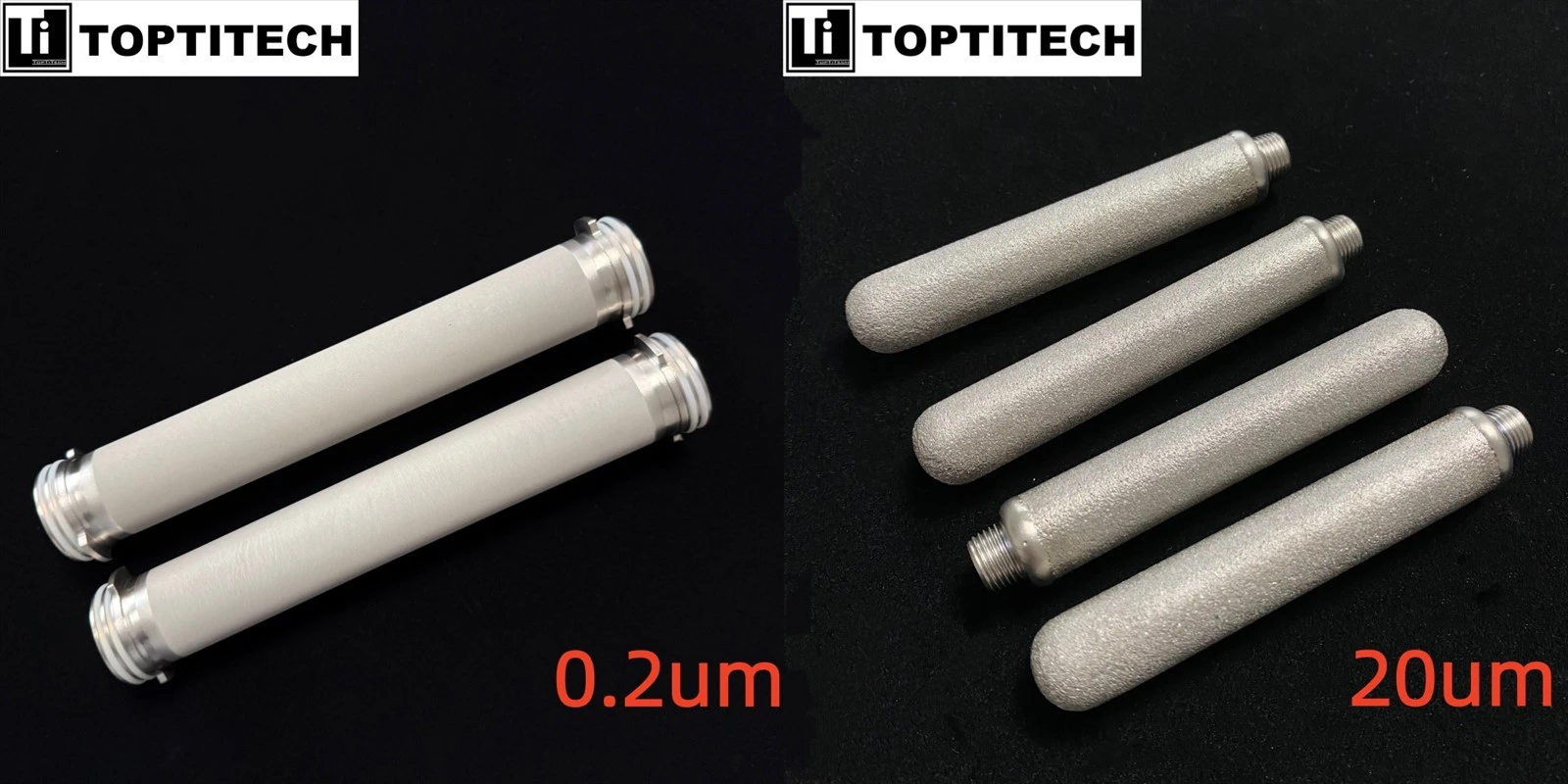
A higher rating means finer pores and greater flow resistance.
At a constant flow rate, a higher-precision cartridge will generate a higher initial pressure drop.
A high initial pressure drop increases energy consumption and means the cartridge will reach its maximum allowable pressure drop more quickly, resulting in a shorter service life.
You must find the balance between "filtration effectiveness" and "system energy consumption/operating cost."
- Rule 4: Consider Fluid Properties
Viscosity: Higher viscosity fluids flow less easily, causing a dramatic increase in pressure drop across a high-precision cartridge. For high-viscosity fluids (e.g., polymer melts, heavy oils), a coarser rating is often necessary compared to low-viscosity fluids (e.g., water, solvents).
Corrosiveness: Ensure the cartridge material (e.g., 316L, 904L, Hastelloy) is fully compatible with the fluid to prevent corrosion from altering the filtration rating.
- Rule 5: Value Powder Quality and Manufacturing Process
High-quality stainless steel powder (with high sphericity and a narrow size distribution) and advanced sintering technology are the foundation for producing cartridges with uniform pore size distribution.
A 10-micron cartridge with a uniform pore size distribution will outperform a nominal 5-micron cartridge that suffers from defect "super-pores."
Part 4: From Theory to Practice: A Step-by-Step Selection Guide
Gather Data: List the fluid type, viscosity, operating temperature, flow rate, operating pressure, and particle size distribution/concentration.
Determine the Primary Goal: Is it to ensure product purity? Protect equipment? Or collect valuable solids?
Preliminary Screening: Refer to the application spectrum chart above to narrow down a potential rating range.
Consult an Expert: Provide your operational data to a technically proficient filter supplier. Their seasoned engineers can offer recommendations based on simulation and experience.
Validate with Testing: For critical applications, on-machine testing is the most reliable method. Compare the initial pressure drop, service life, and outlet fluid cleanliness of different cartridges to make your final decision.
Conclusion
Selecting a filtration rating between 1 and 100 microns is not a solitary numbers game. It is a strategic decision that impacts system efficiency, operational cost, and end-product quality. Unlocking the "precision code" of stainless steel sintered powder cartridges requires systematic thinking, integrating your objectives, contaminant profile, fluid properties, and system compatibility.
Partnering with a supplier possessing deep technical expertise and a wealth of application experience is the most direct path to a scientific selection. Contact our team of senior engineers today for a free, personalized consultation, and ensure every filtration decision you make is precise and effective.