
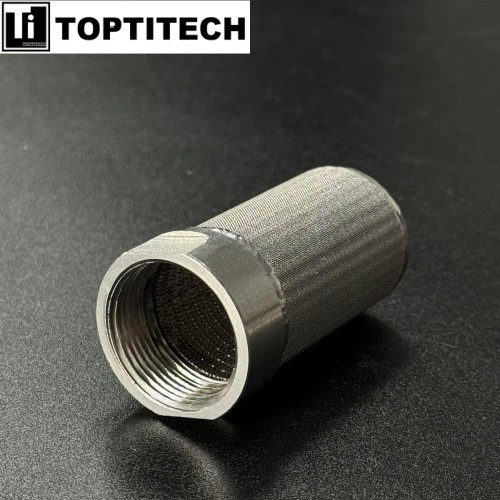
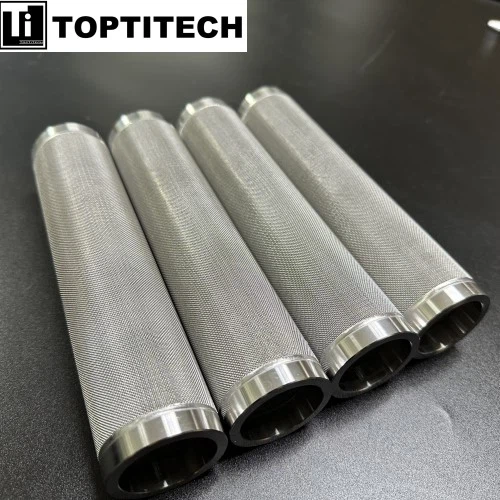
Sintered filter elements, including sintered felt and sintered mesh, are commonly used filter materials that are processed into various shapes such as cylinders, sheets, and cones.
When it comes to sintered mesh filter elements, they offer distinct advantages over sintered felt counterparts. The sintered mesh filter elements are manufactured in straight tube form, ensuring uniform wall thickness and firmness. They exhibit a stable permeability coefficient and can be regenerated for extended service life. Consequently, they find wide application in various equipment.
Equipment systems that can accommodate sintered mesh filter elements and filter cartridges include self-cleaning filters, multi-core backwash filters, security filters, precision filters, and more. In the case of security and precision filters, sintered filter cartridges serve as replacements for non-metallic filter elements such as PP, PE high-flow filters, and large-flow filters. The sintered filter cartridges can be easily interchanged or custom-made based on specific requirements.
Advantages of Sintered Mesh Filter Elements
1. Reusability: Sintered mesh filter elements can be cleaned and reused repeatedly. They demonstrate exceptional regeneration performance, excellent air permeability, and filtration efficiency. This makes them particularly suitable for continuous and automated processes, surpassing other filter materials.
2. Temperature and Chemical Resistance: Sintered mesh filter elements exhibit high-temperature resistance and can withstand acid-base solutions and other demanding media better than non-metallic alternatives.
3. Strength and Pressure Bearing Capacity: These filter elements possess high strength and can withstand substantial pressure, making them adaptable to various customer requirements.
4. Material: Sintered mesh filter elements are available in conventional materials like 304/316L, as well as unconventional options such as 2205, duplex steel, 904L, Hastelloy, Monel, and more.
5. Controlled Pore Size and Porosity: The pore size and porosity of sintered mesh filter elements can be precisely controlled, allowing for tailored filtration precision.
6. Customization: Non-standard parts processing is possible, enabling customization of cylindrical and conical shapes as per specific needs.
Fully Automatic Brush-Type Self-Cleaning Filters or Multi-Core Backwashing Filters
A fully automatic brush-type self-cleaning filter, or a multi-core backwashing filter, is a precision device that utilizes a filter screen (sintered screen) to directly intercept impurities in water, thereby purifying the water quality and safeguarding other equipment and instruments within the system. It serves as a common pre-filtration system for water treatment.
Working Principle Overview
When operating, water enters the equipment through the inlet and initially passes through the sintered mesh cylinder. The filtration accuracy and thickness of the sintered mesh can be customized based on specific requirements. While ensuring high filtration accuracy, the sintered mesh also possesses excellent strength and pressure resistance, allowing it to effectively intercept particulate impurities present in the wastewater. These impurities accumulate on the inner wall of the filter cartridge. Subsequently, the motor drives a rotating shaft that, in turn, activates the brush to scrape and wash away the accumulated impurities. The dislodged impurities settle at the bottom of the filter and are discharged via a drain valve. This entire process can be carried out online without interruption or flow stoppage. In automated control, the system can independently assess the degree of impurity precipitation and signal the automatic sewage valve for discharge. This high level of automation reduces manual intervention, and the filtration accuracy can be customized to cover requirements ranging from 50 μm to 3000 μm, effectively addressing customer needs.