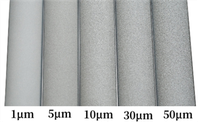

Titanium Fiber Felt is a felt-like material made from pure titanium or titanium alloy fibers. This type of felt material is typically produced by sintering, pressing, or other processing techniques using titanium fibers. Titanium fiber felt exhibits excellent high-temperature resistance and corrosion resistance, and finds wide applications in industries such as thermal engineering, aerospace, and chemical engineering. It possesses good thermal and electrical conductivity, along with certain mechanical strength and stability, making it suitable for applications like insulation, filtration, and adsorption in high-temperature environments.
titanium fiber felt anode gas diffusion layer
Sintered titanium fiber felt serves as the substrate for platinum catalyst deposition. The sample used is circular, with a diameter of 30mm and a thickness of 1mm, with a porosity exceeding 70%. The specific treatment steps are as follows:
Oxide Film Removal
The titanium felt has been immersed in an electrolytic acid solution based on nitric acid and hydrofluoric acid, with a pH value of 0.5 at room temperature. Then, a voltage of 2.5V has been applied to the felt, causing anodic dissolution of the titanium surface.
Argon Gas Cleaning
Following rinsing with deionized water, the titanium workpiece surface undergoes plasma treatment in argon to remove any remaining contaminants on the titanium surface.
Plating
Continuous plasma physical cleaning processes are carried out, followed by further rinsing with deionized water. The titanium fibers are immediately plated with platinum using an electrochemical method in an argon environment. Parameters are set to a pH value of 8 and a temperature of 50°C. The electroplating process is conducted for 10 minutes at a constant cathode voltage of -3.2V relative to the reference electrode. During this electroplating process, the titanium electrode is placed electrically between two connected reference electrodes. The on-time is set to 10 milliseconds, and the off-time is set to 56.7 milliseconds, resulting in a duty cycle of 15% in each cycle. The second part of the electroplating process is repeated for another 10 minutes.

MEA Assembly
The electrode has been impregnated with a proton-conductive ionomer solution in 5 wt.% ethanol and then plated with platinum. The solution has been cast onto the electrode using airbrushing, while the titanium-based electrode is connected to a heated sample holder. The temperature is set to 60°C to accelerate the evaporation of ethanol from the electrode surface.
Assembly into a bipolar plate configuration, totaling 20 sets.

platinium coating on titanium felt
Microscopic images below display sintered titanium fibers coated with platinum. The fibers located on the outer side of the felt can shield the entire coating, an effect explained by the electric field distribution within the primary cell (where the working electrode is situated between two counter electrodes and is parallel to them). The coating is sufficient to ensure the long-term stable adhesion of platinum nanoparticles. The following image showcases microscopic photos of platinum particles deposited on electroplated titanium fibers using a pulse plating process.