
In industrial filtration systems, the selection of filter elements directly determines the efficiency, stability, and operational cost of the entire production line. Among the most widely used stainless steel filter elements, stainless steel powder sintered filters and stainless steel sintered mesh filters are two core options that are often confused by industry practitioners. Many engineers and procurement personnel struggle to choose between the two-obviously, there is no "one-size-fits-all" best filter element, only the most suitable one for specific working conditions. This article will deeply compare the core differences, performance advantages, and application scenarios of the two filter elements, helping you make accurate choices and avoid costly selection mistakes in industrial filtration projects.
As the "core consumables" in the field of industrial filtration, stainless steel powder sintered filters and stainless steel sintered mesh filters are widely used in various industries such as chemical engineering, pharmaceuticals, oil and gas, water treatment, and food and beverage, thanks to their excellent corrosion resistance, mechanical strength, and filtration performance. However, their structural principles and performance focuses are completely different. Improper selection will not only lead to low filtration efficiency and frequent filter replacement but also damage subsequent equipment and increase production costs. This article will analyze the trade-off logic between the two from three dimensions: structural essence, core performance, and scenario adaptation, combined with practical cases in industrial sites, to provide accurate selection guidelines for practitioners.
I. Essential Structural Differences: Powder Sintering vs Mesh Lamination, Determining the Underlying Logic of Performance
To make a good selection and trade-off, it is first necessary to clarify the core structural differences between the two-which is the fundamental factor determining their filtration performance and applicable scenarios, and also the core judgment basis for selection in industrial filtration.
1. Stainless Steel Powder Sintered Filter: Porous Integral Sintering, the Core Choice for Depth Filtration
Stainless steel powder sintered filters use 316L stainless steel powder as raw materials, and through advanced vacuum high-temperature sintering technology, the powder particles are metallurgically bonded to form a uniform, continuous, and interconnected porous integral structure. Its filter layer is integrally formed without splicing gaps, the porosity can be precisely controlled between 30% and 40%, and the pore size range covers 0.1-100μm, making it a typical "depth filtration" element.
Core structural advantages: Integral sintering forming, no leakage risk; uniform pore distribution, enabling precise graded filtration; high overall strength of the filter element, able to withstand a certain pressure difference and high temperature, and easy to clean and regenerate with high reuse rate. This is also the key reason why it stands out in harsh working conditions.
2. Stainless Steel Sintered Mesh Filter: Multi-layer Mesh Lamination, an Efficient Choice for Surface Filtration
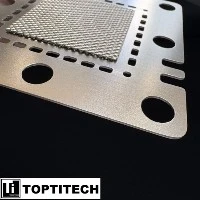
Stainless steel sintered mesh filters are composed of multiple layers of stainless steel woven mesh (plain weave, twill weave) laminated, and metallurgically bonded between layers through high-temperature sintering to form a layered filtration structure-usually divided into a protective layer, a filter layer, and a support layer. Each layer of mesh has a different mesh count, realizing graded filtration from rough filtration to fine filtration. Its filtration accuracy is mainly determined by the mesh count of the innermost filter mesh, with a pore size range generally between 1-300μm, making it a "surface filtration" element.
Core structural advantages: Multi-layer mesh lamination, high filtration efficiency and strong dirt-holding capacity; smooth surface, easy impurity stripping and convenient cleaning; good structural stability, suitable for large-flow filtration scenarios, and relatively low production costs.


II. Comparison of Core Performance: Analysis of 5 Key Dimensions to Clarify Trade-off Keys
Combined with the core needs of industrial filtration (filtration accuracy, temperature and pressure resistance, dirt-holding capacity, regenerability, cost), we accurately compare the two from 5 key dimensions, clearly presenting the core basis for selection and trade-offs.
|
Performance Dimension |
Stainless Steel Powder Sintered Filter |
Stainless Steel Sintered Mesh Filter |
Selection and Trade-off Suggestions |
|
Filtration Accuracy and Method |
Depth filtration, precise pore size (0.1-100μm), capable of high-precision filtration and retention of deep impurities |
Surface filtration, accuracy determined by mesh count (1-300μm), fast filtration speed but difficult to retain fine impurities |
Choose the former for high-precision and fine-particle filtration; choose the latter for large-flow and rough filtration |
|
Temperature and Pressure Resistance |
Temperature resistance up to 300-600℃, pressure resistance 0.1-3.0MPa, suitable for harsh high-temperature and high-pressure working conditions |
Temperature resistance up to 300-600℃, pressure resistance 0.1-5.0MPa, suitable for conventional temperature and pressure scenarios |
Choose the former for high-temperature and high-pressure (such as chemical reaction, steam filtration); choose the latter for conventional working conditions |
|
Dirt-holding Capacity and Regenerability |
Strong dirt-holding capacity, impurities can be retained inside the filter element, regenerable through backwashing and chemical cleaning, with high reuse rate |
Medium dirt-holding capacity, impurities adhere to the surface, easy to clean but limited regeneration times, slightly higher long-term use cost |
Choose the former for scenarios with many impurities and repeated use; choose the latter for scenarios with easy-to-clean impurities and short-term use |
|
Corrosion Resistance |
316L material can resist strong acids, strong alkalis, and organic solvents, suitable for strong corrosion scenarios (such as chemical industry, electroplating wastewater) |
Good corrosion resistance, but the bonding between layers is prone to corrosion and leakage, not suitable for long-term strong corrosion working conditions |
Choose the former for strong corrosion working conditions (such as acid-base filtration); choose the latter for conventional corrosion scenarios |
|
Cost and Cost-effectiveness |
Complex raw materials and sintering process, high initial purchase cost, but good regenerability and low long-term comprehensive cost |
Low mesh raw material cost, simple production process, low initial purchase cost, high short-term cost-effectiveness |
Choose the former for long-term stable operation and harsh working conditions; choose the latter for short-term projects and conventional filtration |