
Products


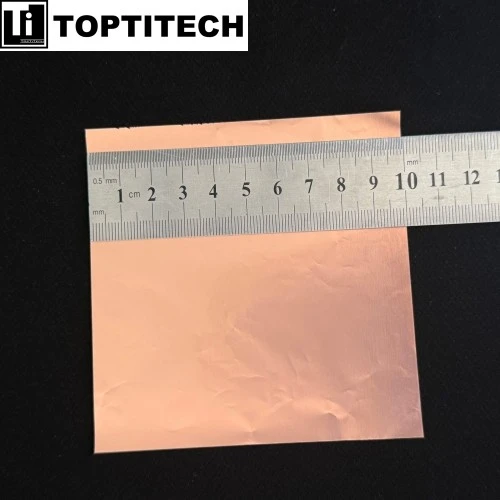


Laser-Perforated Copper Foil 0.012 mm For Lithium-ion Batteries
Sheet Size: 100 mm × 100 mm
Foil Thickness: 12 μm (0.012 mm)
Hole Diameter: 6–8 μm (uniform through-holes)
Send Inquiry
Product Introduction
This product is a high-precision laser-perforated copper foil engineered specifically as an advanced current collector for high-performance lithium-ion batteries. The base substrate is a 12 μm-thick (0.012 mm) high-purity electrodeposited copper foil, supplied in 100 mm × 100 mm sheets, which is subsequently processed through a state-of-the-art femtosecond/picosecond laser micro-drilling system. Under tightly controlled laser power, pulse duration, and beam positioning, the system creates uniformly distributed through-holes with diameters of precisely 6–8 μm across the entire foil surface. The non-contact, cold-ablation nature of the ultra-short-pulse laser ensures that each hole is produced with clean, burr-free edges and a minimal heat-affected zone (HAZ), preserving the original mechanical strength, electrical conductivity, and surface treatment integrity of the copper substrate. Hole pitch, density, and arrangement pattern (hexagonal or square lattice) are fully customizable, enabling precise tuning of open-area ratio to match the specific requirements of the anode chemistry and cell design. Unlike mechanical perforation or chemical etching, laser drilling delivers exceptional dimensional consistency hole-to-hole and sheet-to-sheet, with diameter variation held within ±1 μm and positional accuracy within ±2 μm, making the foil suitable for demanding applications where reproducible porosity is critical.
The 6–8 μm micro-perforations introduce a fundamentally new level of electrochemical and mechanical performance to the anode current collector. First, the through-holes act as dedicated electrolyte transport channels, enabling rapid and uniform wetting of the electrode stack and significantly improving lithium-ion diffusion kinetics, particularly at high charge/discharge rates (4C–6C) where conventional solid foils suffer from concentration polarization and internal resistance buildup. Second, the perforated architecture provides stress-relief pathways that accommodate the substantial volumetric expansion (up to 300%) of silicon and silicon-carbon composite anodes during lithiation; the holes allow the active material to expand into and through the foil plane rather than delaminating from its surface, dramatically reducing capacity fade and extending cycle life. Third, the open structure increases the effective contact area between the copper collector and the coated active material, lowering interfacial resistance and improving adhesion beyond what a flat foil can achieve. Fourth, the selective removal of copper material reduces the overall mass of the non-active collector, contributing a modest but meaningful gain in gravimetric energy density (Wh/kg). Finally, the perforations improve the flexibility and conformability of the electrode, reducing cracking during winding or stacking in cylindrical, prismatic, and pouch cell formats. Combined, these advantages make the laser-perforated copper foil a compelling upgrade for next-generation fast-charging EV batteries, high-energy-density silicon-anode cells, and high-power industrial energy storage systems.
Products Specifications
| Material | High-purity copper foil (≥ 99.8% Cu) | |||
| Sheet Size | 100 mm × 100 mm | |||
| Foil Thickness | 12 μm (0.012 mm) | |||
| Hole Diameter | 6–8 μm (uniform through-holes) | |||
| Hole Arrangement | square lattice | |||
|
Technique |
Laser drilling | |||
Products Features
1. Enhanced Energy Density
By reducing the copper current collector mass, our micro-porous foil allows a higher proportion of active materials within the cell. For ultra-thin copper foils (6 μm or thinner), energy density improvements of 5% or more have been demonstrated compared to conventional 8 μm foils. The porous structure further contributes to weight reduction-meshed copper foils can be over 40% lighter than solid foils of equivalent thickness.
2. Superior Active Material Anchoring
The micro-pores create a mechanical interlocking effect, firmly anchoring the anode active material (graphite or silicon-based composites) to the current collector. Compared to conventional flat copper foil, the contact interface transitions from surface contact to a three-dimensional "mechanical lock" structure. This results in significantly improved adhesion, reduced active material delamination during charge-discharge cycling, and extended battery cycle life.


3. Enhanced Rate Capability
The open-pore architecture creates bidirectional electrolyte infiltration channels throughout the electrode thickness. Lithium-ion diffusion pathways become truly three-dimensional, shortening ion transport distances and reducing internal resistance. This translates into superior fast-charging performance and improved power delivery under high-current discharge conditions.
4. Reduced Internal Resistance
The micro-porous structure increases the effective surface area of the current collector, improving interfacial contact between the copper foil and the active material layer. This lowers electrode polarization, reduces ohmic resistance, and contributes to more efficient electron transfer.
5. Improved Cycle Stability
The combination of stronger adhesion and reduced internal stress helps buffer the volume expansion of high-capacity anode materials (particularly silicon-based anodes) during repeated charge-discharge cycles. This mechanical buffering effect suppresses electrode cracking and capacity fade, delivering superior long-term cycling stability.
Applications
Electric Vehicle (EV) Battery Cells
NCM, NCA, and LFP systems requiring fast charging (≥ 4C), long cycle life (> 2000 cycles), and high energy density (> 250 Wh/kg). The perforated foil is particularly valuable for 800V architecture battery packs where high-rate charging generates significant heat and ionic flux
.
Silicon-Anode and Silicon-Composite Batteries
Where collector flexibility, stress relief, and three-dimensional mechanical anchoring are critical to managing 200–300% volume expansion. Suitable for SiO_x, Si/C, and pure silicon nano-wire or nano-particle anodes.
High-Loading Thick Electrodes
> 4 mAh/cm² coatings requiring deep electrolyte penetration and uniform reaction distribution through the full electrode thickness. Critical for next-generation EV cells targeting > 300 Wh/kg.
Fast-Charging and High-Power Applications
Power tools, e-buses, electric trucks, and grid-tied energy storage systems where 4C–10C charge/discharge rates demand minimal internal resistance and maximum thermal stability.
Low-Temperature and Extreme Environment Batteries
Aerospace, military, and cold-climate EV applications operating at -20°C to -40°C, where improved ionic transport directly translates into higher usable capacity and charge acceptance.
R&D and Pilot Production
Academic research institutions, national laboratories, and battery start-ups requiring reproducible, high-precision substrates for coin-cell testing, Swagelok cell validation, and pilot-scale electrode coating trials.
Packaging, Storage, and Shipping
Sheets are interleaved with protective paper and sealed in moisture-barrier bags to prevent oxidation and surface contamination. Each package is labeled with batch number, manufacturing date, and specification details.


- Storage Conditions: Dry environment, ≤ 35°C, relative humidity < 60%
- Shelf Life: 12 months from date of manufacture under proper storage
- MOQ: sample orders accepted
- Lead Time: 7–15 business days for standard specifications; 20–30 days for custom patterns
- Shipping: Worldwide via DHL or designated freight forwarder
FAQ

Common Problem
What is the standard hole diameter, and can it be customized?
Our standard laser-perforated copper foil features through-holes of 6–8 μm in diameter. Custom hole diameters ranging from 5 μm to 50 μm are available upon request, subject to foil thickness and minimum pitch constraints.
Is the 100 mm × 100 mm sheet the only format available?
No. While 100 mm × 100 mm sheets are standard for R&D and prototyping, we also supply larger sheets and roll-to-roll formats for pilot-scale and mass-production requirements.
How does laser perforation compare to mechanical punching or chemical etching?
Laser drilling achieves smaller, more uniform holes (down to 5 μm) with no die wear, no stress deformation, and no chemical waste. Mechanical punching is limited to ~30 μm minimum hole size and suffers from burr formation; chemical etching produces inconsistent undercutting and generates hazardous waste.
Can holes be placed only in specific regions (selective perforation)?
Yes. Our system supports selective-area perforation - holes can be restricted to the active coating zone while leaving tab, edge, and welding areas solid. This is particularly useful for pouch and prismatic cell designs.
Contact us

Tel: 0917-3873009

Phone: +86 18992731201

Email: zhangjixia@bjygti.com

Fax: 0917-3873009

Address: No. 195, Gaoxin Avenue, High-tech Development Zone, Baoji City, Shaanxi, China

Whatsapp: +86 18992731201
Hot Tags: laser-perforated copper foil 0.012 mm for lithium-ion batteries, China, suppliers, manufacturers, customized, usage, pricelist, for sale, in stock, free sample, porous material, Customized 5 20 40 100 Micron Porous Metal 316 Stainless Steel Wire Mesh Filter Element, High Precision Sintered Porous Stainless Steel Wire Mesh Screen Filter Disc, High temperature porous powder sintered metal filter discs, Platinum coated titanium mesh anode for hard chrome plating bath, Precision titanium porous discs, special purpose Stainless Steel sintered wire mesh woven disc filter
Send Inquiry
You Might Also Like
-
![Sintered Porous Ultra-thin 0.3mm Titanium Plates For Electrolyzers]() Sintered Porous Ultra-thin 0.3mm Titanium Plates For Elec...view more>
Sintered Porous Ultra-thin 0.3mm Titanium Plates For Elec...view more> -
![Sintered Metal Porous Gas Sparger/Diffuser High Porosity]() Sintered Metal Porous Gas Sparger/Diffuser High Porosityview more>
Sintered Metal Porous Gas Sparger/Diffuser High Porosityview more> -
![MMO Titanium Electrodes Ru-Ir Coated]() MMO Titanium Electrodes Ru-Ir Coatedview more>
MMO Titanium Electrodes Ru-Ir Coatedview more> -
![Titanium Aeration Head Flat-panel Ozone]() Titanium Aeration Head Flat-panel Ozoneview more>
Titanium Aeration Head Flat-panel Ozoneview more> -
![GR1 Sintered Titanium Rod Filter]() GR1 Sintered Titanium Rod Filterview more>
GR1 Sintered Titanium Rod Filterview more> -
![MMO Coated Titanium Anodes for Water Treatment]() MMO Coated Titanium Anodes for Water Treatmentview more>
MMO Coated Titanium Anodes for Water Treatmentview more>