

Products

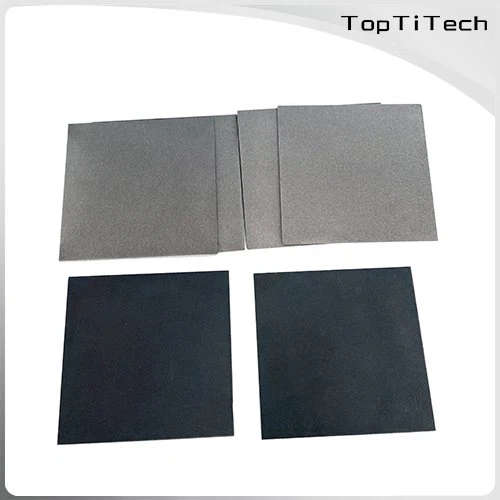
Titanium Anode Plate
2. Long service life of electrode
3. Can follow the higher current density, operating current density: 10000A/M2 belongs to the industrial pure titanium as the base of oxygen evolution type anode
4.Cost-effective
Send Inquiry
Product Introduction
The titanium anode plate is produced by Toptitech and we use this method to produce: high-
temperature sintering of titanium substrate coated with precious metal iridium salt.
And usually, our customers are widely used in electroplating, electrolysis, and other hydrometallurgical
industries. As we know that the preparation and application of the electrode have been quite mature,
with a history of 40 years. But compared with the traditional platinum-plated electrode in the alkaline
copper process, the titanium anode has incomparable advantages over the platinum-plated electrode:

Advantage
1. Titanium anode has a long working life. In the chlor-alkali industry produced by the diaphragm
method, the metal anode is resistant to chlorine and alkali corrosion. The anode life has reached more
than 6 years, while the graphite anode is only 8 months.
2. It can overcome the dissolution problem of graphite anode and lead anode, and avoid the pollution
of electrolyte and cathode products, thus improving the purity of metal products.
3. It can increase the current density. In the production of Chlor-alkali by the diaphragm method, the
working current density of the graphite anode is 8A/dm2, and the titanium anode can be doubled to
17A/dm2. In this way, under the same conditions of the electrolysis plant and the electrolysis cell, the
output can be doubled and the Single-slot production capacity effectively improves labor productivity.
When electrolysis is carried out under high working current density, it is more appropriate to use
titanium anode.
4. Due to the use of metal anodes, high temperature and high current density operations of chlorate
electrolytic cells are possible. The use of the metal anode improves the structure of the electrolytic cell,
reduces power consumption, and accelerates the chemical reaction of hypochlorite and gas chlorate,
thereby improving production performance.
5. With the adoption of DSA, the design concept and operating conditions of the mercury method and
diaphragm method salt electrolyzer is improved, and the energy consumption is reduced. The low
overpotential characteristics of DSA and the easy removal of air bubbles on the surface between the
electrodes and the electrodes are important reasons for the voltage drop of the metal anode
electrolyzer.
Due to the many advantages of titanium anode, its development has brought great economic benefits
to the chlor-alkali industry, so it will soon be used all over the world. Chlor-alkali production capacity is
about 41 million tons per year in the world, and no less than 70% of them use titanium anodes.
Titanium anodes are known as a major technological revolution in the chlor-alkali industry.
Subsequently, titanium anodes have also been widely used in many electrolytic industries.
6. The size of the anode is stable, and the distance between the electrodes does not change during the
electrolysis process, which can ensure that the electrolysis operation is carried out under the condition
of stable cell voltage.
7. It can avoid the short circuit problem after the lead anode is deformed, so the current efficiency can
be improved.
8. Titanium anode is light in weight, which can reduce labor intensity.
9. The switch is easy to manufacture and can be high-precision.
10. The working voltage is low, so the power consumption is small, which can save power
consumption and the DC power consumption can be reduced by 10%~20%.
The main reasons for the low working voltage of titanium anodes are as follows:
1) The overpotentials of active coated titanium anodes to chlorine and oxygen are relatively low. When
brine electrolysis produces Chlor-alkali, the overpotential of titanium anode to chlorine is low, which is
140mV lower than that of graphite anode at 1A/cm2;
2) it can reduce the "bubble shielding effect". The degree of gas filling between the electrodes
is greatly reduced, the ohmic drop between the two electrodes is about 700mV and the diameter of
the bubble is about 3mm;
3) the resistance of the anode structure is reduced;
4) the distance between
the electrodes is shortened. In the 1960s, the annual electricity consumption of the world's salt
electrolysis industry was about 150 billion kWh. After using metal anodes, about 300 million kWh of
electricity could be saved every year.
11. In the production of Chlor-alkali, after using a titanium anode, the product quality is high, the
purity of chlorine gas is high, does not contain CO2, and the concentration of alkali is high, which can
save steam for heating and energy consumption.
12. It has strong corrosion resistance and can work in many electrolytic media with strong corrosion
and special requirements.
13. The base metal titanium can be used repeatedly.
14. The emergence of metal anodes can be designed and industrialized using the latest ionic
membrane electrolysis technology emerging recently in the Chlor-alkali industry.
1. Technical characteristics
2. High catalytic activity
the platinum-plated electrode is a high oxygen potential (1.563V, relative to mercurous sulfate)
electrode, while the MMO anode is a low oxygen evolution electrode (1.385V, relative to mercurous
sulfate).
3. Pollution-free Memos
4. Cost-effective
MMO electrodes have better electrochemical stability in alkaline copper plating electrolytes, as well as
excellent electrolytic activity and durability. Having maintained the same service life as platinum-plated
electrodes (coating thickness of 3.5mm), MMO anodes are about 80% of the price of platinum-plated
electrodes.
5. Considering the cost of the MMO anode and PT electrode, it is obvious that the MMO electrode is
economical. Why did we say that?
Since copper applications in printed circuits require a reverse pulse period (PPR), we know that the use
of platinum-plated titanium insoluble anodes is prohibited. However, this phenomenon can be
avoided by using a stable-size anode, and insoluble anode technology can successfully achieve
performance advantages in such applications.
6. anode maintenance is the least. There is no need to stop production to clean and replenish the
anode, replace the anode bag and re-coating the anode (productivity improvement, labor cost
reduction);
7. The life of the insoluble anode depends on the type, working current density, and contact with
various electroplating chemicals;
Positive direction pulsation (PPR) plating anode
Other anode productions from our factory:
Using positive and negative pulse electroplating anode has the following characteristics:
1. The geometry of the anode remains the same, thus optimizing the current distribution.
2. Less maintenance of the anode. There is no need to stop the production line to clean and replenish
the anode.
3. To solve the problem of a uniform coating of deep hole electroplating:
high current efficiency can withstand 1000A/ M2 current density.
4. It will not pollute the electroplating medium.
The positive and negative pulse electroplating anode is an oxygen evolution-type electrode with pure
titanium (TA2) as the substrate. Electric anode service life and excellent corrosion resistance.
Contact:
If you have any questions about the Titanium anode, please feel free to contact us. Working hours: 8:30 a.m. to 17:30 p.m.
E-mail: zhangjixia@bjygti.com
Hot Tags: titanium anode plate, China, suppliers, manufacturers, customized, usage, pricelist, for sale, in stock, free sample, porous material, Custom Titanium Targets, titanium alloy strips, GR1 titanium coil heat exchanger, High purity GR1 titanium plate or sheet, Titanium screw, Gr5 alloy of titanium foil
Send Inquiry


