The Chlor-alkali industry, with a history of over 100 years, is a chemical industry that produces chlorine gas and caustic soda through the electrolysis of salt solution. It was one of the earliest industries in the chemical sector to utilize titanium. Titanium equipment plays a crucial role in Chlor-alkali production, including metal anode electrolytic cells, ion membrane electrolytic cells, tubular wet chlorine coolers, refined brine preheaters, dechlorination towers, Chlor-alkali cooling and washing towers, vacuum dechlorination pumps, and valves.

The article highlights the historical evolution of using metal anodes in the Chlor-alkali industry, replacing graphite anodes. The concept of dimensionally stable anodes (DSA), which are titanium substrates coated with noble metal oxide electrodes, was introduced in the 1950s. Industrialization of titanium anodes began in the late 1960s, and countries like the United States, Italy, Japan, Germany, and France swiftly adopted metal anodes. The use of metal anodes significantly contributed to the production of caustic soda.
The Chlor-alkali industry in China witnessed three major transformations in caustic soda production equipment. Firstly, the transition from horizontal tanks to vertical adsorption diaphragm electrolytic cells in the early 1960s led to a substantial increase in caustic soda output. The second change involved replacing graphite anode electrolytic cells with metal anode electrolytic cells. The adoption of titanium anodes started in the 1970s, and by 1996, a large number of metal anode diaphragm electrolyzers were being used across the country. The third revolution introduced ion-exchange membrane electrolyzers in the mid-1980s, promoting energy-efficient caustic soda production.

titanium anode and cathode
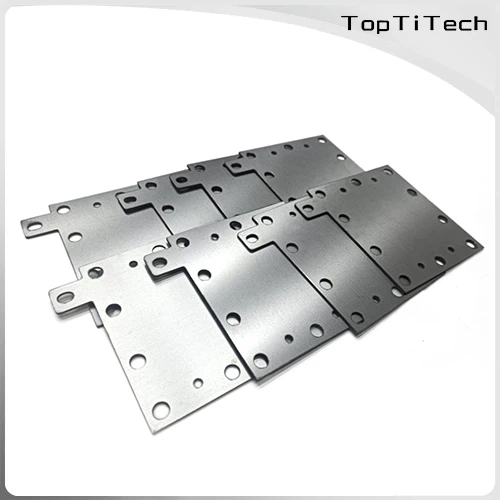 titanium anode
Titanium equipment, including pumps, pipes, and heat exchangers, found extensive application in various systems of ion-exchange membrane electrolyzers. These systems include the anolyte circulation system, brine system, dechlorination system, wet chlorine gas delivery system, and chlorine water circulation system.
Overall, the Chlor-alkali industry's adoption of titanium equipment, particularly metal anodes and ion-exchange membrane electrolyzers, has played a vital role in improving the production efficiency and capacity of caustic soda.