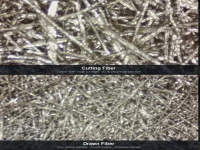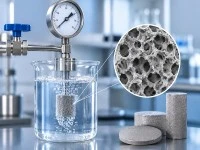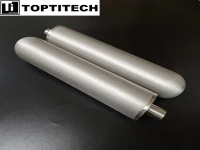

 Sintered nickel felt starts with micron-scale nickel fibers that are laid into a mat and bonded in a high-temperature sintering furnace. How those fibers are made decides everything about the felt - its pores, its conductivity, its price. There are two routes in the industry: drawn fiber (bundle-drawn, continuous filament) and cutting fiber (cut from nickel bar). Put simply: drawn fiber is finer, more uniform and performs better, but costs more. Cutting fiber, with a typical average pore size of 20–30 µm, does the job at a fraction of the cost - which is why it remains the industry's default choice.
How the Two Fibers Are Made
Drawn fiber is produced by sealing nickel wire into a metal envelope, drawing the bundled assembly down through successive dies, then annealing and separating the filaments. The result is a continuous fiber with a tight diameter tolerance (around 20 µm for nickel) and a smooth surface - so conductive and thermal paths run straight through the mat, and mechanical strength stays high.
Cutting fiber is machined directly from nickel bar into short segments, typically 10–60 µm in equivalent diameter. The cut edges are rough and irregular, which actually enlarges the specific surface area. Because the fibers are short and randomly oriented, the sintered mat ends up with a more open three-dimensional pore network.
Side-by-Side Comparison
| Property | Drawn Fiber Felt | Cutting Fiber Felt |
| Fiber form | Continuous long filament | Short fiber, random 3-D network |
| Diameter uniformity | High, tight tolerance (~20 µm) | Moderate, wider equivalent-diameter range |
| Average pore size | Uniform, precisely controllable | 20–30 µm (typical) |
| Fiber surface | Smooth | Rough - higher specific surface area |
| Conductivity | Better; uninterrupted current paths | Good; more contact points, longer paths |
| Strength/resilience | Higher; better compression recovery | Good; softer handle |
| Porosity | 70–80% (common range) | 70–80% (common), more open pores |
| Cost | Higher (long process, heavy equipment) | Lower (simple process, high yield) |
| Typical uses | PEM/AEM electrolyzer PTL, precision electrode substrates | Alkaline electrolysis, catalyst supports, filtration, energy storage |

Why Cutting Fiber Still Leads the Market
The cost gap is real. Bundle drawing means envelopes, multiple die passes, annealing and separation. Cutting takes simpler equipment and turns out fiber far faster, so the price difference is substantial.
It is good enough for most jobs. In alkaline electrolysis, catalyst carriers and filtration, a 20–30 µm pore size combined with the rough, high-area fiber surface is often an advantage rather than a compromise.
Supply is mature. Cutting fiber comes in many grades, in volume, on reliable lead times - which matters when you are scaling industrial production.
Drawn fiber goes where it counts. When pore uniformity and continuous conductivity really matter - porous transport layers (PTL) for PEM/AEM electrolyzers, precision electrode substrates - paying extra for uniformity is money well spent.
How to Choose

A practical rule of thumb: for large-area, high-current industrial service, start with cutting fiber felt and keep the budget under control. Reach for drawn fiber when you need high-performance electrodes, precision PTLs, or anything sensitive to pore consistency. The two grades are less rivals than teammates - one carries the volume, the other carries the precision.