

Why Is Titanium Highly Resistant to Corrosion?
Titanium is used in chemical processing, marine equipment and electrochemical systems because it holds up in media that attack carbon steel and 316L stainless.
The oxide on the surface does the work. Titanium left in air, or in water carrying dissolved oxygen, grows a TiO₂ layer 1.5 to 10 nm thick within minutes. That layer covers the metal without gaps and stays on it, so the medium meets oxide rather than metal.
A scratch takes the film off locally. Where water or oxygen reaches the spot, the oxide grows back in milliseconds to minutes, and passivation is the name engineers give that regrowth.
Regrowth needs water or oxygen. Inside a dry, deaerated acid line neither is present, and the metal corrodes like the steel beside it. Where the film does come back, performance depends on composition, surface condition, manufacturing process and service environment.

Material Grade and Surface Condition
Grade 1 and Grade 2 differ by 0.07% oxygen and 0.10% iron, and the tensile strength that separates them is 240 MPa against 345 MPa. In neutral seawater the corrosion rate of the two grades differs by less than the scatter of the test.
Surface condition causes more failures than grade does. Iron picked up from tooling, grinding residue and handling marks change the chemistry of the surface layer, and in salt spray that iron rusts within a week. The pit that follows starts under the rust, in the titanium below it.
The cleaning step is written into the specification, because pickling in HNO₃/HF removes the contaminated layer together with 2 to 5 µm of metal. A weld with a straw-coloured oxide is pickled; a weld with blue or grey oxide has the layer removed before service.
On porous products the same rules apply to the pore surfaces, which cannot be checked by eye.

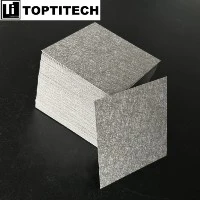
Porous titanium contains interconnected pores that pass gas or liquid, so the wetted area runs far beyond the outside surface of the part. A felt at 62% porosity with 25 µm fibre carries about 600 cm² of wetted surface per cubic centimetre (4 × 0.38 ÷ 0.0025). A disc 40 mm across and 3 mm thick exposes about 0.23 m².
The medium reaches the outer surface and the pore walls alike. Pore structure also sets where liquid moves fast and where it stands still, and a stagnant pocket keeps whatever settles into it.
Powder cleanliness, sintering atmosphere and handling after sintering decide the state of the pore walls as the part leaves the furnace. Vacuum sintering at 1200 °C removes most contamination, and nitric passivation after machining takes off the rest.
For sintered plates, porous tubes and fibre felt, that consistency is checked as part of product quality control.
Open porosity on its own does not lower corrosion resistance. What changes the answer is pore geometry, how easily the medium reaches a given pore, and how long it stays there.
Effects of Temperature and Chemical Media
Titanium holds up in oxidizing media and in many chloride solutions. Concentration and temperature move that limit, and they move it together.
Reducing acids, concentrated acids and fluoride-bearing media attack the metal or destabilise the film. Reaction rates roughly double per 10 °C, while film formation slows as the metal heats, and the two effects run in the same direction.

Sulfuric acid shows the concentration effect. A few percent at ambient temperature is handled for years. The same concentration at 60 °C dissolves the film and attacks the metal at millimetres per year. At 98% the acid holds almost no free water and titanium is serviceable again, so a batch diluted to a few percent and held at 60 °C is worse than either the concentrated acid or the same dilute acid cold.
For filtration duties, the medium, its concentration, the operating temperature and the exposure time are established before a titanium element is selected.
Electrochemical Environment and Titanium PTL
In electrochemical systems the potential and the surrounding electrolyte both act on the film.
A titanium PTL in a PEM water electrolyser runs on the oxygen side at pH 2 and 60 to 80 °C, with the anode potential near 1.8 V. The oxide grows past 20 nm under those conditions, and contact resistance against the adjacent component rises from about 5 to 50 mΩ·cm². The difference appears as cell voltage loss.
Coatings are chosen against those conditions. Iridium oxide or platinum holds contact resistance below 10 mΩ·cm² for several thousand hours. On the cathode, potentials below −0.6 V vs RHE drive hydrogen into the lattice as TiH₂, and a few hundred ppm halves elongation.
Coated and uncoated PTLs are specified as separate products for this reason.

How to Evaluate Titanium in Practical
Five parameters should be fixed before a titanium product is quoted:
Material grade: the grade and material specification required.
Chemical medium: the species present, their concentrations and any impurities.
Operating temperature: normal running temperature and maximum service temperature.
Structural design: for porous components, pore size, porosity, thickness and how easily the fluid reaches the pores.
Service conditions: pressure, flow, exposure time and the maintenance routine.

Where the duty is demanding, corrosion testing under representative conditions answers what a table cannot, and 90 days on a bypass rack returns mass loss, pitting count and crevice depth.
Every case above comes back to the same film. Palladium in Grade 7 changes how stable it is, and iron left by a tool starts it uneven. In a porous part some pore walls sit in moving liquid while others sit in a stagnant pocket, and the liquid in that pocket can strip the film while the wall next to it stays bright.
For porous components, the pore structure and the real fluid contact conditions are assessed alongside the medium. A part that meets every line of the specification still fails when one pore wall never sees fresh liquid.