

In a previous article, we outlined the unique filtration characteristics and industry pain points associated with metal hydride hydrogen storage systems, the limitations of traditional filtration solutions in these systems, and the manufacturing processes and filtration mechanisms of sintered metal powder filter elements. In this article, we will analyze the intrinsic material differences between SS316L stainless steel and titanium sintered filter elements under hydrogen service conditions, discuss industry guidelines for the structural design of sintered filter elements for bidirectional hydrogen charging and discharging, and examine typical failure modes and industry operation and maintenance standards for these elements in hydrogen storage systems.
Material Intrinsic Differences: SS316L vs. Titanium Sintered Powder Filters in Hydrogen Energy Applications
The solid-state hydrogen storage industry predominantly employs two types of sintered powder filter elements: Austenitic SS316L stainless steel and Pure Titanium. While both share a consistent structural design supporting symmetrical bi-directional filtration, their core differentiators lie in hydrogen embrittlement resistance, corrosion tolerance, material compatibility, and lifecycle cost. The following industry-level comparative analysis delineates their respective application scenarios.


| Core Performance Dimension | SS316L Sintered Powder Filter | Titanium Sintered Powder Filter |
| Hydrogen Embrittlement Resistance | Complies with NACE MR0175 hydrogen service standards. Withstands long-term exposure to 50 barg high-pressure hydrogen without hydrogen-induced cracking (HIC) under standard ambient temperature cyclic conditions. Suitable for the majority of civil and industrial solid-state hydrogen storage systems. | Possesses a dense lattice structure with extremely low hydrogen atom adsorption rates. Exhibits comprehensively superior resistance to hydrogen embrittlement compared to 316L, making it ideal for high-temperature hydrogen storage and long-term unattended extreme operating conditions, with negligible embrittlement failure risk. |
| System Material Compatibility | Homologous with industry-standard 316L piping, flanges, and valve bodies, eliminating galvanic corrosion risks. Offers optimal weldability and sealing compatibility, serving as the standardized default selection for the industry. | As a dissimilar metal, direct connection with 316L piping creates a potential difference that can induce galvanic corrosion. Necessitates the use of insulating gaskets, increasing system assembly complexity. |
| High-Temperature & Regeneration Performance | Maximum baking regeneration temperature of 450°C. Meets standard hydrogen back-flushing and vacuum baking regeneration requirements, ensuring a long cyclic service life. | Maximum baking regeneration temperature of 300°C. Demonstrates excellent resistance to high-temperature thermal shock, adapting to high-temperature hydrogen release conditions with sustained structural integrity. |
| Porosity Uniformity & Pressure Drop | Good pore uniformity with stable flow resistance. Exhibits excellent bi-directional differential pressure consistency and low manufacturing costs with strong mass production stability. | Superior powder particle size consistency leading to a more regular pore structure. Delivers a slightly lower initial pressure drop compared to SS316L under the same precision rating, providing enhanced fluid stability. |
| Industry Application Positioning | The industry's standard universal grade, suitable for over 90% of civil and industrial solid-state hydrogen storage equipment. Balances performance with cost-efficiency, making it the preferred choice for large-scale projects. | Specialized for demanding high-end applications, predominantly utilized in military, aerospace, extreme on-vehicle conditions, and long-life maintenance-free hydrogen storage systems. Represents the premium solution in the industry. |
Design Standards for Sintered Filter Elements under Bi-Directional Hydrogen Flow
Bi-directional flow is a defining characteristic distinguishing metal hydride storage systems from other hydrogen filtration scenarios and is a primary cause of filter failure. The industry has adopted a unified structural design framework with the following key principles:
Mandatory Uniform Symmetrical Pore Structure
Asymmetric gradient sintered filters are strictly prohibited. Uniform symmetrical filters have identical internal and external pore sizes. This ensures synchronous filtration efficiency, fluid differential pressure, and dirt-holding capacity during both forward (discharge) and reverse (charge) operations. The positive and negative pressure drop deviation can be controlled within 0.02 bar, preventing interference with the system's pressure closed-loop control. Conversely, asymmetric filters operating in reverse mode cause fine powder layers to face direct powder impact, leading to rapid surface caking and blockage, thus significantly compromising charging efficiency.
Dominant Candle/Tubular Structure

Compared to flat or cup-type sintered filters, the candle/tubular structure offers a larger effective filtration area and higher dirt-holding capacity per unit volume. It is ideally suited for standard DN15/DN20 hydrogen piping interfaces. Furthermore, the tubular geometry ensures uniform stress distribution, capable of withstanding 50 barg high pressure and cyclic pressure pulses, with superior anti-deformation capabilities compared to flat-plate elements.
Standard Filtration Precision Grading Logic
Based on the particle size distribution of metal hydride powders (50–200 µm), the industry has established clear precision selection boundaries to prevent both over-filtration and under-filtration.
►0.1µm–0.2µm (Ultra-High Precision): Completely unsuitable. Excessively small pores result in an impractically high baseline pressure drop and rapid clogging. No viable industry application exists.
►2µm (High Precision): Achieves full-size particle interception, capable of capturing all secondary ultra-fine dust. Recommended for laboratory-scale hydrogen storage units equipped with downstream high-precision analytical instruments.
►10µm (Standard Precision): Provides 100% interception of all primary hydride powders. This grade optimally balances a low-pressure drop with high dirt-holding capacity, making it the most common standard precision for industrial solid-state hydrogen storage.
►≥20µm (Coarse Precision): Ineffective at capturing secondary wear-generated fines, posing a risk of micro-particle penetration. Suitable only for primary coarse filtration stages.
Effective Flow Area Redundancy Design Specification
The industry standard mandates that the net effective flow area of the filter element (accounting for porosity and clogging redundancy) be at least 1.2 times the maximum system flow demand. This adequate area redundancy slows down powder clogging, reduces maintenance frequency, ensures stable hydrogen flow rates under bi-directional flow, and prevents pressure fluctuations from affecting the sorption/desorption kinetics of the hydrogen storage alloy.
Typical Failure Modes and Industry Operation & Maintenance Standards
1. Three Common Failure Scenarios
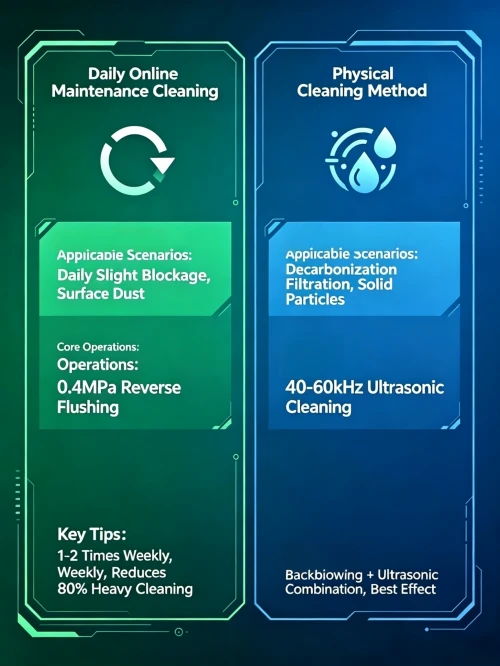
Surface Powder Caking: Accumulation of powder on the filter surface during prolonged one-way hydrogen discharge. Addressed by passive self-cleaning via the system's inherent reverse charging gas flow, requiring no additional disassembly.
Deep Pore Plugging: Micro-fine dust particles becoming embedded in the filter's internal pore structure, rendering passive back-flushing ineffective. The standard remediation involves offline high-pressure gas back-flushing + vacuum high-temperature baking regeneration.
Hydrogen-Induced Stress Cracking (HISC): Inferior sintered filters (non-hydrogen-grade) with lattice defects develop micro-cracks under prolonged high-pressure hydrogen exposure. The industry mandates that all applicable filters must be accompanied by a hydrogen embrittlement test report.
2. Standard Operating and Maintenance Procedures
Routine Maintenance: Automated back-flushing during the hydrogen charging cycle ensures passive de-dusting without manual intervention.
Periodic Maintenance: Perform offline regeneration every 6 months. This process can restore over 95% of the original pressure drop performance.
Prohibited Actions: Strictly no organic solvent cleaning and no high-pressure water rinsing to prevent oxidation of the metal pores and media contamination.
Industry Trends and Future Technologies
◢ Lightweighting and Integrated Monolithic Design
The future of mobile on-vehicle solid-state hydrogen storage involves the adoption of integrally sintered filter connectors. This entails directly sintering the filter element and pipe fitting into a single unit, eliminating sealing connections and minimizing potential leak points. Titanium filter elements are expected to see increased penetration in lightweight vehicular applications.
◢ Composite Homogeneous Gradient Structures
To address the current trade-off between high-precision (high-pressure drop) and coarse-precision (inadequate fines capture) filters, next-generation elements will feature a symmetrical composite structure with coarse outer pores and fine inner pores. This innovation aims to achieve both bi-directional flow capability, low initial pressure drop, and comprehensive dust interception for high-power, large-capacity hydrogen storage units.
◢ Integrated Online Condition Monitoring
By integrating real-time differential pressure monitoring modules, the industry is moving towards establishing a pressure drop-clogging relationship model. This enables predictive filter life forecasting and proactive maintenance, aligning with the operational requirements of smart, unattended hydrogen energy stations.
Conclusion
The core filtration requirements for metal hydride solid-state hydrogen storage systems fundamentally revolve around the synergistic resolution of three critical challenges: high-pressure hydrogen embrittlement protection, bi-directional flow compatibility, and long-term hard powder retention. SS316L sintered powder filters, with their high compatibility and cost-effectiveness, remain the industry standard. Titanium powder filters, leveraging superior hydrogen embrittlement and high-temperature resistance, command the high-end specialized market segment.
Critically, unlike standard gas filtration scenarios, filtration design for solid-state hydrogen storage must not solely pursue ultra-high precision. Instead, it requires a balanced approach integrating powder particle size, bi-directional flow characteristics, and system pressure drop limitations. As solid-state hydrogen storage industrialization accelerates, integrated, intelligent, and long-life sintered metal filter elements will become increasingly indispensable components for ensuring the safe and reliable operation of these energy systems.


