
Global green hydrogen infrastructure expansion raises strict demands for reliable filtration inside hydrogen storage equipment. Conventional polymer filters, woven mesh and ceramic plates fail under cyclic temperature swings, alternating gas flow and long-term high-purity hydrogen exposure, causing clogging, cracking and downstream equipment contamination.
Powder sintered metal filters, manufactured via integrated powder metallurgy sintering, feature fully interconnected three-dimensional pore networks, outstanding hydrogen embrittlement resistance, reusable regenerability and balanced permeability & particle retention. This article systematically breaks down operating conditions of mainstream hydrogen storage systems, analyzes material selection standards, structural design specifications, typical on-site failure modes and standardized maintenance workflows, delivering actionable technical references for hydrogen storage equipment designers, system integrators and material procurement engineers.
1 Harsh Operating Conditions & Filtration Pain Points
Three Main Hydrogen Storage Working Environments
1. 70/350 bar high-pressure gaseous hydrogen storage: Frequent pressure pulses generate metal wear debris that scratches fuel cell stacks and precision regulators. Filters must resist high-velocity gas impact and particle penetration.
2. Metal hydride solid-state hydrogen storage (0–50 barg, -20℃ ~ 300℃): Bidirectional charging/discharging flow wears hydride alloy into 2–10 μm hard fine dust. Filters require consistent dual-way filtration efficiency and high dirt holding capacity.
3. Cryogenic liquid hydrogen storage (-253℃): Extreme low temperature induces thermal stress; ice crystals and oxide contaminants demand all-metal filters with stable low-temperature mechanical strength.
Shortcomings of Traditional Filter Media
- Polymer filters: Hydrogen embrittlement, organic leaching, no high-temperature regeneration capability.
- Woven wire mesh: Irregular apertures deform under cyclic scouring, only limited surface filtration.
- Ceramic plates: Prone to thermal shock cracking, difficult custom machining.
- Asymmetric gradient sintered filters: Reverse charging flow instantly clogs fine inner pores and elevates system pressure drop.
Homogeneous symmetric powder sintered metal filters become the universal industry-standard solution.
2 Manufacturing & Filtration Mechanism of Sintered Metal Filters
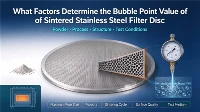
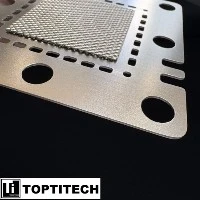
SS316L or titanium powder is compressed and vacuum sintered at high temperature without adhesives, forming an integral porous structure with controllable porosity and uniform pores. Post-processing includes laser cutting, welding and surface passivation to fit tank and pipeline assembly.
The filter delivers triple filtration effects:
1. Surface screening blocks large hydride powder and metal debris, removable via reverse hydrogen purging;
2. Deep-layer labyrinth pores trap ultrafine secondary dust to protect downstream precision hardware;
3. Porous skeleton rectifies turbulent flow and reduces powder suspension inside hydride beds.
3 Material Selection: SS316L vs Titanium Sintered Filters
| Performance Index | SS316L Sintered Filter | Pure Titanium Sintered Filter |
|---|---|---|
| Hydrogen Embrittlement | Compliant with NACE MR0175, suitable for most room-temperature gaseous & solid-state storage | Ultra-low hydrogen absorption, ideal for high-temperature hydride reactors and long-term unmanned equipment |
| System Compatibility | Matches standard 316L pipelines, no galvanic corrosion, easy welding | Dissimilar metal; insulated gaskets required to avoid electrochemical corrosion |
| Temperature Range | -40℃ ~ 450℃, max regeneration temperature 450℃ | -253℃ ~ 350℃, stable under severe thermal shock |
| Market Positioning | Cost-effective standard grade for mass industrial hydrogen storage | Premium grade for vehicle-mounted, aerospace and high-temperature hydrogen storage systems |
4 Key Installation Positions in Hydrogen Storage Equipment
1. Central tubular filter (solid-state hydride tanks): Buried in alloy powder beds for uniform hydrogen distribution, dust interception and auxiliary heat exchange; common specification 5–15 μm.
2. Outlet terminal filter disc (all storage tanks): Secondary protection before outlet valves to block escaped fine particles, usually 2–10 μm symmetric porous sheets.
3. Pipeline inline sintered cartridges (700 bar vehicle hydrwelding slag and metal abrasion debris in high-pressure filling loops.
5 Industry Standard Design Specifications
1. Adopt homogeneous symmetric pore structures only; asymmetric gradient filters are forbidden for bidirectional hydride storage systems to avoid sharp pressure drop surges during charging.
2. Standard pore size selection:
- 2 μm: Laboratory test cells with high-precision analytical instruments
- 10 μm: Mainstream commercial solid-state hydrogen storage reactors
- ≥20 μm: Only for front pre-filtration
3. Effective filtration area must be 1.2 times the peak hydrogen flow to extend regeneration intervals.


6 Typical Filter Failures & Standard Maintenance
Three Common Failure Modes
1. Surface powder cake: Automatically cleaned by reverse hydrogen flow during charging without disassembly.
2. Deep pore embedding clogging: Resolved via offline high-pressure nitrogen backwash + vacuum baking regeneration (over 95% pressure drop recovery).
3. Hydrogen-induced microcracking: Low-quality sintered filters with lattice defects; qualified suppliers must provide hydrogen embrittlement test reports.
Operation Rules
- Routine self-cleaning via charging reverse flow; no daily manual maintenance needed.
- Regeneration cycle: Every 6 months for gaseous storage; 500–800 charge-discharge cycles for rare-earth hydride tanks; 300–500 cycles for Mg-based high-temperature reactors.
- Forbidden: Organic solvent soaking and high-pressure water flushing to prevent pore oxidation and impurity contamination.
7 Industry Development Trends
1. Integrated sintered filter joints: Combine filter and pipeline connectors as one piece to eliminate sealing leakage points, widely applied for lightweight vehicle hydrogen tanks.
2. Symmetric gradient composite sintered media: Balance low pressure drop and full-spectrum dust interception for large-capacity industrial storage systems.
3. Differential pressure intelligent monitoring: Real-time clogging detection realizes predictive maintenance for unattended smart hydrogen stations.
4. Surface modified anti-adhesion sintered filters: Reduce hydride powder adhesion and extend continuous service cycles.
Conclusion
Powder sintered metal filters solve three core hydrogen storage filtration challenges: hydrogen embrittlement resistance, stable bidirectional flow performance and long-term hard dust interception. SS316L filters dominate mainstream stationary and gaseous hydrogen storage projects for balanced cost and compatibility, while titanium filters serve high-end vehicle, aerospace and high-temperature solid-state hydride equipment.
Storage system designers should select filter material, pore size and structure based on storage type, pressure, temperature and particle distribution. With rapid expansion of green hydrogen storage capacity, integrated, long-life sintered metal filters will become indispensable core supporting components for safe and stable hydrogen storage operation.