

One essential method used in the production of steel is the hot rolling process. Forming and refining steel requires heating steel billets or ingots to high temperatures and then carefully rolling them. This page offers a thorough explanation of the hot rolling process, including its benefits, surface features, and effects on steel's mechanical properties.
Hot Rolling Process
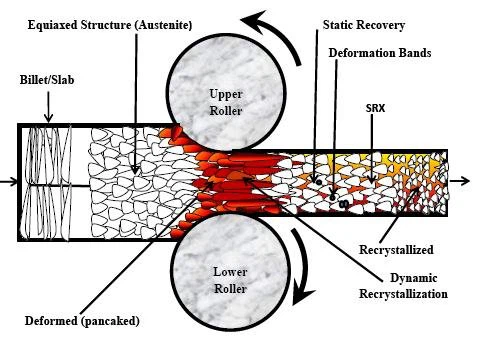
Steel is heated to a high temperature during the hot rolling process in order to shape and refine it. After being heated to a temperature between 1100°C and 1250°C, steel ingots or billets are sent through rolling mills. Usually, the ultimate rolling temperature is kept between 800°C and 900°C to allow the steel to cool naturally in the surrounding air.
Scale, or iron oxide, accumulates on the surface of the steel during hot rolling. Although the scale makes the steel resistant to corrosion and allows for outdoor storage, it also causes dimensional variances and a somewhat rough surface. Cold rolling is a common extra procedure used for applications needing high surface smoothness and dimensional accuracy.
Advantages of Hot Rolling
The hot rolling process offers several advantages in steel manufacturing:
- Efficient Forming and High Productivity:
Hot rolling allows for the rapid forming of steel, resulting in high productivity. The process is capable of producing a wide range of steel sections, meeting diverse industrial requirements.
- Preservation of Coating:
Unlike certain metalworking processes, hot rolling does not compromise the integrity of any protective coatings applied to the steel. This makes it suitable for manufacturing coated steel products, including galvanized or painted steel.
- Enhanced Mechanical Properties:
Hot rolling significantly improves the mechanical properties of steel, particularly its yield point. Through recrystallization and grain refinement during the process, the final steel product exhibits enhanced strength and toughness.