
While solution chemistry and temperature control lay the foundation for uniform titanium alloy chemical polishing, they are far from the only factors that determine final surface quality. In many production scenarios, even well‑formulated baths and tightly controlled temperatures fail to eliminate non‑uniformity, indicating that hidden variables related to fluid dynamics, workpiece handling, pretreatment status, and bath maintenance are still at play. These often‑overlooked elements can directly disrupt etching consistency, induce local concentration gradients, or create uneven contact between the workpiece surface and the polishing solution. In the upcoming sections of this series, we will further explore these secondary but critical influencing factors, provide detailed troubleshooting methods, and establish a complete, production‑oriented optimization framework to achieve truly stable and repeatable chemical polishing results.
4. Bath Aging and Titanium Ion Accumulation
As the polishing bath is used, dissolved titanium accumulates in the solution. Ti³⁺ and Ti⁴⁺ ions increase the viscosity and alter the diffusion characteristics of the bath. This accumulation is insidious because pH alone does not reliably indicate bath condition.

At low titanium concentrations, the bath behaves predictably. As titanium builds up, several changes occur: the effective HF concentration decreases due to complexation, the diffusion boundary layer thickens, and the polish rate slows non-uniformly. At high concentrations, dissolved titanium may begin to plate back onto workpiece surfaces, inhibiting uniform material removal and introducing surface contamination.
Bath life varies significantly with workpiece geometry, processing temperature, and total surface area treated. For high-volume production, analysis of titanium concentration (via titration or ICP) is recommended, with partial bath replacement or regeneration when titanium content exceeds a threshold typically between 15–25 g/L. Regeneration methods include selective precipitation of titanium salts through cooling and filtration, or the addition of fresh HF/HNO₃ concentrate to rebalance the active components.
5. Fluid Dynamics: Agitation, Workpiece Positioning, and Mass Transport
Uniform polishing requires uniform access of fresh solution to every point on the workpiece surface. In stagnant or poorly agitated baths, localized depletion of reactants and accumulation of reaction products create concentration gradients that translate directly into non-uniform polish results.
Several agitation methods are available, each with distinct characteristics:
For large or geometrically complex parts, a combination approach often works best: recirculating flow to maintain bulk solution uniformity plus mechanical agitation of the workpiece to break boundary layers at the surface. Workpiece orientation also matters. Flat plates should be positioned vertically rather than horizontally to avoid trapping gas bubbles against the surface. Parts with blind holes or internal cavities require special fixturing to ensure solution exchange within those features.

6. Pre-Treatment and Surface Condition Effects
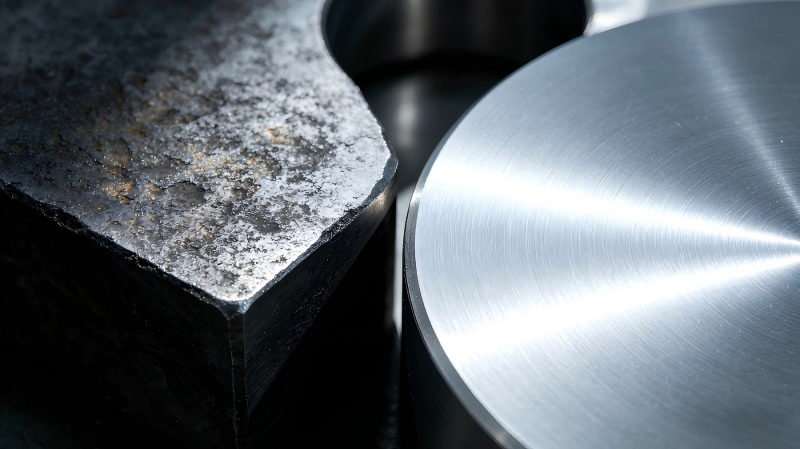
Non-uniform polishing often originates before the workpiece ever enters the polishing bath. Titanium surfaces naturally carry a passive oxide film that varies in thickness and composition depending on prior thermal and mechanical history. If this oxide film is not uniformly removed before polishing, the initial attack will proceed at different rates across the surface, producing a non-uniform result even if the subsequent polishing process is perfectly controlled.
The standard solution is a two-step approach: first, a pre-polish deoxidizing step using a milder acidic mixture to strip the native oxide uniformly. Only then does the workpiece enter the full-strength chemical polishing bath. Alkaline degreasing followed by thorough rinsing is also essential. Any residual oil, grease, or shop soil blocks acid access locally, creating characteristic unetched spots or stains. Studies have shown that contamination during processing, storage, and transport is a primary cause of localized discoloration on titanium surfaces.
Water quality is a frequently overlooked variable. Deionized or distilled water should be used for both bath make-up and rinse stages. Tap water introduces chlorides, sulfates, and metal ions that can interfere with bath chemistry or leave drying stains on polished surfaces.
Continuing