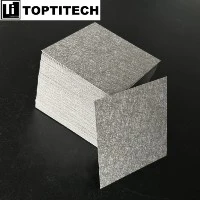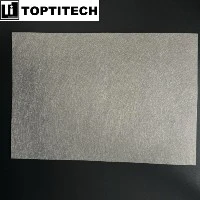

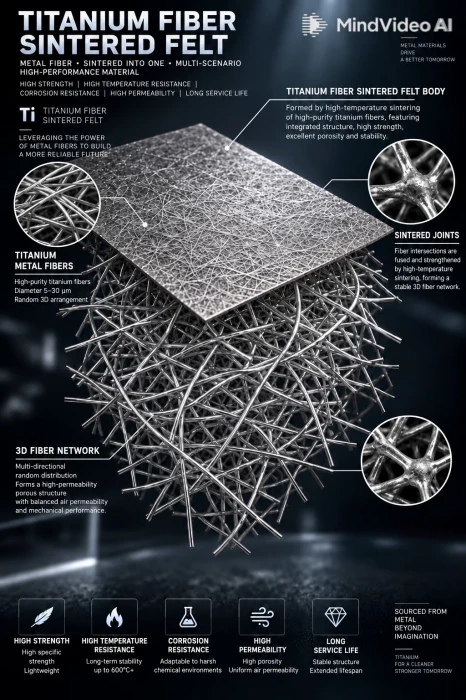
 Titanium fiber sintered felt (Ti felt) is a three-dimensional porous metal made of high-purity titanium fibers that are randomly laid up and integrally sintered at high temperature. Combining metallic conductivity and strength with titanium's corrosion resistance and a controllable porosity of 60–85%, it is a key functional material for hydrogen-energy electrodes and precision filtration.
Ti felt is formed from titanium fibers of roughly 5–30 μm diameter, interwoven in three dimensions. At fiber intersections, high-temperature diffusion sintering creates metallurgically bonded "sinter joints," producing a stable porous skeleton with interconnected open cells.
Material Overview
| Property | Typical range | Engineering significance |
| Porosity | 60% – 85% (controllable) | Governs permeability, flux and electrolyte penetration |
| Pore size (throat) | ~5 – 80 μm | Governs filtration rating and bubble distribution uniformity |
| Fiber diameter | 5 – 30 μm | Affects specific surface area and conductive network density |
| Thickness | 0.2 – 2.0 mm | Governs pressure drop, dirt-holding capacity, diffusion path |
| Temperature resistance | ≥ 600 °C (long-term in air) | Sustains high-temperature service and thermal regeneration |
| Corrosion resistance | Acids, alkalis, organics | Stable across wide pH and high-potential environments |
Manufacturing Process
Performance consistency depends on tight process control.
The mainstream route is a three-stage chain - fiber cutting → felt formation → high-temperature sintering - where sintering temperature and holding time determine joint strength and final pore architecture:

Typical manufacturing route of titanium fiber sintered felt
Electrode Applications
In electrochemical devices, TFSF serves as the gas diffusion layer (GDL) / porous transport layer (PTL) and electrode substrate, simultaneously satisfying three conflicting demands: electron conduction, gas–liquid transport, and uniform distribution.
PEM Electrolyzers & Fuel Cells
Anode PTL (oxygen evolution): high potential, oxygen-rich, strongly acidic - off-limits to steel and carbon, making TFSF the industrial default. Typical 0.2–0.4 mm thick, 70–78% porosity; Pt or Ir coatings reduce interfacial contact resistance and suppress passivation-film growth.
Cathode GDL (hydrogen evolution): milder duty; thicker grades (0.4–0.6 mm) improve water removal and gas distribution.
Typical data: at 2 A/cm², a 75%-porosity felt with proper flow-field design keeps mass-transport losses to the tens-of-mV level, clearly outperforming sintered porous titanium plates.
Vanadium Redox Flow Batteries (VRFB)
As a positive-electrode substrate, TFSF offers far higher compressive stability and conductivity uniformity than carbon felt; thermal or acid oxidation introduces surface oxygen groups that improve wettability and electrochemical activity.
Filtration Applications
TFSF's depth-filtration structure outperforms woven meshes (single-layer, coarse rating) and sintered powder cartridges (low flux, fouling-prone) in demanding service:
Chemical & pharmaceutical: acidic/alkaline process liquids, catalyst recovery, activated-carbon capture; 5–50 μm rating;
Gas filtration: hot-gas dust removal, steam filtration, compressor intake - 300–600 °C continuous service;
Food & beverage: pre-filtration ahead of sterile rating, with zero leachables;
Aerospace & hydraulics: high-reliability fuel and hydraulic-oil filtration under shock and vibration.
Elements support back-flushing and chemical regeneration; with differential-pressure monitoring, service life reaches several years, beating disposable media on total lifecycle cost.
How to Choose Porosity & Thickness
1. Porosity
| Porosity | Structure | Best suited for |
| 60–70% | Dense packing, highest strength, narrow pore distribution | Fine filtration (≥5 μm), high differential pressure, silencers |
| 70–78% | Flux–strength balance point | PEM electrolyzer PTL, GDL, general chemical filtration |
| 78–85% | High voids, low pressure drop, high dirt capacity | Flow-battery electrodes, high-flow prefiltration, viscous media |
2. Thickness
| Thickness | Filtration logic | Electrode logic | |
| 0.2–0.3 mm | Low-Δp surface filtration, prefiltration | High-current-density anodes; short bubble escape path | |
| 0.4–0.6 mm | General depth filtration; precision × flux balance | Standard GDL/PTL grade; most versatile | |
| 0.8–1.2 mm | High dirt capacity, regenerable cartridges | Low-flow electrodes; flow-conditioning buffer | |
| 1.5–2.0 mm | Hot-gas dust removal, catalyst supports |
|
Conclusion
The value of Ti felt lies not in any single extreme property, but in the rare combination of conductivity × corrosion resistance × controllable porosity × weldability. As PEM water electrolysis, long-duration flow-battery storage and advanced fluid filtration scale up, titanium felt is evolving from a specialty material into a platform functional material. Mastering the porosity–thickness–duty mapping is the starting point for specifying it well.