
Sintered ceramic and sintered metal porous filter elements are two commonly used materials in filtration applications. While they serve similar purposes, there are distinct differences in their structure, characteristics, and applications. This article aims to provide a comprehensive comparison between the two, highlighting their unique features and suitability for various filtration needs.
Structure and Characteristics:


Sintered Ceramic Porous Filter Elements:
Sintered ceramic filter elements are composed of ceramic materials, offering a uniform pore structure with adjustable pore sizes. They exhibit excellent high-temperature resistance, corrosion resistance, and precise filtration capabilities. These features make them ideal for applications requiring high-temperature or corrosive media filtration, effectively removing suspended solids, impurities, and microorganisms.
Sintered Metal Porous Filter Elements:
On the other hand, sintered metal porous filter elements are fabricated using metal powders through a sintering process. They possess a complex network of interconnecting channels and voids, providing high strength and thermal conductivity. These filter elements are suitable for high-pressure and high-temperature environments, excelling in gas and liquid filtration applications by effectively capturing solid particles, micro-particles, and contaminants.
Manufacturing Processes:


Sintered Ceramic Porous Filter Elements:
The production of sintered ceramic filter elements involves several steps. These include raw material preparation, shaping, drying, and sintering. The ceramic materials are carefully selected, processed, and shaped into the desired filter element form. Subsequently, the elements undergo drying and sintering processes to achieve the final product.
Sintered Metal Porous Filter Elements:
The manufacturing process of sintered metal porous filter elements typically includes raw material preparation, shaping, and sintering. Metal powders are mixed, shaped into the desired form, and then sintered at elevated temperatures. The sintering process enables particle bonding, resulting in a robust porous structure.
Applications:
Sintered Ceramic Porous Filter Elements:
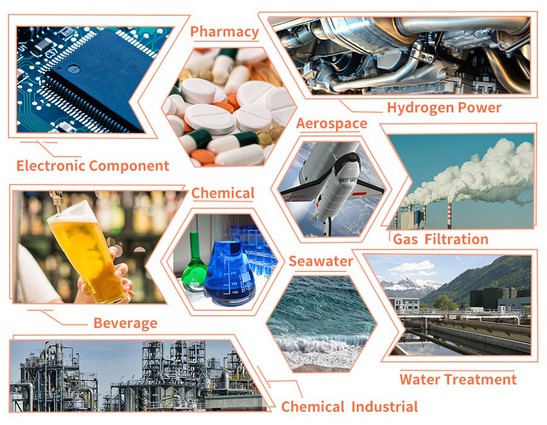
Sintered ceramic porous filter elements find extensive applications in industries such as chemicals, petroleum, and food processing. They are commonly used for liquid filtration and separation, effectively removing impurities, suspended solids, and microorganisms. Additionally, they are employed in gas filtration and purification processes, including air purification systems and industrial gas treatment.
Sintered Metal Porous Filter Elements:
Sintered metal porous filter elements are widely utilized in gas and liquid filtration, as well as catalyst support applications. Their high-temperature resistance, corrosion resistance, and adjustable pore sizes make them suitable for various industries. They are commonly employed in gas filtration systems, liquid filtration in chemical processes, and as catalyst carriers in catalytic reactions and chemical synthesis.
In conclusion, sintered ceramic and sintered metal porous filter elements offer distinct advantages in filtration applications. Sintered ceramic elements exhibit precise filtration capabilities, high-temperature resistance, and corrosion resistance. On the other hand, sintered metal elements provide high strength, thermal conductivity, and adjustable pore sizes. The choice between these materials depends on specific filtration requirements and operating conditions. By understanding their unique characteristics and applications, one can select the most suitable filter element to achieve optimal filtration and separation efficiency.