

PEM and AEM are two distinct types of electrolytes employed in fuel cells. PEM stands for Proton Exchange Membrane, while AEM stands for Anion Exchange Membrane.
The primary distinction between PEM and AEM lies in the ions they facilitate transport for. PEMs transport protons, whereas AEMs transport anions. In a PEM fuel cell, hydrogen gas is passed over a platinum catalyst, causing the hydrogen molecules to split into protons and electrons. The PEM exclusively allows protons to permeate, while the electrons are compelled to flow through an external circuit, generating electricity. Conversely, in an AEM fuel cell, oxygen gas is passed over a catalyst, resulting in the creation of hydroxide ions. The AEM selectively permits the passage of hydroxide ions while the positively charged ions are routed through an external circuit, generating electricity.
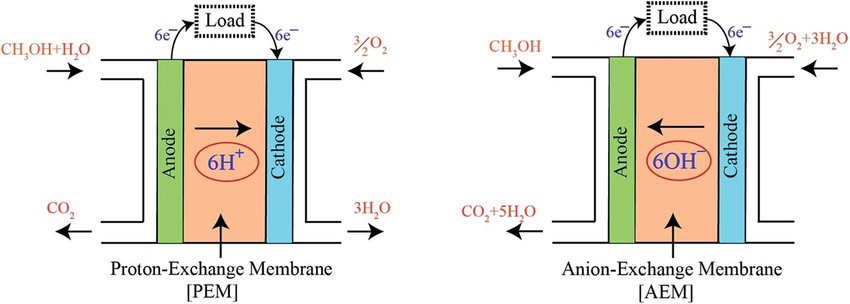
Another distinction between PEM and AEM lies in their operational requirements. PEMs necessitate relatively low temperatures (around 80-100°C) and a humid environment to function optimally. AEMs, however, can operate at higher temperatures (up to 120-150°C) and do not require a humid environment.
In terms of performance, PEMs exhibit higher power density and efficiency compared to AEMs, but their manufacturing costs are also higher. AEMs, conversely, are more cost-effective to manufacture but offer lower performance.
Ultimately, the selection between PEM and AEM depends on the specific demands of the fuel cell application. PEMs are commonly employed in automotive applications, while AEMs find utility in stationary applications such as backup power systems for buildings.