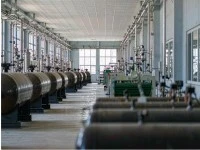

In a proton exchange membrane electrolyzer, the sintered titanium plate ranks third among major component categories by stack cost, behind the bipolar plate and the membrane electrode assembly. Its failure mode, however, is rarely confined to itself. The precious-metal coating degrades first. The membrane follows. Stack efficiency then declines across the whole unit.
The component occupies an unglamorous position, comparable to the support structure within a plate heat exchanger or the current-collecting tab on a battery cell. It is never the headline specification in a product brochure. Yet insufficient strength, uneven pore distribution or progressive corrosion will compromise the far more expensive catalyst and membrane layers above it.
Over the past two years, as green hydrogen projects have moved from demonstration toward industrial scale, this component has moved correspondingly higher on procurement agendas.
Position and function within the stack
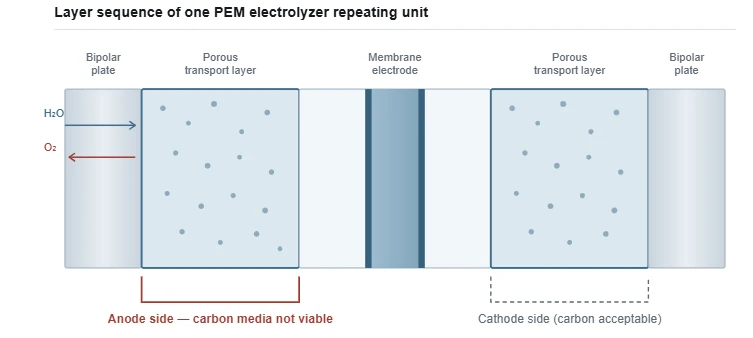
The geometry is established by stack design. A PEM electrolyzer stack is assembled by repeating a single unit - end plate, bipolar plate, porous transport layer, membrane electrode assembly, porous transport layer, bipolar plate. The sintered titanium plate occupies the porous transport layer on either side of the membrane electrode assembly, designated PTL in industry usage and sometimes referred to simply as the gas diffusion layer.
Requirements at that position are imposed by the operating environment rather than by preference. The anode side is acidic, strongly oxidising, continuously wetted and continuously generating oxygen. Carbon-based media - the carbon paper long established in fuel cells - does not survive there; it oxidises and loses structural integrity. The anode side therefore requires a metal, and specifically one able to withstand that environment. Titanium is effectively the only practical candidate.
At that position the component must satisfy four requirements simultaneously: distribute water uniformly to the catalyst layer surface, remove evolved oxygen, conduct current out of the cell, and retain dimensional stability under the compressive load of stack assembly. These requirements are in tension. Raising porosity improves water and gas transport while reducing strength. Increasing thickness restores strength but raises both electrical resistance and stack volume.
Three material routes, three distinct functions
Sintered titanium plate is not a single product category. Three routes dominate commercial supply: Porous sintered plate, titanium fibre felt, and multilayer sintered wire mesh. All three can serve as a porous transport layer, but each is optimised for different demands.
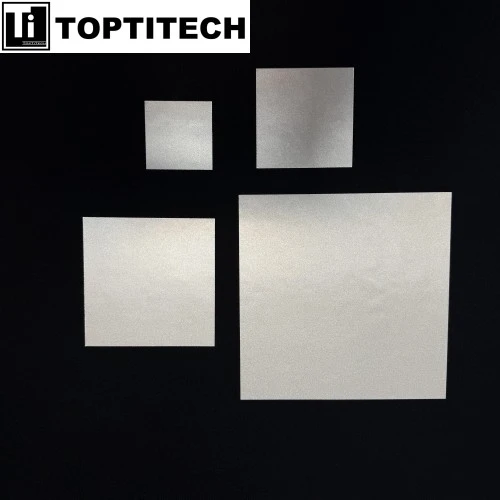
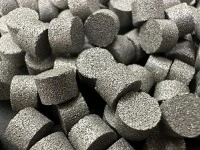
Powder-sintered plate is produced from spherical or near-spherical pure titanium powder, pressed or rolled to shape and then sintered. It delivers tight, uniform pore control, a flat surface and high compressive strength, making it suited to a low-porosity flow-guiding support layer.
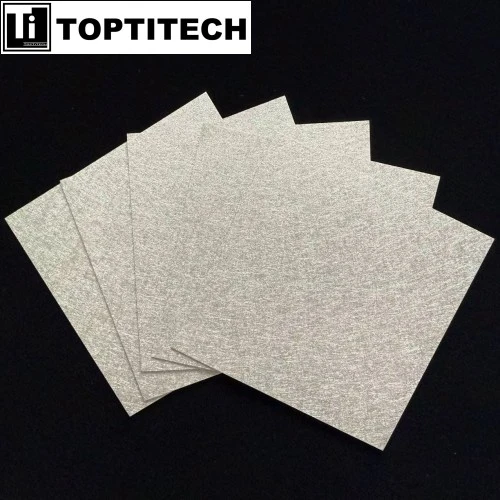
Titanium fibre felt is formed by laying micron-scale titanium fibre in a nonwoven process and vacuum sintering the result. Porosity runs high - typically 60 to 85 percent in commercial grades - with good three-dimensional connectivity, low resistance to fluid flow and useful flexibility. The trade-off lies in flatness and compressive stiffness compared with powder-sintered plate.
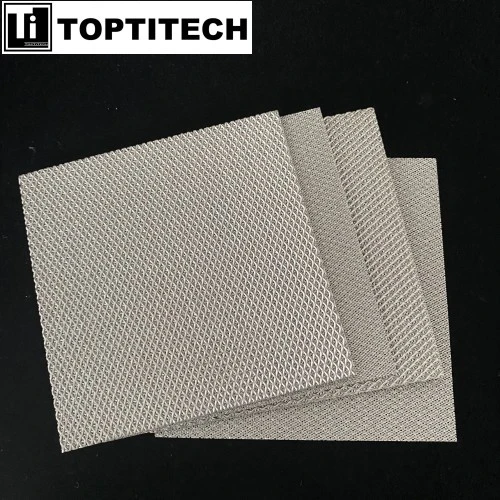
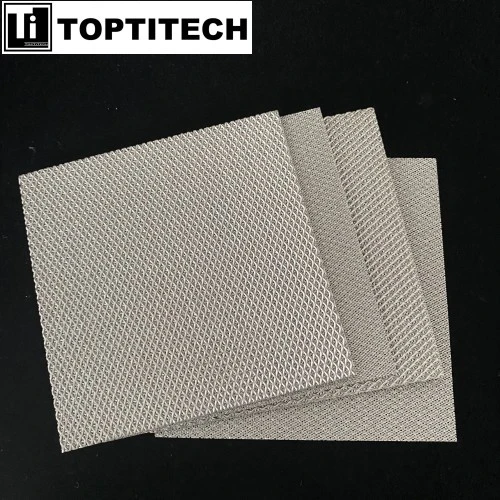
Multilayer sintered titanium mesh follows a different principle: three to five woven titanium wire layers are stacked and sintered into a single body. Its design value lies not in porosity but in structural rigidity. The stacked construction produces a three-dimensional through-pore network with high compressive strength, which suits the high-load support skeleton role in pressurised electrolyzer designs.
In practical terms, fibre felt excels at fluid transport, powder plate at pore tolerance control, and multilayer mesh at maintaining dimensional stability under load. Stack designs frequently combine them - multilayer mesh as the skeleton, felt or powder plate as the functional layer.
Applications beyond hydrogen production
Considered outside the electrolyzer context, the application surface is broader than commonly assumed. These uses share a single characteristic: the duty conditions defeat both stainless steel and polymeric materials.
Electrolyzer gas diffusion layers
Anode-side PTL in PEM and AEM electrolyzers, combining water distribution, gas removal, current collection and structural support. The alkaline AEM route is also generating demand for nickel mesh.
Corrosive media filtration
Liquid purification and catalyst recovery in nitric, sulphuric, acetic, oxalic and phosphoric acid, and in 5 percent hydrochloric acid. Corrosion rates for titanium are substantially below those of stainless steel in these media.
Aeration and electro-oxidation
Biological aeration plates for wastewater treatment, micro and nano bubble diffusion, anode substrates for electrochemical oxidation, and electrolytic recovery of heavy metals.
Pre-treatment and guard filtration
Profiled tube sections and guard filtration stages in seawater desalination plants. Titanium is close to inert against chloride, making it the established choice in seawater duty.
Sterile filtration and purification
Sterile liquid purification and high-purity water filter elements. The sintered body is monolithic, presenting no loose particles - a prerequisite in clean duty.
Plating bath filtration and anodes
Plating solution filtration and corrosion-resistant anode plates. The metal conducts in its own right, so resistance remains stable and no organic contamination is introduced.
A further application receives comparatively little attention but warrants note: the oxygenation membrane plate in extracorporeal membrane oxygenation (ECMO) circuits. Haemocompatibility and particle-shedding requirements there are substantially stricter than in general industrial filtration, placing the entry barrier considerably higher.
Market scale and outlook
Over a longer horizon, the standing of multilayer sintered titanium mesh is shifting.
It was previously grouped within the broad filtration materials category. Customers compared it by the square centimetre, suppliers sold titanium by the tonne, and neither party treated it as strategically significant. It now appears on electrolyzer stack bills of materials, in gas diffusion layer technical agreements, and on hydrogen exhibition floor plans. The reference framework against which it is assessed has changed.
Behind that change is the broader transition of green hydrogen from demonstration to industrial scale. Among the materials expanding alongside it, titanium sintered plate holds a distinct position: its function is difficult to substitute. Carbon media does not survive the anode's oxidising environment, and stainless steel does not provide sufficient corrosion resistance. That physical constraint is a more reliable indicator than any market forecast.