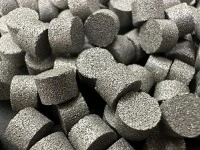

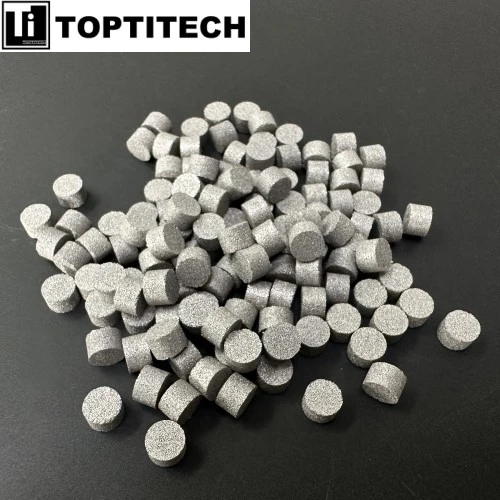
A disc under five millimetres across, barely more than a millimetre thick, is sealed into a metal cavity beside a chip. It has no interface, no power connection, no communication link. From the moment it ships it will never be measured on its own again. The day it stops working is the day the whole device is written off.
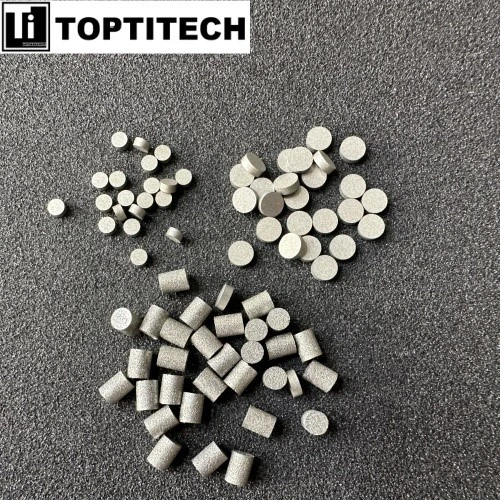
Engineers call this component a getter. Understanding why it matters starts with a counterintuitive fact: a hermetic seal is not the same thing as a vacuum.
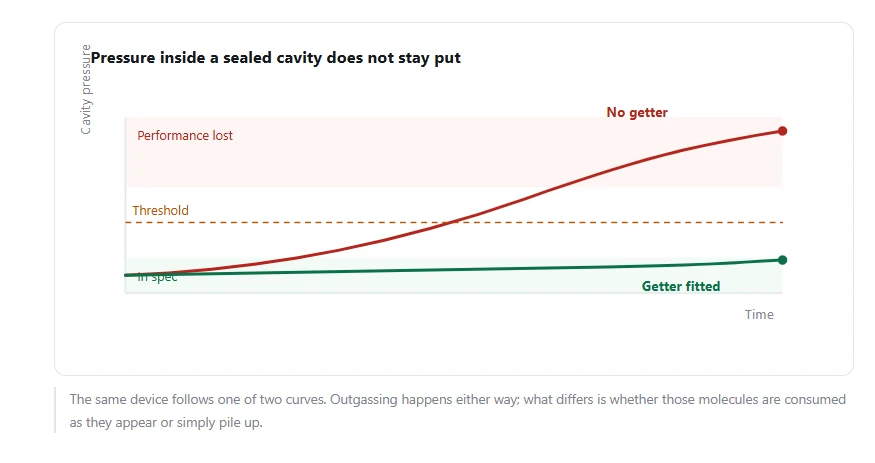
The cavity is genuinely evacuated at the moment packaging completes. From the next day onward, cavity walls, solder, adsorbed layers on chip surfaces and the metal itself all begin releasing gas slowly - moisture, hydrogen, carbon monoxide. The industry calls this outgassing. Those molecules have nowhere to go, so they accumulate. Pressure creeps upward, and device performance degrades along a curve nobody can see.
What happens when vacuum degrades
Different devices fail in different ways, but the outcome is equally terminal.
In MEMS gyroscopes and accelerometers, residual gas molecules introduce viscous damping. The vibrating structure ends up oscillating through a medium instead of moving freely in vacuum. The result is a drop in Q factor - and once quality factor falls, signal-to-noise collapses and zero-point drift increases. The positioning accuracy of an inertial navigation system ultimately rests on this number.
How large the effect is can be stated directly. Published work on wafer-level vacuum packaging reports roughly an eightyfold improvement in quality factor once a getter is integrated into the sealed resonator. On a quad-mass gyroscope in an ultra-high vacuum package, Q values reach the 2×10⁶ range - close to the device's own thermoelastic damping limit - and that vacuum is held over the long term by a passive getter inside the cavity. Across a year of observation the Q factor did not decay; it improved slightly.
In uncooled infrared detectors, gas molecules provide an additional thermal conduction path. Microbolometers form images from extremely small temperature changes, so once gas carries heat away, sensitivity is diluted. These packages generally need internal pressure held below roughly 10 mTorr for the solid-state thermal conductance to dominate instead of the gas.
In traveling-wave tubes and laser diodes, the mechanism is more direct. Oxygen and moisture attack cathode emitters and laser facets, causing cathode poisoning and facet oxidation. These failures tend to be abrupt - the device works one day and loses output power the next.
All three failure modes share one trait: they are not design defects. They are caused by what the materials slowly release over time. The answer is not to redesign the device, but to place something inside the cavity that continuously consumes those gases.
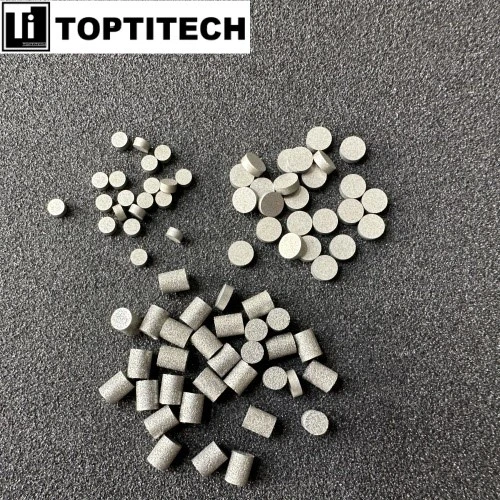
Why pure titanium can do this
Titanium is chemically aggressive. At elevated temperatures it reacts strongly with oxygen, nitrogen, carbon and hydrogen to form stable compounds. This is precisely why titanium welding demands rigid inert-gas protection, and why titanium machining is prone to oxidation - as a structural material, this reactivity is a persistent nuisance.
A getter turns that liability into the function itself.
The key detail is that titanium rapidly forms an oxide passivation layer in air, which seals off its reactivity. In vacuum, however, heating to a sufficient temperature causes that surface oxide to diffuse inward into the metal, re-exposing a clean, highly active titanium surface. The process is called activation. An activated getter behaves like a chemical sponge, capturing reactive gas molecules in the cavity with high efficiency.
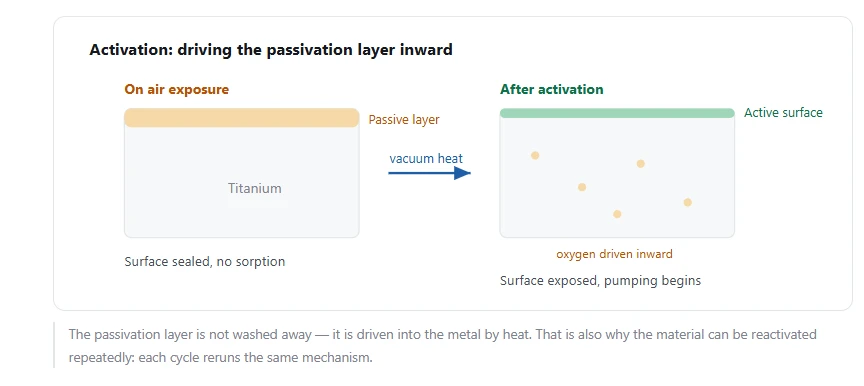
This is the dividing line between a non-evaporable getter (NEG) and an evaporable one.
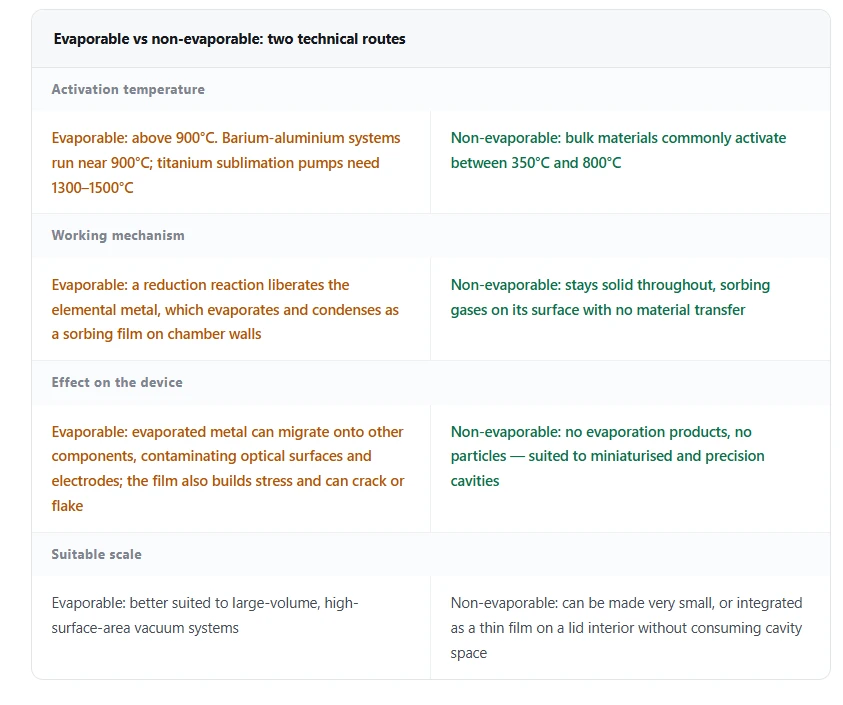
One clarification on temperature is worth making here. The frequently quoted figure of activation "as low as 180°C" refers to thin-film getters such as Ti-Zr-V, where a nanocrystalline structure shortens the diffusion path. Bulk sintered titanium does not sit in that range; its typical activation window is about 400–800°C. For MEMS devices whose cavity volumes are measured in cubic millimetres, the choice is effectively made for you: non-evaporable only.
How a getter works, in four steps
Packaging - it enters with a passivating shell
Exposed to air, the getter spontaneously grows a protective layer of oxides, nitrides and carbides. That layer keeps it inert through assembly, shipping and reflow soldering, preventing irreversible reaction with atmosphere. It also means the part ships inactive, with its capacity still untapped.
01
Activation - the passivation layer diffuses inward
Once sealed, the getter is heated to its activation temperature in vacuum or an inert atmosphere. Surface oxide diffuses into the metal bulk, exposing a clean and highly active surface. The step is reversible, and documented systems tolerate well over a hundred reactivation cycles - so a device can restart its pumping capability more than once over its service life.
02
Capture - chemical bonding, not physical adsorption
The active surface reacts chemically with gas molecules to form stable compounds rather than merely trapping them. Oxygen, nitrogen and carbon monoxide form extremely strong bonds with titanium and will not be released even at high temperature. This irreversible sorption eliminates any risk of secondary contamination.
03
Sustained operation - hydrogen follows a different path
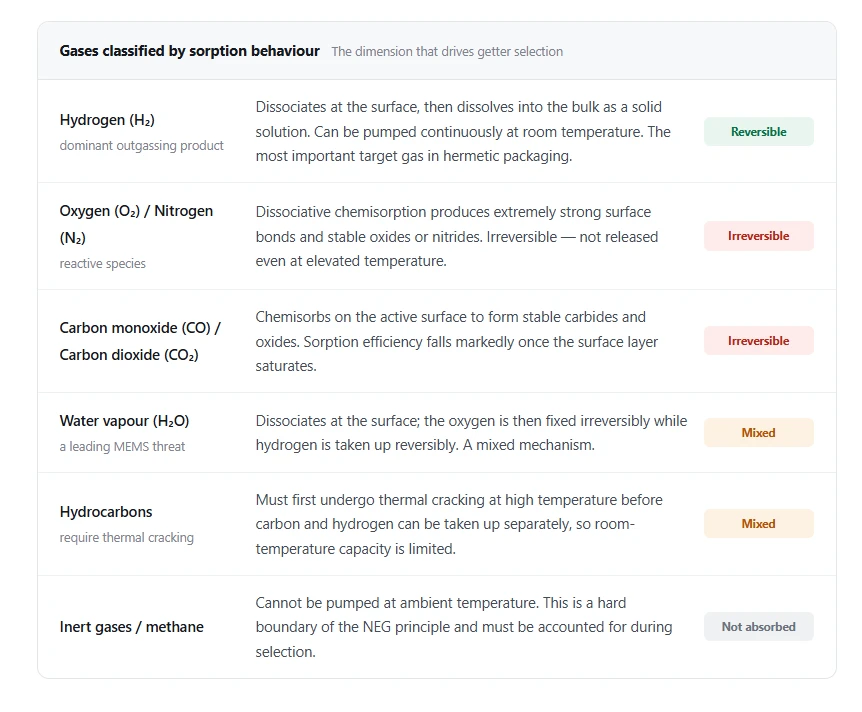
Hydrogen is the exception. It dissociates at the surface first, then diffuses into the bulk to form a solid solution, which makes its sorption reversible. That allows continuous hydrogen pumping at room temperature - and hydrogen happens to be the dominant outgassing product in hermetic packages. Once sorption reaches thermodynamic equilibrium, the relationship between hydrogen concentration, partial pressure and getter temperature follows Sievert's Law.
04
Not every gas can be absorbed
This point is frequently misunderstood: a getter is not a universal pump. Its capability varies widely across gas species, and it does not handle inert gases at all.
Why powder metallurgy beats a solid block here
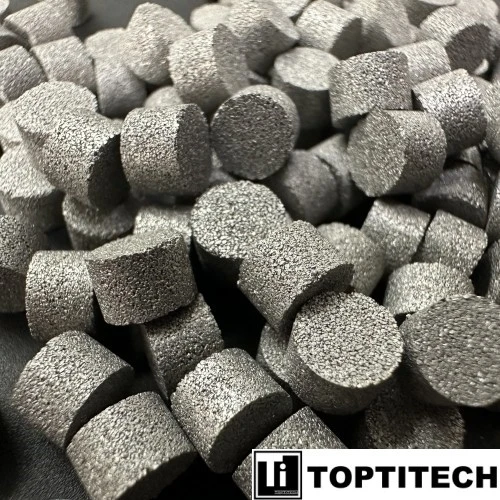
A getter's core performance metrics are sorption capacity and pumping speed, and both depend directly on usable surface area. That determines the manufacturing route: pure titanium powder is pressed and then vacuum sintered at high temperature to produce a porous structure.
Porosity is typically controlled in the 30 to 40 percent range. The resulting advantages build on one another:
30–40%
Typical porosity
100%
Pure titanium, no binder
Monolithic
Vacuum-sintered diffusion bond
10 μm order
Typical pore size
Surface area first. Porosity opens up the interior into a large network of interconnected micro-channels, multiplying effective surface area and packing far more working interface into the same envelope.
Then hydrogen pathways. Hydrogen must diffuse into the bulk. A porous matrix provides high-diffusivity routes so hydrogen can be absorbed and stored safely, avoiding the local concentration spikes that push the material toward embrittlement.
Structural integrity. Vacuum sintering creates a monolithic diffusion bond rather than bonded particles, so the part withstands mechanical shock and vibration and will not fracture into particles even after full saturation - which matters enormously when it sits beside optical surfaces and chips.
Cleanliness. Being 100 percent pure titanium with no binder, the material has very low outgassing and low vapour pressure. The organic residues that binder-based routes can leave behind simply are not present.
Where it is actually used
MEMS inertial devices
Gyroscopes and accelerometers need high vacuum to reduce gas damping and preserve Q factor. Insufficient vacuum shows up directly as increased zero-point drift, affecting inertial navigation accuracy.
Uncooled infrared detectors
Microbolometers image through minute temperature change. Residual gas creates thermal conduction losses that dilute sensitivity, so long-term vacuum stability is critical.
Traveling-wave tubes
In satellite communications and radar amplifiers, the getter continuously sorbs residual gas to prevent cathode poisoning, sustaining stable emission and extending service life.
Laser diode packaging
Inside hermetic packages, it absorbs moisture and corrosive species, slowing facet oxidation and the formation of dark line defects that degrade output stability in fibre optic and data centre transceivers.
Analytical instruments and accelerators
Acting as a compact distributed pump in portable mass spectrometers, electron microscopes and particle accelerator beamlines, managing hydrogen and process gases locally to sustain ultra-high vacuum.
Atomic clocks and resonators
Suppressing internal outgassing noise in precision frequency devices, reducing drift and extending long-term stability over years of service.
The limits deserve equal billing
Inert gases cannot be pumped. Helium, neon, argon and methane are entirely unresponsive at ambient temperature. If a cavity has an inert gas background, the getter cannot help - this is a boundary set by the physics.
Capacity has a ceiling. It is a battery, not a generator. Once surface sites saturate, efficiency drops sharply. Design must therefore account for cavity volume, outgassing rate and expected lifetime, not simply pick a part by size.
Hydrogen has a defined embrittlement threshold. Dissolved hydrogen cannot accumulate without limit. Zirconium-based alloys embrittle around 20 Torr·L/g, and practice is to operate at no more than about half that figure. Because hydrogen keeps accumulating in service, the capacity calculation belongs in the design phase, and periodic regeneration is needed to release it. Left unmanaged, the lattice expansion turns the material to powder - which makes the getter itself the contamination source.
Activation is mandatory, not optional. An unactivated getter has zero function. The packaging process must include a defined activation step - laser or resistive heating - and that requirement has to be aligned at design stage, not discovered during production.
One fact that tends to get overlooked
Within a device bill of materials, a getter sits in the lowest price bracket. Its failure mode, though, is unusual: it does not break a device, it quietly makes it worse. And because it can never be inspected independently once sealed, a failure costs far more to remedy than the part itself.
That is why more design teams now treat it as a design element requiring early involvement rather than a component sourced at the procurement stage. Cavity volume, target lifetime, outgassing rate, activation method and mounting position are all coupled. The earlier these enter the design process, the more room and process margin are available.
Seen that way, a titanium disc under five millimetres across tests not the material itself, but the engineering completeness of the entire product definition phase.