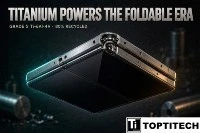

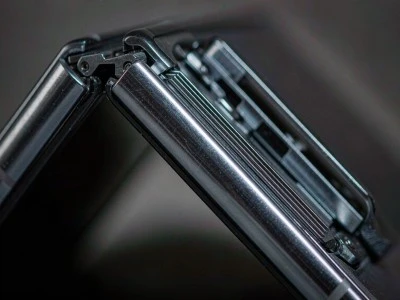
Nearly September, a premium folding phone went on sale at around $2,000. The detail worth studying was not the display or the chip inside it. It was a hinge cover less than two centimetres across, formed in a single operation from 100% recycled titanium using metal additive manufacturing.
The part is small enough to disappear inside a bill of materials. It also marks the first time titanium has been placed at the most mechanically demanding point of a mainstream consumer device.

Three waves: how titanium reached the phone's most loaded joint
Titanium is not a new material. Its adoption in consumer hardware has moved in stages, and each stage asked something different of it.
Watch cases
- solving for weight and skin contact
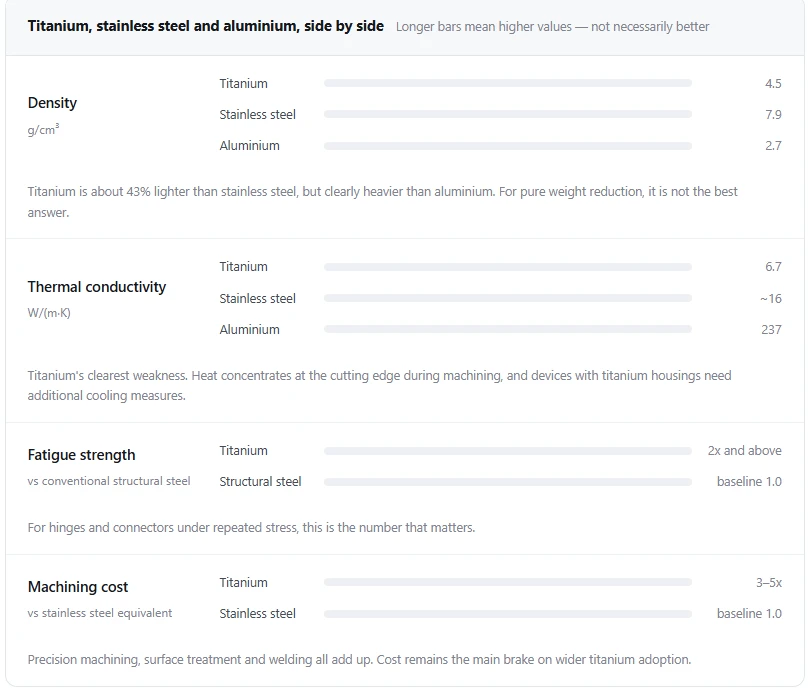
Wearables are unusually weight-sensitive. A watch sits on a wrist for the better part of sixteen hours, and twenty extra grams is noticeable. Titanium has a density of roughly 4.5 g/cm³, about 43% lighter than stainless steel, with tensile strength approaching 1.5 times that of steel. It is also skin-friendly, avoiding the contact sensitivity that nickel-bearing alloys can trigger. Over the past two years, titanium cases have moved through several consecutive generations on flagship smartwatches - the strongest evidence a material can receive.
Phone frames - solving for feel
Flagship handsets adopted titanium rails for grip and differentiation. The push did not hold everywhere, and some models returned to aluminium in later generations. The reason is straightforward: a frame is a large, geometrically simple part, and titanium's machining cost and poor thermal conductivity are hard to justify at that scale.
Hinges and load-bearing internals
- solving for survival
Hinges, hinge covers and structural ribs carry the most complex load paths in a folding phone, have the least room to work with, and fail most expensively. Titanium's value here has nothing to do with appearance or weight. It is about whether the part holds up under repeated stress.
What a hinge has to survive
A folding phone is expected to complete more than 200,000 open-and-close cycles. At a hundred folds a day, that covers more than five years of heavy use.
Every cycle produces small relative movement and friction between the pins, gears and support plates inside the hinge. Engineers call this fretting wear. Unlike ordinary sliding friction, it begins as micro-cracks at the surface, which then grow under repeated stress until the structure fails.
Titanium's resistance to fretting fatigue is the main reason it can hold this position. Published test data puts titanium's fatigue strength at more than twice that of conventional structural steel. When a component is built as a single additively manufactured piece rather than an assembly, fatigue life improves by roughly 1.5 times while assembly joints fall by about 70% - and fewer joints means fewer places for a failure to begin.
Space is the other hard constraint. Unfolded thickness on current flagship designs has been driven down to around 4.5 mm, and every part inside the hinge has to be thin and reliable at the same time. At that scale, the list of workable materials is short.
Why these parts are almost always 3D printed
Titanium carries an unavoidable weakness: thermal conductivity of about 6.7 W/(m·K), against roughly 237 W/(m·K) for aluminium - more than a thirtyfold gap. In cutting operations, heat concentrates at the tool edge with nowhere to go, and tools wear out quickly. Combined with titanium's chemical reactivity, conventional CNC machining of these components means low efficiency, heavy tool consumption and yield problems.
Hinge interiors are also a textbook case of complex geometry: lattice structures, reinforcement ribs, non-standard channels. Produce each feature in a separate operation and assemble afterwards, and both cost and cumulative tolerance error run past the point of viability.
Laser powder bed fusion fits the problem directly. Complex structures form in one operation, assembly steps disappear, and material waste drops sharply. Titanium feedstock is expensive, so every gram that near-net-shape forming saves is real money.

The trade-off is yield. For precision hinge components, trial production yields have at times fallen below 50%. Lifting them depends on the whole chain working together - powder particle size distribution, recoating uniformity, laser parameters and post-processing. A drift in any one of them shows up in the final pass rate.
Three pressure points on the material supply chain
When consumer electronics scales up, powder producers feel it first.
01
Narrower particle size
Small, thin-walled parts need fine spherical powder between 15 and 53 micrometres. That band demands tighter sphericity, flowability and oxygen control - excess oxygen directly reduces ductility.
02
Recycled titanium loop
The hinge cover is made from 100% recycled titanium, and the significance goes past sustainability language. Titanium smelting is expensive. Turning machining scrap and rejected parts back into qualified powder opens a second door on the raw material side.
03
Batch consistency
Moving from million-unit to ten-million-unit volumes changes the question from "can it be made" to "does unit 1,000,000 match unit one". Powder batch stability becomes a hard qualification threshold.

The limits are real
Describing titanium as a universal material would be misleading. Its constraints in consumer electronics are just as clear as its advantages:
Heat dissipation is a genuine problem.
Thermal conductivity sits far below aluminium, so device interiors need additional cooling structures to compensate - in a space that is already tight.
Cost runs several times higher.
Titanium components can cost three to five times their stainless steel equivalents, across precision machining, surface treatment and welding. Early yield shortfalls push unit cost up further.
Not every part justifies it.
In mid-range devices, aluminium remains the better balance of cost and performance. Titanium makes sense under specific operating conditions - it solves a "must survive" problem, not a "should look premium" one.
Zooming out: titanium applications moving on the same timeline
Phones are one slice of the picture. Line up the past month of industry developments, and aerospace, marine, energy and medical applications are all advancing in parallel.
| Application | Recent development |
|---|---|
| Aero engines | 700°C-class high-temperature titanium powder has completed validation on large-format components for blades, casings and blisks, offering a partial substitute for certain superalloys. |
| Deep-sea equipment | Titanium pressure hulls for crewed submersibles and deep-sea station structures continue to scale. Titanium now holds more than 60% share in deep-sea equipment materials. |
| Hydrogen storage | Titanium resists hydrogen permeation better than stainless steel or aluminium, suited to high-pressure storage vessels and refuelling station piping. Still at bench-validation stage. |
| Low-altitude aviation | Ultralight eVTOL designs use 3D-printed titanium structures and folding-wing hinges, bringing total airframe weight into the 110 kg class, now entering airworthiness testing. |
| Medical implants | 3D-printed porous titanium implants have an elastic modulus close to human bone, reducing stress shielding. Custom implant lead times have dropped from weeks to days. |
| Architectural cladding | Landmark buildings are adopting titanium roofing and curtain wall systems with a design life beyond 100 years. China's architectural titanium demand has grown at over 25% annually for three years. |
Frequently Asked Questions
Why is titanium used in foldable phone hinges?
+
-
A hinge must survive more than 200,000 open-and-close cycles without developing cracks. Titanium's fatigue strength is more than twice that of conventional structural steel, and it resists fretting wear - the surface-level damage that starts micro-cracks where hinge parts rub against each other.
Why can't titanium hinge parts be machined conventionally?
+
-
Titanium's thermal conductivity is about 6.7 W/(m·K) against 237 W/(m·K) for aluminium. During cutting, heat concentrates at the tool edge and wear accelerates. Hinge interiors also use lattice and rib structures that would require multiple machining steps plus assembly if produced the traditional way.
What particle size titanium powder do consumer electronics need?
+
-
Small, thin-walled components call for fine spherical titanium powder in the 15 to 53 micrometre range, with tighter control of sphericity, flowability and oxygen content than general industrial grades.
Does titanium conduct heat worse than aluminium?
+
-
Yes. Titanium's thermal conductivity is roughly 6.7 W/(m·K), compared with about 237 W/(m·K) for aluminium - more than a thirtyfold difference. Devices with titanium housings usually need additional internal cooling measures.
The real significance of consumer electronics for titanium is not tonnage. Per-device use is genuinely small.
It is the order of magnitude. Phones ship in tens of millions. Once a component is proven, titanium's procurement base, powder capacity and quality standards get pulled to an entirely different scale. Scale brings cost down. Lower cost is what makes the material affordable for aerospace, marine and energy applications too.
Whether that cycle turns depends on how fast yields climb and powder costs fall over the next year.