

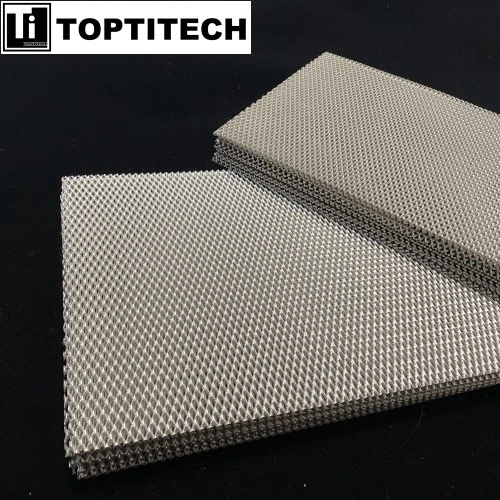
Titanium expanded mesh has seen decades of use in aerospace and marine engineering, typically in roles that draw little public attention. Titanium expanded mesh is now used in green hydrogen production. As PEM water electrolysis scales up, the mesh serves inside electrolyzers to conduct electricity, distribute gases and liquids, and provide mechanical support. In effect, it acts as a structural and electrochemical backbone of the cell. This transition not only broadens the application landscape for titanium but also supports reductions in the production cost of clean hydrogen.

Stretching metal with minimal material loss
The manufacturing process begins with a solid sheet or foil of pure titanium. Precision stamping, then stretching - the outcome is an open mesh. The openings are diamond-shaped. Unlike punched plate or woven wire cloth, the stretching method uses nearly all of the original material. A single square meter of titanium sheet can be processed into approximately three to four square meters of mesh, resulting in a substantially lower titanium requirement per unit area. For a metal often considered costly, this efficiency makes titanium economically practical for applications that require large coverage areas.
But the real advantage is structural. Woven meshes rely on individual wires touching each other. In acidic baths, oxides build up at the contact points, causing resistance heat and voltage drops. That leads to ohmic losses you can't ignore. Expanded mesh avoids this entirely because it's one continuous piece. Current flows evenly across every strand-no dead zones, no hot spots. For electrochemistry, that difference can determine whether a system delivers top performance or fails early.

Where titanium mesh shines: PEM electrolyzers
A major challenge in PEM water electrolysis arises from the anode environment. Under highly acidic and oxidizing operating conditions, conventional carbon-based gas diffusion layers exhibit limited chemical stability. Continuous exposure to this environment promotes carbon corrosion, leading to progressive oxidation of the carbon matrix and the formation of CO₂. That eats away the material, causes compression failure, and drives up resistance. The result? A sharp drop in performance.
Titanium mesh fixes that. A passive oxide layer on titanium confers resistance to acidic and alkaline electrolytes. In the harsh environment of a PEM electrolyzer, it's irreplaceable. As the porous transport layer (PTL) or GDL on the anode side, its 3D open structure allows efficient gas-liquid diffusion, heat management, and uniform current distribution.
0.05mm ultra-thin mesh
for PEM electrolyzers needing strong acid resistance.
1–2mm thick mesh
for alkaline electrolyzers.
TC4 titanium alloy mesh
handles high-temperature operation up to 120°C.

A proven track record-from chlor-alkali to hydrogen
Titanium mesh isn't new to electrochemistry. Before the recent growth in hydrogen production, titanium anodes had already seen extensive use in chlor-alkali plants, diaphragm caustic soda production, chlorate manufacturing, and seawater electrolysis for chlorine. In chlor-alkali applications, titanium anodes typically operate for more than six years at stable current densities around 17 A/dm². Extending this technology to hydrogen electrolysis is a gradual evolution of an established practice, not a fundamental departure.

Manufacturing response to rising electrolysis demand
As carbon neutrality goals advance, demand for water electrolysis has grown substantially. A number of precision mesh manufacturers and titanium processing companies in China have redirected part of their production toward this application.Available thicknesses range from 0.05 mm ultra-thin titanium mesh to TC4 alloy mesh for high-temperature applications. Product types include woven, punched, and expanded forms. Several suppliers presented diamond-shaped electrode mesh series for AEM and PEM electrolyzers at the 2026 Guangzhou International Hydrogen Technology Expo. That's a clear sign: titanium expanded mesh has entered the fast lane of industrialization for green hydrogen equipment.
Applications of this material span seawater treatment, chlor-alkali production, electroplating anodes, and chemical filtration. Owing to its high resistance to seawater and various oxidizing or acidic media, including wet chlorine, hypochlorite, nitric acid, and organic acids, it demonstrates enhanced durability compared with stainless steel and many traditional metallic materials. In such environments, its service life exceeds that of stainless steel and other conventional metals. In these environments, this material lasts longer than stainless steel and other conventional metals. A titanium mesh filter basket used for seawater intake can have a design life of 60 years. No other metal comes close. That's why titanium mesh is becoming the go-to material for marine equipment, shipbuilding, and even direct seawater electrolysis.

Cost trends: from high-cost specialty to economically viable material
The takeaway? A material once reserved for aerospace is now proving its economic value in everyday clean-tech applications. As PEM and AEM electrolyzer technologies mature, and as titanium processing continues to improve, titanium mesh will only become more cost-competitive.
For companies in the green hydrogen supply chain, choosing the right titanium mesh isn't just a materials decision. Selection involves balancing system efficiency, service life, and cost. Key criteria include:
Strand width and mesh opening size match your gas diffusion needs.
Surface coatings, including platinum and iridium–tantalum formulations, exhibit adhesion strengths exceeding 15 MPa while maintaining consistent coating distribution across the substrate.

Titanium expanded mesh was initially developed for aerospace and rocket propulsion applications. Now it's fueling the green hydrogen revolution. And the story isn't over. The next big application might be right in your hands-in the battery current collectors of electric vehicles. When that happens, titanium mesh will prove once again that real material innovation isn't about replacing one thing with another. It's about offering the best answer to the challenges of our time.