
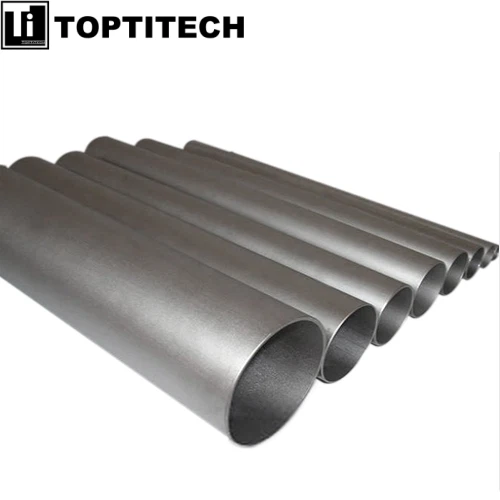
 In 1965, Harvey Aluminum Company of the United States constructed a seawater desalination plant in the Virgin Islands. The heat transfer pipes used in the plant were all seamless titanium tubes with a wall thickness of 0.7mm. The total length of the tubes was 1.85 million meters, weighing approximately 24 tons. The plant had a daily capacity of processing 1.84 million cubic meters of seawater.
In 1967, Matsushima Carbon Mine Co., Ltd. in Japan completed a 2650t/d seawater desalination facility. Due to corrosion caused by bromine (Br) in seawater, copper alloys could not be used for the heat transfer tubes and tube plates of the ventilation condenser and jet compressors. Titanium was used instead, and no corrosion-related failures occurred.
Freshwater accounts for approximately 3% of the Earth's water resources. Obtaining water resources through seawater desalination is a new trend, especially in water-stressed regions like the Middle East. Seawater desalination to obtain freshwater has been practiced since the 1950s. By 1979, 1468 seawater desalination facilities were built worldwide, and by 1993, 9014 facilities were constructed in 5738 locations globally. In 2004, approximately 15,000 seawater desalination facilities were under construction worldwide.
The main methods of seawater desalination are as follows:
Evaporation methods: single-stage flash distillation, multiple-stage flash distillation, vertical multiple-effect distillation, horizontal multiple-effect distillation, submerged tube distillation, and vapor compression.
Membrane methods: electrodialysis, reverse osmosis.
Hybrid methods.
Among these, the most widely used method is evaporation, followed by reverse osmosis, while electrodialysis is less commonly used.
Application of Titanium in Marine Civil Engineering
The main challenge faced by marine construction is severe corrosion from seawater and salt particles. Titanium materials are preferred in marine construction due to their excellent corrosion resistance. In the field of marine construction, titanium has three main applications:
Corrosion protection for steel structural components.
Corrosion-resistant structural components.
Corrosion protection for concrete structural components.
Titanium materials have become the preferred choice for marine structures, serving two purposes: using titanium sheets to cover susceptible corrosion areas and employing titanium-steel composite panels for corrosive parts of marine structures.