
Sintered metal porous materials are widely used in various applications such as filtration, separation, and catalysis due to their unique properties and performance. These materials are made by compacting metal powders into a desired shape, followed by sintering at high temperatures to bond the particles together. The resulting structure consists of a network of interconnected pores that allow for the passage of fluids or gases while retaining particles or molecules of a certain size. In this article, we will discuss the filtration mechanism of sintered metal porous materials.
Mechanism of Filtration
The filtration mechanism of sintered metal porous materials can be described by several physical and chemical processes. The primary mechanism is based on the size exclusion principle, where particles or molecules larger than the pore size are retained while smaller ones pass through. The pore size distribution and geometry of the sintered metal porous material play a crucial role in determining the filtration performance. Generally, smaller pore sizes result in higher retention efficiency but lower flow rates, while larger pore sizes result in lower retention efficiency but higher flow rates.

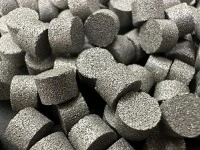
Titanium sintered filter elements

Metal sintered porous filtration cartridge
Another important mechanism is surface capture, where particles or molecules are captured on the surface of the pores due to attractive forces such as Van der Waals forces, electrostatic interactions, or chemical bonding. This mechanism is particularly relevant for particles or molecules that are smaller than the pore size but have a higher affinity for the pore surface. The surface capture mechanism can significantly improve the retention efficiency of sintered metal porous materials.
Furthermore, the tortuous path of the pore network also contributes to the filtration mechanism by increasing the residence time of particles or molecules within the porous structure. The longer residence time allows for more interactions between particles or molecules and the pore surface, which enhances the retention efficiency.
Application of Sintered Metal Porous Materials
Sintered metal porous materials are widely used in various applications such as:
Filtration of liquids and gases in the chemical, petrochemical, and pharmaceutical industries
Separation of solid-liquid or liquid-liquid mixtures in the food and beverage industry
Catalysis in the chemical and petrochemical industries
Heat transfer in the electronic and aerospace industries
Conclusion
In conclusion, the filtration mechanism of sintered metal porous materials is based on the size exclusion principle, surface capture, and tortuous path. These mechanisms are influenced by the pore size distribution, geometry, and surface properties of the sintered metal porous material. Understanding the filtration mechanism is crucial for designing and optimizing the performance of sintered metal porous materials for various applications.