
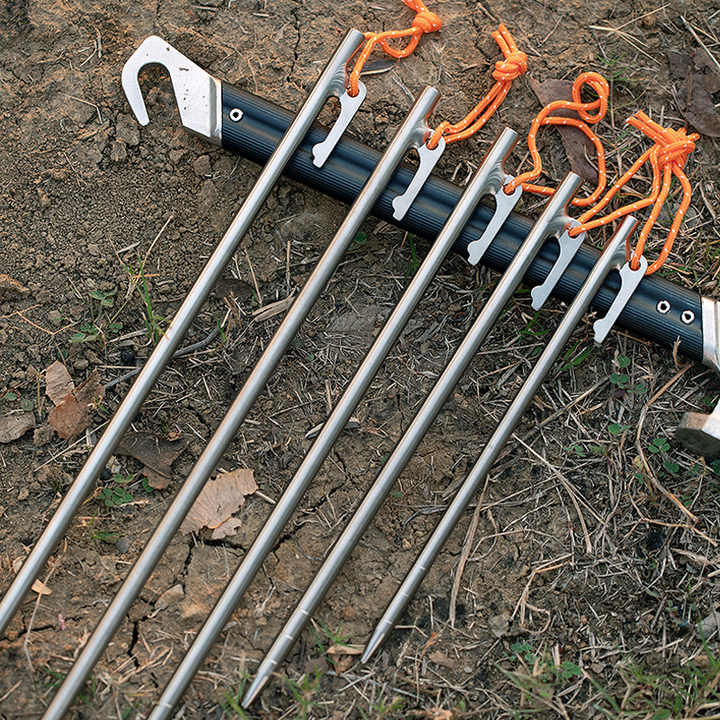
Modern camping equipment demands materials that balance structural integrity with environmental adaptability. Titanium alloy tent stakes exemplify this equilibrium through advanced metallurgical properties.
Here are five technical advantages defining their superiority:
Optimized Strength-to-Weight Ratio
Beta-phase titanium alloys achieve tensile strengths exceeding 480MPa while maintaining densities 40% lower than stainless steel. This enables load-bearing capacities above 150kg with stake weights under 15g, critical for ultralight backpacking systems.
Oxidation Resistance
Native titanium dioxide passivation layers provide pH stability across 2-13 ranges, eliminating galvanic corrosion in saline or acidic soils. Surface hardness exceeding 350HV minimizes abrasion wear during repeated insertion cycles.
Thermal Stability
Linear thermal expansion coefficients of 8.6×10⁻⁶/℃ ensure dimensional retention across -50°C to 300°C operational ranges. Cryogenic embrittlement thresholds remain below -150°C, outperforming aluminum alloys in alpine conditions.
Fatigue Resistance
Work-hardened Ti-6Al-4V variants demonstrate 10⁷ cycle endurance limits at 75% of ultimate tensile strength, resisting deformation under dynamic wind loads. Spiral groove geometries enhance soil adhesion by 32% compared to straight-shaft designs.
Sustainable Lifecycle
Closed-loop recycling processes recover 98% of feedstock material, reducing carbon footprints by 62% versus virgin alloy production. Electropolished surfaces resist biofilm formation, extending service life beyond decade-long use.
These metallurgical characteristics position titanium stakes as optimal solutions for technical mountaineering, coastal expeditions, and long-duration thru-hikes. Their phase transformation behaviors and slip system mechanics continue to drive innovations in outdoor gear design.