
High-power lithium-ion battery packs suffer from severe thermal challenges under fast charging and continuous high C-rate discharge. Rapid heat generation creates local hotspots, widens inter-cell temperature deviation, accelerates calendar ageing and raises thermal runaway hazards. Conventional active cooling solutions including liquid cold plates and forced air systems deliver reliable temperature control, yet they bring extra parasitic power consumption, additional BOM cost, bulky assembly and more potential failure points.
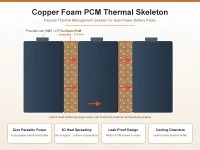
Phase change material (PCM) provides a promising passive alternative. It absorbs excess heat through latent heat during melting and releases stored heat when solidifying, requiring no running power. However, raw PCM has extremely low intrinsic thermal conductivity. Under intense peak heat flux, only the PCM layer adjacent to cell surfaces participates in heat buffering, while most of the bulk PCM remains inactive. This fundamental thermal bottleneck limits its practical adoption in high-power battery systems. Open-cell copper foam addresses this weakness by serving as a three-dimensional thermal skeleton embedded within the PCM matrix. The interconnected high-conductivity copper ligament network rapidly spreads heat across the full PCM volume, homogenises temperature distribution, and physically locks molten PCM inside pores to prevent leakage.
This article breaks down how copper foam parameters (PPI, porosity, thickness, purity) interact with PCM selection, identifies working boundaries for passive BTMS.
1. Core Working Principle
The copper foam-PCM composite separates two independent but coupled functions. The PCM acts as thermal energy storage medium, maintaining a stable temperature plateau around its melting point via latent heat exchange. The copper foam skeleton establishes continuous high-speed thermal conduction pathways, expands the effective heat transfer area and eliminates localised thermal stagnation zones.
Unlike graphite powder or flake fillers which only improve bulk conductivity partially, open-cell copper foam forms a fully percolated 3D conduction network. This volumetric heat spreading capability is particularly valuable for dense prismatic cell stacks and tightly packed cylindrical battery modules where hotspots easily develop between cells.
2. Key Copper Foam Parameter Matching for Battery PCM Skeletons
PPI (Pores Per Inch)
PPI defines pore size and ligament density of the porous structure, directly regulating heat transfer speed and available void space for PCM infiltration.
10–30 PPI coarse foam features large open cavities and low tortuosity. It prioritises maximum PCM loading and total latent heat capacity, suitable for stationary energy storage systems with moderate and steady heat generation. Its drawback is fewer thermal junctions, leading to slower hotspot dissipation.
40–70 PPI medium foam is the widely recognised sweet spot for most high-power fast-charging battery packs. It balances dense thermal ligaments for rapid heat spreading and sufficient pore volume to hold large amounts of PCM. This specification is heavily validated for NMC and LFP modules with regular fast-charging cycles.
80–110 PPI fine foam has an intricate dense ligament network and ultra-high internal surface area. It responds extremely fast to transient heat pulses and delivers exceptional temperature uniformity. The trade-off is reduced pore fraction, which lowers total latent heat per unit volume. It is recommended for pulse-heavy applications such as power equipment and hybrid battery-supercapacitor systems.

Porosity
Porosity represents the void fraction of copper foam and determines the maximum PCM saturation ratio. 94–96% porosity remains the preferred industrial specification. This range guarantees continuous copper conduction paths while reserving abundant void space for PCM filling. Ligaments maintain mechanical integrity after thousands of repeated melt-freeze thermal cycles without fracture or contact degradation.
Foam above 97% porosity has ultra-thin copper struts. Although it achieves higher PCM fill ratio, mechanical robustness and through-plane thermal conductivity drop significantly, with high risk of ligament breakage under thermal cycling and vibration. Foam below 92% porosity contains excessive copper by volume. The composite becomes metal-heavy, latent heat density declines, pack energy density is compromised and material cost increases unnecessarily.
Thickness, Purity and Surface Condition
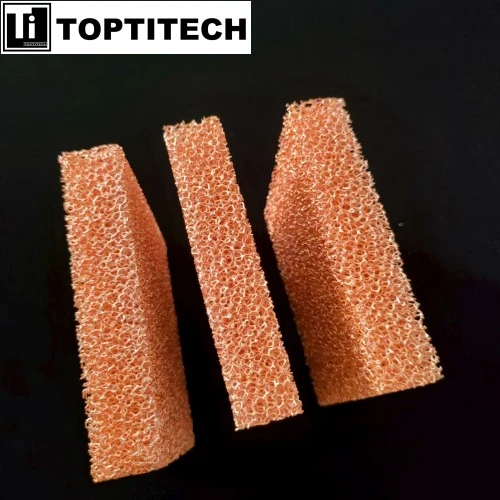
Foam sheet thickness should precisely match the interstitial gap between neighbouring cells, with typical application ranges from 2 mm to 8 mm for prismatic modules. Over-thick foam traps unactivated PCM in the central zone, while undersized foam creates insulating air gaps between foam and cell casing.
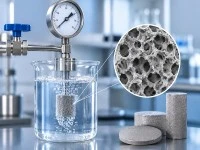
Oxygen-free high-conductivity copper with purity ≥99.9% is the standard selection. Impurities segregated along ligaments form thermal bottlenecks and accelerate oxidation. Native copper oxide layers on strut surfaces must be removed before PCM infiltration, as oxide films introduce interfacial thermal resistance and weaken heat transfer between copper and PCM. Proper surface wettability treatment is also critical to avoid trapped air pockets inside pores, which degrade composite thermal performance.
3. PCM Selection Rules to Pair with Copper Foam Skeletons
The copper foam skeleton amplifies the inherent thermal behaviour of the selected PCM rather than changing its phase-change temperature. Engineers must match the PCM melting point to the battery's optimal operating temperature window.
For mainstream NMC and LFP lithium-ion packs, the target melting point falls within 35–45 °C. For high-temperature stationary energy storage installations, blended PCM with 45–55 °C melting point is commonly adopted. Custom eutectic PCM formulations are available for low-temperature working environments.
Two frequent design pitfalls should be avoided. Choosing a PCM melting point far below the battery steady-state operating temperature leads to permanent melting and loss of temperature buffering function. A melting point set too high means the PCM will never enter the phase-change region, and the foam only works as a static heat spreader, wasting latent heat potential.
Copper foam is compatible with paraffin, fatty acids and form-stable PCM. For corrosive salt hydrate PCM, surface passivation on copper ligaments is mandatory to prevent long-term chemical corrosion.
4. System Integration: Passive or Hybrid Thermal Management
Standalone passive copper foam-PCM BTMS works reliably for battery systems with intermittent peak heat loads and adequate cooling recovery time between cycles. Typical use cases include stationary energy storage, low-speed electric vehicles and marine battery packs.
When batteries sustain continuous high heat output, such as repeated back-to-back DC fast charging and prolonged high-speed driving, the PCM will be fully melted and lose its temperature plateau effect. Under such conditions, copper foam PCM functions as a hybrid thermal buffer. The composite absorbs transient heat spikes instantly, while a secondary lightweight cooling system such as natural convection fins or simplified liquidcircuit slowly rejects accumulated heat. This hybrid scheme reduces the required cooling capacity and downsizes the active cooling subsystem.
Gradient porosity foam architecture is an advanced optimisation option. Higher copper density (lower porosity) is arranged adjacent to cell surfaces for rapid heat extraction, while higher porosity is reserved in outer zones for larger PCM storage capacity, further shortening melting duration and improving temperature consistency.
5. Common Failure Modes and Validation Checklist
Even well-specified copper foam PCM skeletons can degrade without complete validation. The core failure modes include ligament fatigue and contact loss after long-term melt-freeze cycling, poor infiltration leading to trapped air voids, copper corrosion caused by incompatible PCM chemistry, and performance deterioration under mechanical shock and vibration.
Essential validation tests cover thermal cycling ageing to track structural degradation, vibration and shock testing for vehicle-mounted packs, saturation infiltration inspection, long-term chemical compatibility verification between copper surface and PCM, and thermal runaway abuse tests. It is necessary to confirm that the copper skeleton homogenises heat safely and will not create unintended conductive paths that accelerate thermal propagation.
Closing
Passive thermal management built on copper foam PCM skeletons resolves the core limitation of neat phase change materials: slow heat diffusion and underutilised latent heat capacity. By tuning PPI, porosity, thickness and copper purity to match cell format, peak C-rate and PCM melting temperature, battery designers can develop compact, low-maintenance BTMS without continuous parasitic power draw.
Copper foam is not a generic commodity thermal filler. It is an engineered three-dimensional thermal architecture. The best-performing implementations treat the foam skeleton, PCM chemistry, and module stack geometry as one coupled thermal system instead of separate discrete components.