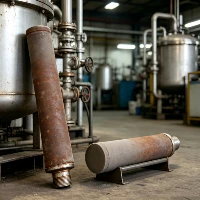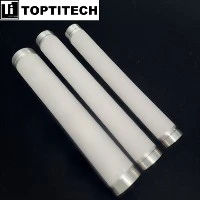

In the filtration and separation industry, "stainless steel" is often automatically equated with "never rust." However, as professionals engaged in the manufacturing of sintered metal filter elements and filter plates, we understand that stainless steel is not absolutely rust-proof, but rather "resistant to rust" under specific conditions. For porous materials like 316L stainless steel sintered powder filter elements, the large specific surface area and high surface activity make corrosion issues even more worthy of in-depth attention. This article analyzes, from a materials science perspective, the rusting mechanisms of 316L sintered filter elements, typical corrosion scenarios, and provides scientific recommendations for storage and use.
Why Does 316L Stainless Steel "Not Rust"? - The Principle of the Passive Film
 The "rust-proof" characteristic of 316L stainless steel originates from an extremely thin (a few nanometers thick) yet dense chromium-rich oxide film (passive film) on its surface. This film, primarily composed of Cr₂O₃, prevents further oxygen penetration and oxidation of the base metal, thereby imparting resistance to atmospheric oxidation and corrosion.
Compared to standard 304 stainless steel, 316L contains added molybdenum (Mo), which significantly enhances its resistance to pitting corrosion in chloride-containing environments. Its critical pitting temperature in desalinated seawater is approximately 42.7°C (without additives). This characteristic makes 316L the preferred material for sintered filter elements, particularly suitable for handling media containing salts, weak acids, or weak alkalis.
However, it must be clearly understood that the passive film is thermodynamically "metastable." When environmental conditions change or the passive film is continuously damaged, corrosion will occur.
Under What Conditions Will 316L Sintered Powder Filter Elements Rust?
The manufacturing process itself can also affect corrosion resistance. The sintering process, conducted at high temperatures (up to 0.9Tm, near the material's melting point) under vacuum conditions to achieve diffusion bonding between layers, leads to significant grain growth (diameter increasing approximately tenfold). While this somewhat reduces mechanical properties, the corrosion resistance does not change significantly. The actual causes of rusting are the following operational and storage environmental factors:
◥1. Chloride Pitting Corrosion - The Most Critical Threat
Chloride ions (Cl⁻) are the "number one enemy" of 316L stainless steel. In chloride-containing environments (e.g., seawater, brine, chlorine-based disinfectants), Cl⁻ preferentially attacks weak points in the passive film, causing localized film rupture and forming pitting corrosion pits. Studies show that in a water treatment plant environment, corrosion products on 316L contained significant amounts of ferric chloride (FeCl₃), confirming that chloride ions directly participated in the corrosion reaction. Elevated temperatures accelerate this process - the critical pitting temperature of 316L is only 42.7°C in seawater, above which the risk of pitting increases sharply.
◥2. Electrochemical Corrosion - Contact with Dissimilar Metals
When other metal dust or particles (e.g., iron or copper fines) adhere to the filter surface, a micro-galvanic cell can form in humid air, triggering electrochemical reactions that accelerate passive film breakdown. This is highly likely during processing, installation, or use of sintered filter elements.
◥3. Chemical Corrosion - Acids, Alkalis, Salts, and Organics
→Acid, alkali, or salt solutions (e.g., limewater, alkaline splashes) can directly corrode the surface, causing localized attack.
→Organic juices (e.g., fruit juice, broth) can form organic acids under humid, oxygen-rich conditions, causing long-term corrosion of the metal surface.
→Polluted atmospheres (containing sulfides, nitrogen oxides) can form sulfuric or nitric acid droplets upon contact with condensed moisture, causing chemical corrosion.
◥4. Crevice Corrosion and Under-Deposit Corrosion
Narrow crevices at support layers, connections, or contact points with equipment can trap electrolyte solutions, creating concentration cells due to oxygen gradients and initiating crevice corrosion. Additionally, solid particle deposits or biofilms on the filter surface often create localized environments conducive to corrosion.
How to Effectively Prevent Rusting of 316L Sintered Filter Elements?
1. Protective Measures During Use
→Strictly Control Chloride Concentration and Temperature: Avoid long-term use of 316L filter elements in high-temperature (>42°C), high-chloride environments. For processing hot chloride-containing fluids, consider upgrading to higher-grade alloys such as 904L or duplex stainless steel.
→Prevent Dissimilar Metal Contact: During installation and use, prevent iron, copper, or other metal dust/particles from adhering to the filter surface. Use stainless steel tools to avoid scratching the surface.
→Clean Promptly: Clean the filter element when the pressure differential exceeds 0.15 MPa or flow rate drops by more than 30%. Recommended cleaning methods:
→Physical cleaning: Backwashing (≤0.3 MPa), ultrasonic cleaning (40 kHz, neutral detergent), or soft nylon brush wiping. Never use metal brushes.
→Chemical cleaning: Soak in 5% sodium hydroxide (60°C) for 30 minutes for grease/oil removal; circulate 5% citric acid for 20 minutes for inorganic salt deposits; soak in 0.1% sodium hypochlorite for 1 hour for biofilm (316L grade only).
→Avoid strong acids: 316L can tolerate weak acids but should never be cleaned with strong acids such as concentrated sulfuric or hydrochloric acid.
→Follow Proper Sterilization Procedures: Sterilize food-grade filter elements with 121°C steam for 30 minutes. Do not spray with alcohol directly.
2. Storage and Maintenance Guidelines
→Dry Thoroughly Before Sealed Storage: After cleaning, dry completely with compressed air (humidity < 30%) before sealing in dedicated plastic bags for storage.

→Avoid Humid and Contaminated Environments: Store long-term idle filter elements in a dry, clean indoor area away from acids, alkalis, and salts.
→Regular Inspection: Visually inspect the mesh for deformation monthly, and conduct a pressure integrity test annually. Replace immediately if cracks, perforations, or persistently high pressure differentials are found after repeated cleaning.
Conclusion
316L stainless steel sintered powder filter elements are not "eternally rust-proof," but rather have an excellent corrosion-resistant service life under their designed operating conditions. Rusting occurs fundamentally when the passive film is damaged and cannot self-repair. As professional manufacturers, we strongly recommend that customers thoroughly understand their application conditions - especially temperature, chloride concentration, and media pH - and implement targeted protective measures across material selection, installation, cleaning, and storage stages. This approach maximizes the service value and lifespan of the filter elements. Scientific usage is the key to unlocking the true potential of their "stainless" capabilities.