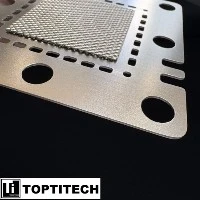

Forging is a manufacturing technique used to shape titanium materials by applying external force to a titanium billet, resulting in plastic deformation and improving performance. This process is employed in the production of mechanical parts, workpieces, tools, and blanks. Depending on the slider movement, there are two types of forging methods: vertical and horizontal movement of the slider, which is used for forging slender parts, and the use of compensation devices to enable movement in other directions. The choice of forging method affects factors such as forging force, process, material utilization, output, dimensional tolerances, lubrication, and cooling methods. Achieving automation in forging operations is dependent on these factors.
Forging can be classified based on the movement of the billet into free forging, upsetting, extrusion, die forging, closed die forging, and closed upsetting. Closed die forging and closed upsetting offer high material utilization as there is no material loss due to flying edges. These methods allow for the production of complex forgings in a single or multiple processes. The absence of flying edges reduces the force area required for forging, resulting in a lower load. However, it is crucial to avoid complete restriction of the billet. Therefore, strict control over billet volume, the relative position of the forging die, accurate measurement of forgings, and efforts to minimize forging die wear are necessary.
Based on the movement of the forging die, forging techniques can be categorized as pendulum rolling, pendulum swivel forging, roll forging, wedge cross rolling, ring rolling, and inclined rolling. Pendulum rolling, pendulum swivel forging, and ring rolling can also be used for fine forging. Roll forging and cross rolling can be employed as pre-processing methods for slender materials to enhance material utilization. Rotary forging, similar to free forging, involves partial forming and offers the advantage of requiring less forging force compared to the size of the forging. In rotary forging, including free forging, material expands from the die surface to the free surface during processing, making it challenging to maintain accuracy. Therefore, computer control of the forging die movement and rotary forging process enables the production of complex-shaped and highly accurate products with low forging forces, such as turbine blades and large-sized forgings with diverse varieties.


To achieve high accuracy, care should be taken to prevent overload at the lower dead center and control the speed and position of the die. These factors significantly impact forging tolerances, shape accuracy, and die life. Additionally, measures such as adjusting slide guide clearance, ensuring rigidity, adjusting the lower dead point, and utilizing subsidized transmission devices should be implemented to maintain accuracy.
Titanium forging materials primarily consist of pure titanium and titanium alloys with various compositions. These materials exist in the form of bars, ingots, metal powder, or liquid metal. The forging ratio, which refers to the ratio of the cross-sectional area before deformation to that after deformation, plays a crucial role in attaining product quality and cost reduction. Round or square bars are commonly used as billets for small and medium-sized forgings. Bars offer uniform and excellent grain organization, mechanical properties, accurate shape and size, and good surface quality, facilitating mass production. By controlling the heating temperature and deformation conditions, it is possible to forge high-performance forgings without requiring extensive deformation.
Contact:
If you have any questions, please feel free to contact us. Working hours: 8:30 a.m. to 17:30 p.m.
E-mail: zhangjixia@bjygti.com