
Sintered filter elements can be classified based on the material used and their functional division.
Material Classification
a) Metal Sintered Filter Elements: These include sintered mesh filters and sintered felt filters primarily made of stainless steel. There are also specialized metal sintered filters such as titanium rod sintered filter elements and Monel sintered filter elements.

b) Non-metallic Sintered Filter Elements: These encompass activated carbon sintered filters made of activated carbon material, powder sintered filter elements, copper powder sintered filter elements made of metal powder, and polymer-based PE sintered filter elements.
Functional Division
a) Surface Filter Sintered Filter Elements: Surface filter sintered elements are exemplified by sintered mesh filter elements. They rely on sintered mesh for surface filtration.
b) Deep Filter Sintered Filter Elements: Deep filter sintered elements utilize fibers, particles, or powders for filtration. Examples include copper powder sintered filter elements, activated carbon sintered filter elements, and sintered felt filter elements.
The process of sintering involves heating and compacting a metal substance until it becomes a high-purity metal. In nature, metals are typically found as compounds consisting of multiple elements. For industrial purposes, ores that can be directly smelted are becoming scarce, necessitating the use of lower-grade ores. These ores are crushed, ground, and refined to produce a suitable feedstock. The resulting mineral powder is then sintered to purify and transform it into a usable form.
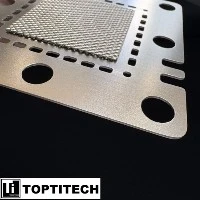
Toptitech specializes in producing sintered mesh filter elements, which offer the following characteristics:
Wide range of filtration precision: Stable filtration performance across a range of 1μm to 100μm.
Stable filtration precision: The filter layer maintains its shape and integrity due to the protection provided by the upper and lower layers of wire mesh and the solidification process during sintering.
High strength: The support of additional layers ensures high-pressure resistance and mechanical strength.
Easy to clean: Surface filter material allows for easy cleaning, including backwashing.
Corrosion-resistant: Utilizing SUS316L material provides high resistance to corrosion.
Easy to process: Suitable for various processing methods such as cutting, bending, stamping, stretching, and welding.
Main connection methods include standard interfaces (e.g., 222, 220, 226), quick interface connections, threaded connections, flange connections, tie rod connections, and custom interfaces. Sintered mesh filter elements find applications in the filtration of polyester, water treatment, oil products, pharmaceuticals, food and beverages, chemicals, chemical fiber products, and high-temperature air filtration, among others.