
Titanium welding is a precise process influenced by the elemental properties present in the material. Oxygen and nitrogen, when interstitially fused within titanium, induce lattice distortion, elevating deformation resistance and hardness while diminishing ductility and toughness. Excess oxygen and nitrogen content in weld seams are detrimental and should be minimized.
Hydrogen exacerbates weld metal impact toughness reduction and lowers ductility, leading to joint brittleness. Carbon's presence in titanium, primarily in interstitial solid solution form at room temperature, enhances strength but diminishes ductility. Exceeding carbon solubility results in the formation of brittle TiC, prone to crack formation. Standards dictate a carbon limit of 0.1% in titanium and its alloys to prevent these issues.
Ensuring thorough cleaning of workpieces and welding wire is crucial to prevent carbon contamination during welding. Titanium's weldability is notable due to its low thermal conductivity, confining metal melting to the arc zone and facilitating good flowability. Its low coefficient of thermal expansion further enhances weldability.
During titanium welding, meticulous protection of the welding zone and post-weld high-temperature regions is imperative to shield against air interference. Employing 99.99% pure argon and trailing shields is essential. Mechanical machining is preferred for weld seam grooving over grinding methods. Avoidance of spot welding and application of high-frequency arc starting are recommended. Post-weld heat treatment should be minimized, with temperatures kept below 650°C if necessary.
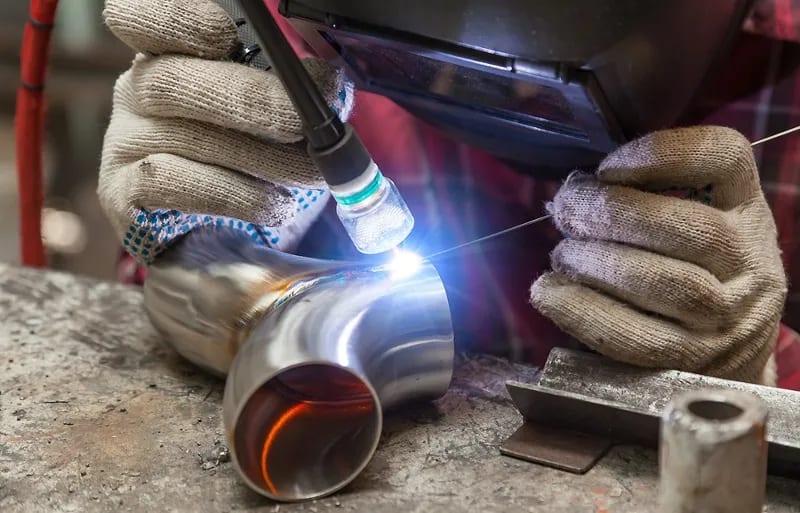
The color variation in titanium weld seams signifies oxidation levels and relates to weld quality. Ranging from silver-white (unoxidized) to gray (severely oxidized), color changes reflect reduced plasticity with increased oxidation. Deeper colors indicate higher oxidation, correlating with increased hardness and harmful substance content in welds, compromising quality.