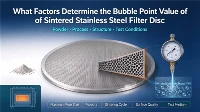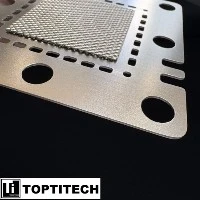

Porous metal sintered filtration components are functional filtration media manufactured through powder metallurgy or wire mesh sintering processes. They are widely employed in chemical, pharmaceutical, food, environmental protection, and new energy industries. Based on differences in substrate materials and structural designs, common product categories include titanium powder sintered filter cartridges, titanium powder sintered filter plates, and stainless steel wire mesh sintered filter cartridges. Although all three fall under the category of sintered metal filtration media, each plays a distinct technical role in practice due to variations in material properties and forming processes. A brief introduction to each type from TOPTITECH is provided below.
Titanium Powder Sintered Filter Cartridges

Titanium powder sintered filter cartridges are manufactured from high-purity titanium powder through cold isostatic pressing and high-temperature vacuum sintering, resulting in a rigid porous body with a three-dimensional interconnected pore structure. The pore architecture is uniform and precisely controllable, with filtration accuracy adjustable within the range of 0.1μm to 100μm depending on process requirements. These cartridges also exhibit outstanding corrosion resistance and excellent biocompatibility.
The key feature of these filter cartridges lies in their exceptional chemical stability. They are capable of withstanding long-term exposure to a wide range of strong acids, weak alkalis, and chloride-containing media, making them particularly suitable for applications involving chloride-induced corrosion risks. The surface of pure titanium spontaneously forms a dense oxide film, which prevents pitting or crevice corrosion even in high-potential oxidizing environments. Additionally, titanium filter cartridges offer good compressive strength and thermal shock resistance, maintaining structural integrity under significant temperature gradients without cracking or deformation.
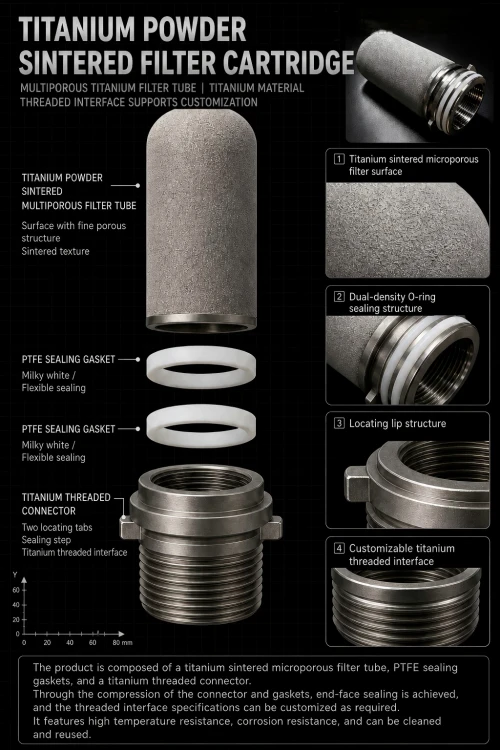
In terms of applications, titanium powder sintered filter cartridges are widely used in sterile filtration in the pharmaceutical industry, ultrapure water treatment in semiconductor manufacturing, catalyst recovery in chemical processes, and as porous transport layers in water electrolysis systems for hydrogen production. In the biomedical field, their biocompatibility enables their use as filtration components in implantable devices or as aeration elements in cell culture media.
Titanium Powder Sintered Filter Plates
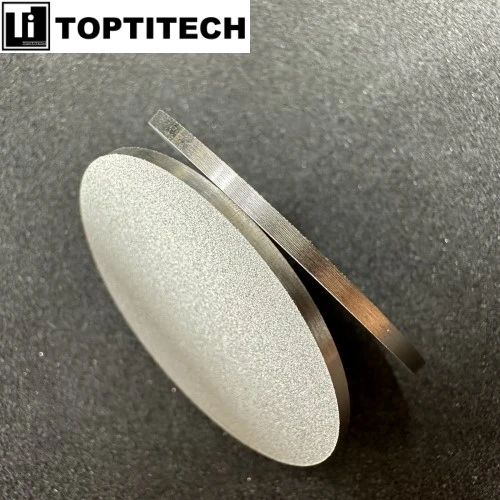
Titanium powder sintered filter plates belong to the same family of titanium-based sintered porous materials as filter cartridges but are distinguished by their plate-type geometry, which makes them suitable for high-flow, large-surface-area filtration applications. The manufacturing process similarly relies on isostatic pressing and vacuum sintering, but through different mold designs and sintering support methods, large-dimension plates with thin wall thickness and good flatness can be produced.
The primary advantage of titanium filter plates lies in their high filtration flux per unit area and excellent rigidity, which prevents bending or deformation under differential pressure. Thickness can be customized within the range of 1mm to 10mm to balance filtration accuracy and structural strength. Furthermore, the surface of these plates can be machined for subsequent drilling, slotting, or welding assembly, facilitating system integration.

In practical applications, titanium powder sintered filter plates are commonly employed in large-scale industrial filtration systems for liquid distribution and solid-liquid separation, such as leachate filtration in metallurgical processes, activated carbon retention in fine chemical production, and sludge dewatering pretreatment in environmental water treatment. In electrolyzer systems, titanium filter plates also serve as electrode supports or bubble-barrier components to optimize fluid distribution during electrolysis.
Stainless Steel Wire Mesh Sintered Filter Cartridges
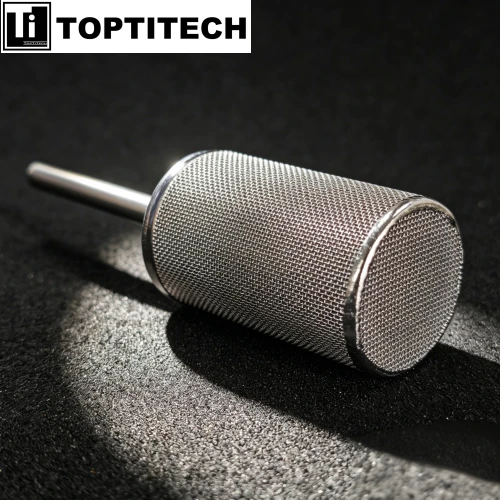
Stainless steel wire mesh sintered filter cartridges are manufactured by stacking multiple layers of stainless steel wire mesh (typically 304 or 316L grades) with varying mesh counts, followed by high-temperature vacuum sintering to form an integrated rigid filtration element. The structure consists of protective layers, filtration layers, dispersion layers, and support layers, all of which are metallurgically bonded during the sintering process without the introduction of weld points or binders.
The distinctive features of this type of filter cartridge are its high open-area ratio and low flow resistance. Because the wire mesh itself provides regular and continuous flow channels, the cartridge operates with very low pressure drop, making it particularly suitable for high-flow recirculation filtration systems. Moreover, 316L material exhibits good resistance to acidic media and organic solvents, enabling it to handle most chemical fluid processing tasks. Its rigid structure also facilitates in-situ backwashing, making maintenance straightforward and efficient.
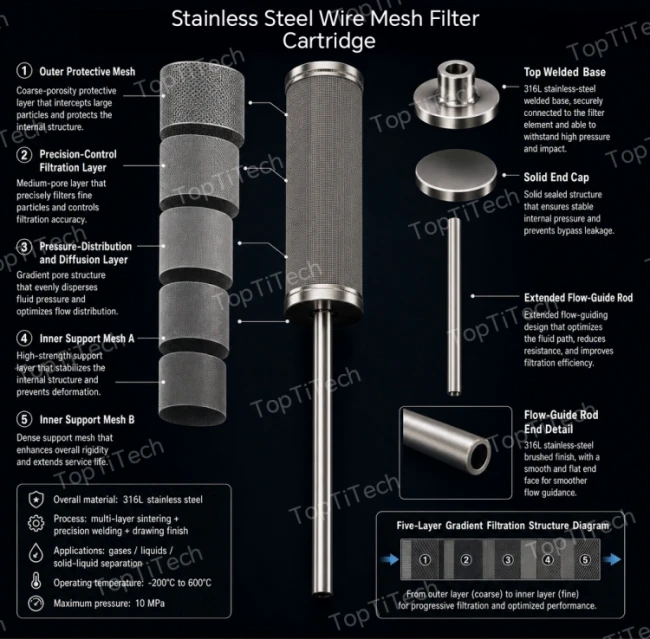
Stainless steel wire mesh sintered filter cartridges are extensively applied in polymer melt filtration within the petrochemical industry, where their excellent thermal stability and fatigue resistance allow them to withstand frequent start-stop cycles and thermal shock. Additionally, they play critical roles in fruit pulp filtration in the food and beverage industry, oil refining in hydraulic systems, and exhaust gas scrubber water treatment in marine applications.