
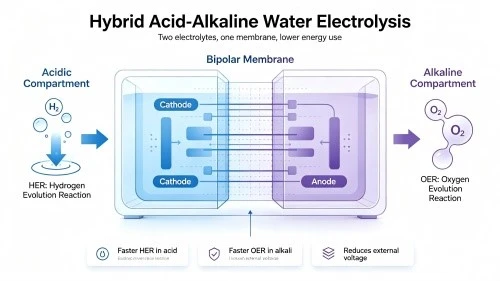
Hybrid acid-alkaline water electrolysis is a new electrochemical technology. It makes hydrogen gas from water. It works differently from traditional water electrolysis technology. Traditional electrolysis systems use only one type of electrolyte. They run with either alkaline conditions or acidic conditions inside the whole electrolysis cell. Hybrid acid-alkaline water electrolysis uses two separate electrolytes. One cell chamber holds an acidic solution. The other cell chamber holds an alkaline solution. A special membrane sits between the two chambers. This membrane stops the acid and alkali from neutralizing each other.
This special setup lets each half chemical reaction happen in its best pH condition. The hydrogen evolution reaction (HER) happens in the acidic chamber. The HER reaction runs faster in acidic liquid environments. The oxygen evolution reaction (OER) happens in the alkaline chamber. The OER reaction runs faster in alkaline liquid environments. Every chemical reaction works under favorable kinetic conditions.
The two chambers have different pH values. This difference forms a chemical potential gradient. This gradient changes the reversible hydrogen electrode potential on both electrodes. This change lowers the external voltage needed to split water molecules. The system combines chemical potential energy and electrical energy. This combination cuts down the total energy use of the process.
Key Components of the System
Bipolar Membrane (BPM). The BPM is the core part of the system. It has a cation exchange layer (CEL) and an anion exchange layer (AEL). The two layers bond together. A water dissociation catalyst stays at the joint of the two layers. The BPM produces protons and hydroxide ions under reverse-bias polarization. Protons move into the acidic chamber. Hydroxide ions move into the alkaline chamber. The BPM keeps the stable pH gradient inside the electrolysis cell.
Electrodes. The anode is placed in the alkaline chamber. The anode supports the OER reaction. Nickel-based materials are the common base material for anodes. Nickel woven mesh is a reliable platform for electrode work. The cathode is placed in the acidic chamber. The cathode supports the HER reaction. Bifunctional electrocatalysts can drive both HER and OER reactions. Cobalt-nickel phosphide nanowire electrodes have this bifunctional performance.
Performance Advantages
Many research tests prove this technology has better working performance. Its hydrogen production speed is four times higher than traditional alkaline electrolysis at 2.2 V. Its energy use drops by about 30% at a current density of 200 mA/cm². The system reaches a current density of 200 mA/cm² with only 1.39 V cell voltage. This performance is better than most traditional water electrolyzers. The BPM-based asymmetric water electrolysis is a good alternative to traditional proton exchange membrane systems and anion exchange membrane systems.
This technology supports large-scale electrolyzer design and production. It allows flexible adjustments to electrolyte composition. The system can work with the latest advanced electrocatalysts. The system has stable long-term working ability. A single circulating electrolyzer runs stably for over 25 hours. It keeps a current density of 10 mA/cm² at 1.550 V. The system can also work with solar power at a voltage of 0.908 V.