
Titanium absorbs hydrogen readily, and the amount it takes up is small enough to sit inside a compliant mill certificate. What follows is where the hydride appears, how the damage develops, and which service conditions decide the outcome.
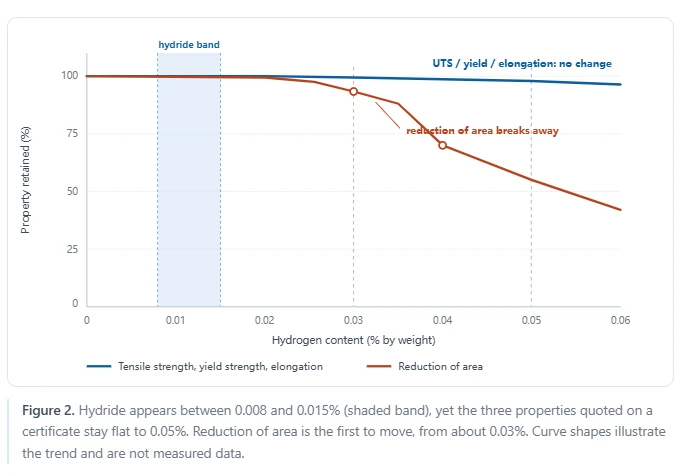
Titanium is a highly reactive metal, and hydrogen absorption is one of its most persistent behaviours. Once the hydrogen content inside the material reaches 0.008% to 0.015%, needle-like hydride phases precipitate within the metal and can be observed directly under an optical microscope. As the hydrogen content continues to rise, the number of hydride precipitates increases and their volume grows, which damages the structural stability of the titanium matrix and gives rise to a range of corrosion and failure problems.
Corrosion damage that begins with hydrogen absorption and proceeds through hydride formation takes three main forms.
Three Failure Modes Caused by Hydride Formation

Surface hydride spalling corrosion
Where the diffusion rate of hydrogen is relatively slow, hydrides concentrate and build up at the surface of the titanium part. The hydride-rich surface layer then spalls in a brittle manner, which substantially accelerates the corrosion process at the surface.
Stress-induced hydrogen cracking
Under an applied stress, hydrogen atoms diffuse toward regions of stress concentration and precipitate as hydride there. Internal microcracks propagate under continuing stress, link up with one another, and eventually cause hydrogen-induced cracking failure.
Bulk matrix embrittlement
Where a titanium part absorbs a large amount of hydrogen over a wide area and to a high degree, the matrix degrades across the whole section, producing general embrittlement damage and a loss of mechanical integrity throughout the component.
Mechanical Response to Hydrogen
Hydrogen failure in titanium is typical hydride-type embrittlement, and it carries a pronounced sensitivity to strain rate: brittle fracture occurs under high-speed deformation, while at low deformation rates the material shows essentially no embrittlement sensitivity.
On the compositional side, hydrogen above 0.03% significantly reduces the reduction of area. Below 0.05%, the conventional mechanical properties of the material - tensile strength, yield strength, elongation - show no obvious change. Routine mechanical testing therefore cannot reliably establish the hydrogen embrittlement risk of a titanium part.
| Parameter | Value | What it means in practice |
|---|---|---|
| Hydride precipitation begins | 0.008–0.015 % (80–150 ppm) |
Needle-like platelets become resolvable on a polished section under an optical microscope. |
| Spec ceiling, commercially pure grades | 0.0125 % (125 ppm) |
Product standards cap hydrogen inside the precipitation band rather than clearly below it. |
| Spec ceiling, Ti-6Al-4V | 0.015 % | Same position for the workhorse alloy. |
| Reduction of area starts to fall | ≈ 0.03 % (300 ppm) |
The first conventional property that actually moves. |
| Tensile, yield, elongation still flat | < 0.05 % (500 ppm) |
Which is why a tensile certificate says so little. |
| Dry hydrogen attack threshold | ≈ 300 °C | Above this, H2 dissociates at the surface fast enough to matter. |
| Seawater cathodic limit | −0.70 V | Hold the metal above it and the uptake route stays closed. |
| Severe permeation regime | −1.0 V SCE | High cathodic current density; cracking at room temperature becomes credible. |
| Water in hydrogen gas | ≈ 2 wt % | Strong suppression of uptake. |
| Stable-film pH window | 3–12 | Inside it the film holds; outside it the barrier degrades. |
Iron Contamination and Its Effect on Uptake and Corrosion
When titanium is scratched by iron tools during processing, or carries iron particles on its surface, the attached foreign iron becomes a pitting initiation site and at the same time a principal channel through which hydrogen atoms enter the matrix. Both the probability of hydrogen uptake and the probability of corrosion rise substantially.
Trace iron dissolved in solid solution in the titanium matrix, and the iron-rich second phases present in the matrix, behave quite differently: they do not aggravate pitting of the titanium, and they have no marked negative effect on hydrogen uptake or on hydrogen embrittlement.
Surface Condition and Resistance to Hydrogen Uptake
The susceptibility of titanium to hydrogen uptake and embrittlement is closely related to the way the surface was prepared, and the deciding factor is the integrity and stability of the surface oxide film. The protection offered by different processes differs considerably.
Surfaces that have been anodised or thermally oxidised carry a complete and dense oxide film and give the best resistance to hydrogen uptake and embrittlement.
Surfaces that have been pickled in nitric and hydrofluoric acid, or annealed, come next in protective performance.
Surfaces that have been mechanically ground or grit-blasted are the most active, carry a poorly protective film, and are the most prone to hydrogen uptake and embrittlement.
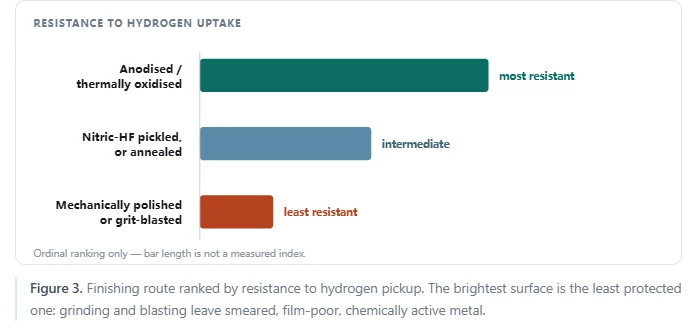
A complete and stable surface oxide film is therefore the primary barrier against hydrogen atoms entering the metal. Where the titanium matrix is left active and exposed, hydrogen uptake failure is very likely to follow.
Where Titanium Picks Up Hydrogen
In practice, hydrogen uptake in titanium is concentrated in four service environments.
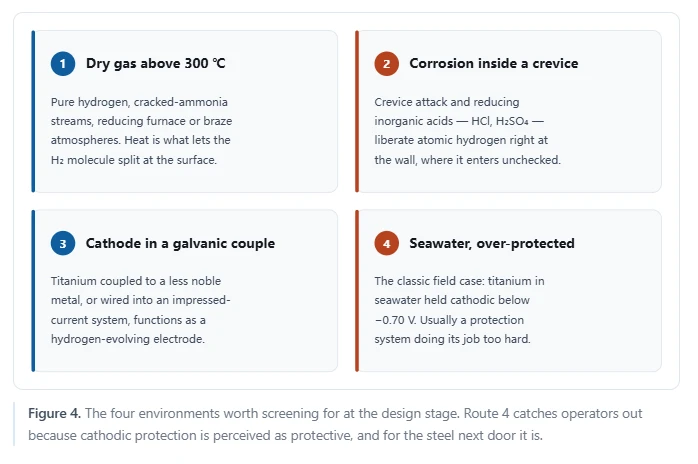
1. Environments of pure hydrogen or hydrogen-containing gas at temperatures above 300 °C.
2. Environments in which nascent hydrogen is generated during crevice corrosion or corrosion by reducing inorganic acids.
3. Environments in which hydrogen atoms are produced during galvanic corrosion or under cathodic protection.
4. Seawater service in which the titanium is cathodic and its potential is below −0.70 V.
For industrial applications, preventing hydrogen uptake failure in titanium requires the operating potential of titanium equipment in seawater service to be held reliably above −0.70 V.
Molecular Versus Nascent Atomic Hydrogen
Hydrogen embrittlement of titanium can occur in a hydrogen gas atmosphere or in an environment where hydrogen is generated electrolytically, and the two differ considerably in hazard. Ordinary hydrogen gas is molecular hydrogen and has relatively low activity. The nascent atomic hydrogen produced by corrosion reactions or by cathodic electrolysis is chemically far more active, is absorbed more readily by the titanium matrix, and is the main cause of hydrogen embrittlement failure in titanium.
The Suppressing Effect of Moisture in a Hydrogen Atmosphere
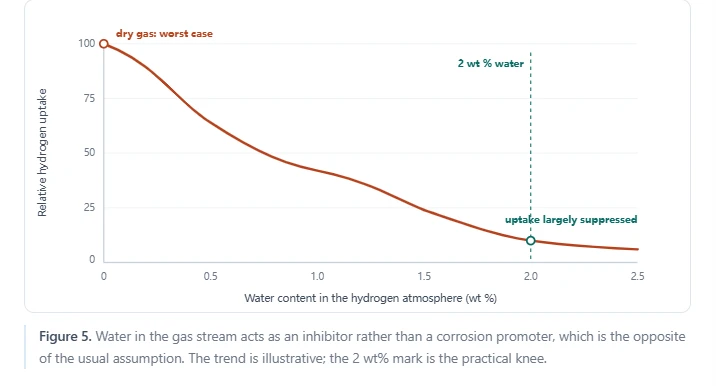
The water content of a hydrogen atmosphere has a very large influence on how much hydrogen titanium absorbs. Under dry, pure hydrogen, both the rate of uptake and the total amount absorbed are at their highest; adding moisture to the gas markedly suppresses the absorption. When the water content of the atmosphere reaches 2% by mass, the barrier effect is very pronounced. The behaviour closely parallels the way moisture suppresses combustion in dry chlorine gas.
Effect of Medium pH and Cathodic Potential
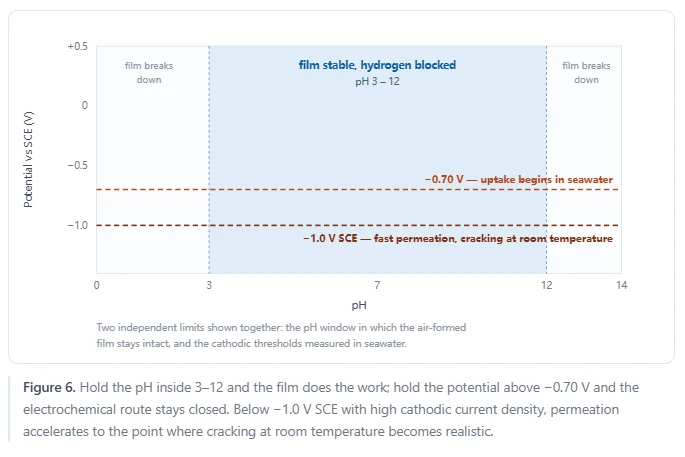
Between pH 3 and pH 12 the surface oxide film on titanium is structurally stable and effectively blocks penetration by hydrogen atoms. Within this range, short-term cathodic charging causes essentially no hydrogen uptake.
Once the pH of the medium falls outside that stable range, the oxide film becomes less stable and its protection fails, so hydrogen atoms enter the matrix readily. Long-term test data show that in a neutral brine environment, marked hydrogen uptake appears when the cathodic potential of the titanium falls below −0.7 V. Where the cathodic current density is very high and the electrode potential is more negative than −1.0 V SCE, hydrogen permeation is accelerated and hydrogen embrittlement of titanium is induced directly at room temperature.
Across all seven factors, the same two variables keep deciding the outcome: how intact the surface oxide film is, and how negative the potential becomes. Neither of them appears on a tensile certificate.