

Titanium alloys exhibit strong affinity for oxygen and nitrogen at elevated temperatures, resulting in the formation of tenacious oxide scales during hot-forming operations. The color and thickness of these scales vary systematically with forming temperature-blue at approximately 600°C, grayish-red at approximately 850°C, and gray at 900°C. As forming temperature rises, scale thickness increases and adhesion to the substrate intensifies, making removal progressively more difficult. Scales generated above 900°C require aggressive chemical stripping that frequently compromises underlying surface integrity.
The industry standard for titanium alloy scale removal remains the two-step alkali-acid method: molten caustic conditioning followed by acid pickling. While effective, this sequence introduces two critical metallurgical risks-premature aging strengthening and hydrogen embrittlement-that demand rigorous process control.
Scale Formation and Characteristics

Titanium alloys develop oxide scales through diffusion-controlled oxidation during hot working. The scale comprises multiple oxide layers, primarily TiO₂, with minor contributions from Ti₂O₃ and TiO depending on oxygen partial pressure and exposure duration.
The temperature-scale relationship follows a consistent pattern across titanium alloy grades:
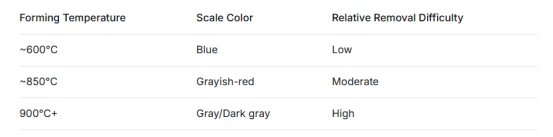
At 600°C, the oxide film remains thin and relatively porous, permitting straightforward chemical removal. At 850°C, scale thickening and sintering increase adhesion. Above 900°C, the scale densifies and bonds strongly with the substrate; removal requires extended exposure to aggressive media, elevating the risk of substrate attack.
TC4 titanium alloy hot-forming surface oxide thickness typically measures less than 2 μm, yet even this thin layer can significantly impair subsequent processing if not completely removed.
The Two-Step Descaling Process
Step One: Molten Caustic Conditioning
The first stage immerses the scaled workpiece in a molten alkaline bath. The caustic medium-typically a blend of NaOH and NaNO₂ or NaOH and NaNO₃-reacts with the oxide scale, loosening its structure and promoting detachment.
Common formulations include:
- NaOH at 700 g/L plus NaNO₂ at 250 g/L (supersaturated solution)
- Boiling temperature approximately 160°C
- Immersion duration up to 6 hours for complete conditioning

Alternative proprietary molten oxidizing salts (e.g., Virgo-type formulations) have also proven effective for hot-rolled alloy scale removal.
The caustic bath operates through chemical conversion: it transforms the adherent oxide into a friable, conditioned layer that subsequent acid pickling can readily dissolve.
Step Two: Acid Pickling
Following caustic conditioning and water rinsing, the workpiece undergoes acid pickling. The standard pickling solution combines nitric acid (HNO₃) with hydrofluoric acid (HF).
Typical acid bath parameters:
- HNO₃:HF volume ratio ≥ 5:1 (critical for hydrogen embrittlement prevention)
- Recommended ratio: 10:1 HNO₃:HF
- Bath temperature: below 60°C to limit hydrogen absorption
- Immersion time: 20 seconds to several minutes depending on scale thickness and alloy composition

The nitric acid serves as an oxidizing agent that passivates the freshly exposed titanium surface, while hydrofluoric acid dissolves the conditioned scale and underlying oxide-contaminated layer.
Pickling removes residual scale and restores the metallic surface finish. For chemically milled materials, salt-bath conditioning may be required to eliminate the oxygen-contaminated layer beneath the scale.
Critical Process Risks
Risk One: Premature Aging Strengthening
The molten caustic bath operates at approximately 450°C. This temperature falls within or near the aging temperature range for α+β and β titanium alloys.
During caustic conditioning, semi-finished products may undergo unintended precipitation strengthening-the nucleation and growth of secondary α or intermetallic phases within the β matrix. This premature aging produces several detrimental outcomes:
- Increased hardness and reduced ductility in subsequent cold working operations
- Elevated risk of cracking during further processing
- Compromised dimensional stability in finished components
The phenomenon is particularly pronounced in β-rich alloys where aging kinetics accelerate at temperatures above 400°C. Unlike controlled aging treatments performed under precisely monitored conditions, caustic-bath exposure occurs without regard to the alloy's temper condition, introducing variability in mechanical properties across production batches.
Risk Two: Hydrogen Embrittlement
Hydrogen embrittlement constitutes the most insidious threat in titanium alloy processing. Titanium and its alloys readily absorb hydrogen from pickling solutions, cleaning baths, and even the atmosphere at elevated temperatures.
The mechanism operates as follows:
During acid pickling, the HF component attacks the titanium surface, generating atomic hydrogen as a byproduct of the dissolution reaction. A portion of this atomic hydrogen diffuses into the titanium lattice rather than recombining into molecular H₂ and escaping.
Once absorbed, hydrogen occupies interstitial sites in the α-Ti lattice. At concentrations exceeding solubility limits, hydrogen precipitates as brittle titanium hydride (TiHₓ) platelets along grain boundaries and slip planes. These hydrides:
- Reduce fracture toughness and fatigue resistance
- Promote intergranular cracking under tensile stress
- Accelerate subcritical crack growth in service environments
The hydrogen embrittlement threshold varies by alloy composition and microstructure, but concentrations as low as 150-200 ppm can produce measurable degradation in mechanical properties.
Several factors exacerbate hydrogen pick-up during pickling:
- HF concentration exceeding optimal levels accelerates the dissolution reaction and generates excessive atomic hydrogen
- Elevated bath temperature above 60°C increases hydrogen diffusivity and absorption kinetics
- Depleted HNO₃ content reduces the passivating effect that would otherwise limit hydrogen ingress
- Extended immersion time prolongs hydrogen exposure
- Titanium ion accumulation above 12 g/L in the bath alters solution chemistry and promotes hydrogen absorption
Hydrogen absorption can be completely prevented by removing iron and nickel surface contamination in a nitric acid solution prior to scale conditioning. This pretreatment eliminates galvanic coupling effects that accelerate hydrogen pick-up during subsequent acid exposure.
Process Control Strategies
Caustic Conditioning Controls

Temperature management remains the primary lever for preventing premature aging. While 450°C represents the conventional operating point, lower-temperature caustic formulations exist. NaOH-NaNO₂ systems operating near 160°C (boiling aqueous solution) offer an alternative that reduces aging risk while maintaining descaling effectiveness.
Time minimization limits thermal exposure. The conditioning duration should be the minimum required to achieve scale loosening-typically determined through coupon testing for each alloy-grade and scale-thickness combination.
Alloy-specific protocols account for varying aging sensitivity. β-rich alloys require more conservative temperature-time parameters than α or near-α alloys.
Acid Pickling Controls

HNO₃:HF ratio maintenance above 5:1 (preferably 10:1) constitutes the single most critical control parameter for hydrogen embrittlement prevention. The nitric acid concentration must never fall below approximately 10%, as this threshold marks the boundary between safe passivation and active hydrogen absorption.
Temperature limitation below 60°C reduces both hydrogen absorption kinetics and general corrosion rates.
Bath monitoring includes regular analysis of acid concentrations and dissolved titanium content. Bath replacement becomes necessary when titanium concentration exceeds 12 g/L.
Post-pickling rinsing with hot water followed by cold water and forced drying prevents residual acid corrosion and minimizes hydrogen ingress during subsequent handling.
Time window constraint requires acid pickling within one hour of caustic conditioning to prevent secondary oxidation of the conditioned surface.
Conclusion
The two-step molten caustic conditioning and acid pickling process remains the industry standard for titanium alloy scale removal. Its effectiveness derives from the complementary action of caustic scale loosening followed by acid dissolution. However, the process introduces two significant metallurgical risks-premature aging strengthening from 450°C caustic exposure and hydrogen embrittlement from uncontrolled HF-HNO₃ pickling.
Successful implementation demands rigorous process control across temperature, time, and solution chemistry parameters. The HNO₃:HF ratio must consistently exceed 5:1 to prevent hydrogen absorption. Caustic bath temperature and duration require minimization to avoid unintended aging responses.
For production environments processing diverse titanium alloy grades and product forms, differentiated process specifications-combined with in-process monitoring and regular bath analysis-offer the most reliable path to consistent scale removal without compromising material properties or component integrity.


