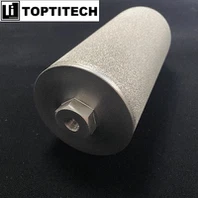
Metal porous materials consist of a diverse array of holes scattered throughout the material, varying in diameter from 2 micrometers to 3 millimeters. These holes can take different shapes, including foam, lotus, and honeycomb structures. Depending on the hole design, porous metal materials can be classified into two categories: independent hole type and continuous hole type.
The independent hole type offers numerous advantages, such as low specific gravity, excellent rigidity, high specific strength, effective vibration absorption, and sound absorption. On the other hand, continuous hole type materials possess these characteristics while also exhibiting good permeability and ventilation. Due to their unique structural and functional properties, porous metal materials find broad applications in aerospace, transportation, construction engineering, mechanical engineering, electrochemical engineering, and environmental protection engineering.

Powder Subtered Porous Materials

Wire mesh porous material

Metal fiber sintered porous material
-
Metal porous materials can be classified into different types, including powder sintered porous materials, metal fiber sintered porous materials, wire mesh porous materials, and foam metal materials. Powder sintered porous materials are produced using metal or alloy powder as the raw material. The process involves shaping the powder into a rigid structure and sintering it at high temperatures, resulting in a porous material with interconnected or semi-connected pores. The pore structure is formed through the stacking of regular and irregular powder particles, with pore size and distribution determined by the particle size composition and preparation process.
-
Bronze, stainless steel, iron, nickel, titanium, tungsten, molybdenum, and refractory metal compounds are commonly used materials for powder sintered porous materials. Traditional preparation methods include compression molding and sintering, isostatic pressing, loose sintering, powder rolling, powder plasticizing extrusion, and slip casting. Additionally, innovative technologies such as centrifugal deposition, injection molding, 3D printing, laser rapid prototyping, and electron beam rapid prototyping provide alternative approaches to creating powder sintered porous materials. -
Centrifugal deposition technology involves using a porous metal tube with larger pore sizes as a support structure. The process starts by preparing a metal powder slurry, which is then placed inside the support tube and subjected to high-speed rotation. Under centrifugal force, the powder particles in the slurry are graded and deposited on the inner wall of the support tube, resulting in a gradient film structure. Subsequent drying, sintering, and other treatments yield a porous membrane tube. This technique is suitable for producing microporous metal films using powders such as titanium, titanium alloys, stainless steel, nickel, and nickel alloys. By utilizing sub-micron and nano-scale particle sizes, it is possible to create microporous metal films with corresponding pore sizes. -
Metal injection molding (MIM) is another method employed in the preparation of powder sintered porous materials. In this process, the powder is mixed with an organic binder and shaped using an injection molding machine. The binder is then removed from the formed blank, and the resulting product is sintered to achieve the desired final properties. MIM technology offers high precision, uniform structure, excellent performance, and cost-effectiveness, making it suitable for manufacturing porous materials from bronze, stainless steel, titanium, nickel, and their alloys. -
Process:
Traditional processes for preparing metal porous materials include compression molding and sintering, isostatic pressing, loose sintering, powder rolling, powder plasticizing extrusion, and slip casting.


copper filter

stainless steel filter

titanium porous sheet