

A titanium flange is a component used to connect pipes, valves, pumps, and other equipment in a piping system. Flanges facilitate the assembly and disassembly of these components while providing a sealed joint. Titanium flanges, specifically, are flanges made from titanium or titanium alloys. Titanium is chosen for its exceptional corrosion resistance, high strength, and low density. Various types of titanium flanges are designed to meet specific requirements in different applications.
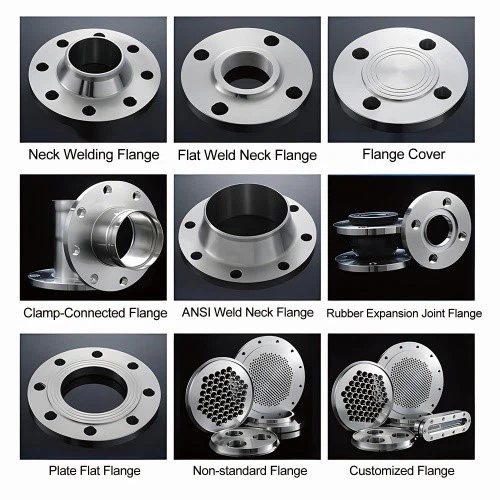
Here are some common types of titanium flanges:
Neck Welding Flange:
The Neck Welding Flange, commonly referred to as a Weld Neck Flange, stands out with its elongated tapered neck, ensuring a smooth transition from the pipe to the flange. Primarily designed for high-pressure applications, this flange is meticulously welded to the pipe, bolstering structural integrity and thwarting potential leakage.
Flat Weld Neck Flange:
In a parallel vein to the Neck Welding Flange, the Flat Weld Neck Flange boasts a flat face on the neck. This design proves especially advantageous in applications where a level surface is requisite for gasket sealing, guaranteeing effective and dependable joint connections.
Flange Cover:
The Flange Cover assumes a pivotal role in shielding the flange and joint from environmental elements, corrosion, and potential damage. These covers are meticulously crafted to snugly fit over the flange, offering an additional layer of protection.
Clamp-Connected Flange:
Known as the Lap Joint Flange, the Clamp-Connected Flange is ingeniously devised to slide over the pipe, subsequently being rotated to align with the bolt holes of the companion flange. This design feature streamlines the alignment and dismantling of the piping system as needed.
ANSI Weld Neck Flange:
Adhering to the rigorous standards established by the American National Standards Institute (ANSI), ANSI Weld Neck Flanges find widespread use in industries adhering to ANSI specifications for their piping systems. These flanges guarantee adherence to recognized standards.
Rubber Expansion Joint Flange:
The Rubber Expansion Joint Flange is associated with flexible joints providing crucial functions such as vibration isolation, noise reduction, and compensation for thermal expansion or contraction in piping systems. These flanges often incorporate rubber or elastomer materials, enhancing flexibility.
Plate Flat Flange:
The Plate Flat Flange is a flat-faced flange sans a raised neck. Its suitability comes to the fore in applications where precise bolt alignment and ease of assembly are pivotal factors for successful and efficient joint connections.
Customized Flange:
Customized Flanges are meticulously tailored to meet specific requirements outlined by the client or application. Designed based on unique dimensions, features, and standards surpassing standard flange types, these flanges ensure an impeccable fit for specialized needs.
Titanium flanges find applications in industries such as aerospace, chemical processing, marine, and others where the unique properties of titanium are advantageous. These properties include corrosion resistance, biocompatibility, and high strength-to-weight ratio. The choice of the type of flange depends on factors like the pressure and temperature requirements, the nature of the fluid being conveyed, and the specific demands of the piping system.