

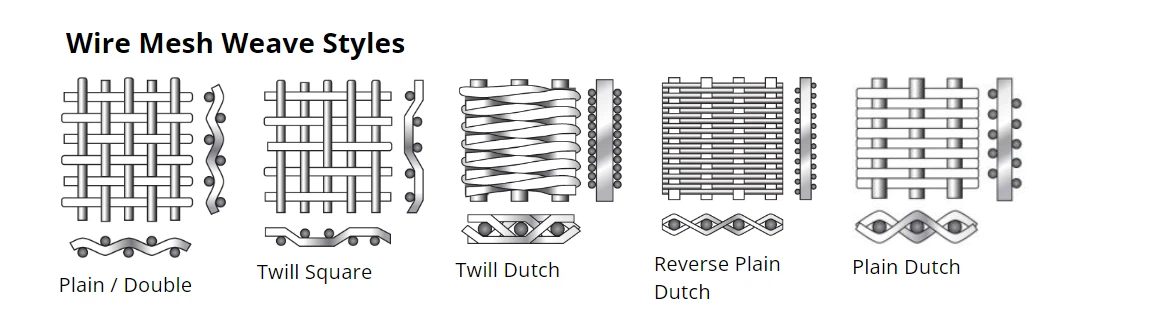
Plain/Double Weave: The plain weave is a commonly used and straightforward method of weaving wire mesh. It results in square openings with wires of the same size in both directions. Each warp wire alternates over and under-fill wires at right angles in both directions.
Twill Square Weave: In this weave, each warp and shute wire is woven alternately over two and under two warp wires. It creates parallel diagonal lines and allows for the use of heavier wires with specific mesh counts. This weave is suitable for applications requiring greater loads and finer filtration.
Twill Dutch Weave: A filter cloth that offers higher strength compared to regular Dutch weaves. It accommodates more wires within a given area. Typically, each shute wire passes over two warp wires and under two, creating square openings. Twill Dutch weave has finer mesh counts and lower flow, making it capable of filtering particles as small as 2 microns in diameter.
Reverse Plain Dutch Weave: This filter cloth reverses the method used in plain and twilled Dutch weaves, with a larger count of wires in the warp and a smaller count in the shute. The warp wires have a smaller diameter and touch each other, while the heavier shute wires are tightly woven together.
Plain Dutch Weave: Primarily used as a filter cloth, this weave features openings that slant diagonally through the cloth and are not visible when looking directly at it. The mesh has a coarser structure and thicker wires in the shute direction, resulting in a compact, firm mesh with high strength.