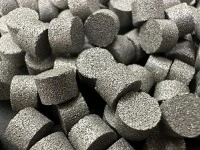

 On 26th February, TOPTITECH announced one of their breakthrough of porous metal products---0.45mm thickness porous titanium plate as PTL in electrolyzer.
Porous titanium plates are widely used in various electrolysis processes, including electrochemical synthesis, electrochemical corrosion, electrodeposition, electrolysis of hydrogen production, electrolysis of water for oxygen production, electrolysis of copper, electrolysis of aluminum, etc. They play a key role in these fields, providing efficient electron and proton transport pathways.
0.45mm thickness PTL in PEM electrolyzer has the following advantages:
High conductivity: Porous titanium plates have excellent conductive properties and can effectively transmit electric current. This allows it to provide a good electron transport path and reduce resistance losses when used as a transport layer in electrolysis.
High gas permeability: The porous titanium plate has good gas permeability and can promote the flow of gas during the electrolysis process. This is very important for some electrochemical systems that require gas to participate in the reaction or need to eliminate bubbles, such as fuel cells, electrolysis of water to produce hydrogen, etc.
Large surface area: Porous titanium plates have a large surface area, which helps increase the contact area for electrolysis reactions and improve reaction efficiency. By increasing the details of the porous structure and adjusting the pore size distribution, the surface area can be further increased, thereby improving transmission efficiency.
Good chemical stability: The porous titanium plate has good chemical stability in the electrolyte and is not prone to corrosion or oxidation reactions. This enables it to operate stably for a long time in various electrolysis environments without negatively affecting the electrolysis process.
By precisely controlling the pore size, porosity, and pore distribution of porous structures, better transport efficiency and reaction selectivity can be achieved.