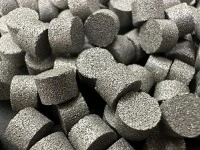
Engineers have developed an efficient process to convert carbon dioxide into fuel. The method involves directly converting the greenhouse gas into formate, a solid fuel that can be stored indefinitely and used for heating homes or powering industries.
Researchers from MIT and Harvard University have made significant progress in this field. They have successfully demonstrated the process in a small-scale laboratory setting, which involves capturing the gas and electrochemically converting it into solid formate powder. This powder can then be used in fuel cells to generate electricity. The researchers believe that the process is scalable and could potentially provide emission-free heat and power to individual households, as well as be applied in industrial or grid-scale settings.
Formate fuel has various applications, ranging from small-scale units for homes to large-scale industrial or grid-scale storage systems. Initially, a household application could involve an electrolysis device about the size of a refrigerator, used to capture carbon dioxide and convert it into formate, which can then be stored in underground or rooftop tanks. When needed, the solid powder would be mixed with water and fed into fuel cells to provide power and heat. The researchers envision this as a community or household demonstration, but they also believe it could be beneficial for factories or the grid in the future.
Formate fuels offer several advantages, such as their benign and stable nature, making them an attractive energy carrier. Potassium formate and sodium formate are already produced industrially and are commonly used as de-icing agents for roads and sidewalks. They are non-toxic, non-flammable, easy to store and transport, and can remain stable in regular steel containers for months or even years.
The work of these engineers has received support from the U.S. Department of Energy's Office of Science. Ted Sargent, a professor of chemistry and electrical and computer engineering at Northwestern University who was not involved in the study, commented that the concept of formate economy is intriguing and the researchers have demonstrated improved liquid-to-liquid conversion efficiency from bicarbonate feedstock to formate, proving that these fuels could be used for power generation in the future.