

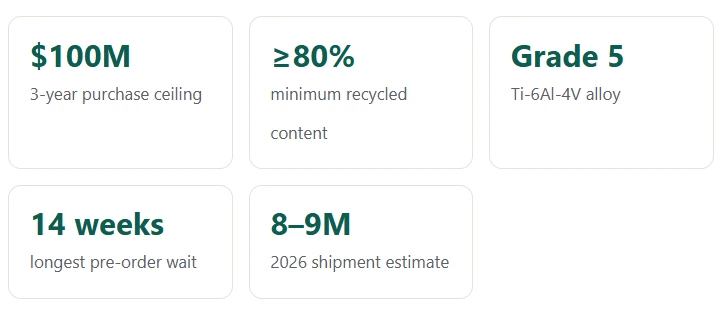
On October 20, Apple announced it will purchase up to $100 million of titanium over the next three years from Perryman Company, a specialty metals producer based in Houston, Pennsylvania. The metal will go into multiple products, including the iPhone Duo - Apple's first foldable, priced at $1,999 and hitting stores on October 24. The deal sits inside Apple's American Manufacturing Program and marks the first time a consumer-electronics OEM has locked titanium supply into its domestic sourcing list through a multi-year agreement.
A Closed-Loop Contract, Not a Volume Deal
Perryman, founded in 1988, handles the full upstream sequence in-house: vacuum arc remelting (VAR), forging, and rolling, all performed in Pennsylvania. The specification requires at least 80% recycled content - primary feedstock is not sponge but reclaimed titanium turnings and plate off-cuts remelted through the company's melt shop. Apple also confirmed that nearly 100 components in the iPhone Duo and iPhone 18 Pro are now sourced from US suppliers across more than a dozen states.
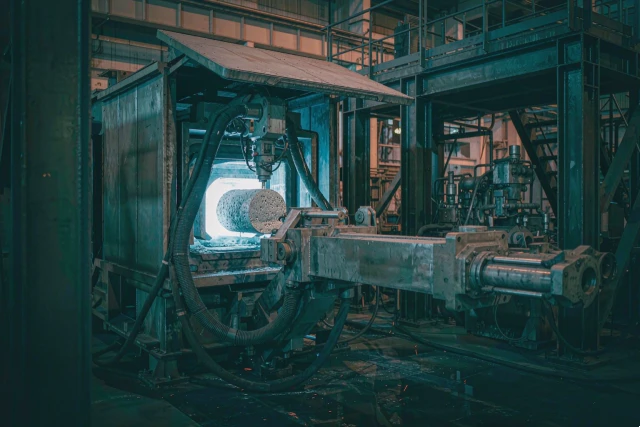
VAR melting remains the gatekeeper of titanium quality: ingots are typically double- or triple-melted to homogenize chemistry and squeeze out inclusions (illustrative image).
Why Titanium Wins the Foldable Engineering Fight
A folding hinge is arguably the most demanding machined assembly in consumer hardware: dozens of precision parts, micron-level tolerances, wall sections down to roughly 0.3 mm, and fatigue life beyond 100,000 open-close cycles. Titanium's strength-to-density ratio simply outclasses the alternatives - Grade 5 Ti-6Al-4V delivers about 895 MPa tensile strength at 4.43 g/cm³, versus roughly 310 MPa at 2.70 g/cm³ for 6061-T6 aluminum and 485 MPa at 8.00 g/cm³ for 316L stainless. A modulus near 114 GPa keeps hinge flexures elastic instead of permanently deforming, and the self-heating passive oxide film (TiO₂) handles corrosion without added plating. Apple's blasted-matte finish with PVD tinting builds directly on that oxide chemistry.
The Sponge Gap America Is Filling With Scrap
Context matters here: the last commercial titanium sponge plant in the United States shut down in 2024. Sponge is the entry point of primary titanium - Kroll-process output that gets compacted into electrodes and VAR-melted into ingots. With domestic sponge capacity at zero, US primary metal is fully import-dependent while aerospace and defense demand keeps climbing under Buy American and DFARS melt-origin rules. An 80% recycled feed spec is, in effect, a strategy to bridge the sponge gap with a closed scrap loop: turnings are sorted, cleaned, deoxidized (interstitial oxygen pushed back under the ~0.20 wt% Grade 5 limit), compacted and remelted. The chemistry is proven; the industrial challenge is feedstock grading and lot-to-lot consistency at consumer-electronics surface standards.
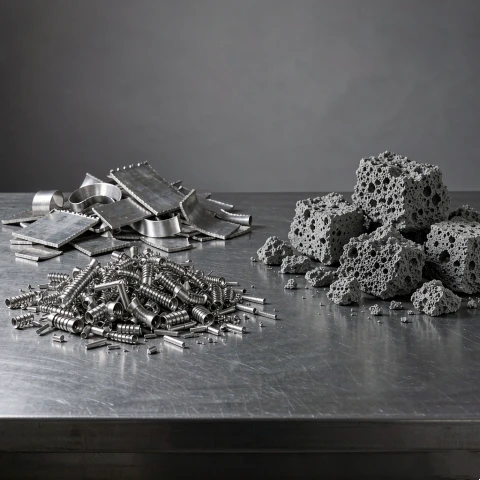
Closed-loop feedstock: machined turnings and plate off-cuts. Interstitial oxygen control is the technical gate for remelting (illustrative image).
Lead Times vs. the Shipment Gap
Pre-orders for the iPhone Duo stretched to about 14 weeks on day one - the longest wait for a new iPhone in a decade - and JPMorgan cut its 2026 shipment forecast to 8–9 million units from 10 million, citing supply chain ramp. Titanium is the slow link: electrode compaction, double VAR melting, forging, hot rolling, annealing, cold rolling and finishing run on monthly timescales, before five-axis CNC machining and hinge assembly even begin. Apple's announcement addresses material availability, not output.
Three Takeaways for the Global Titanium Market
First, consumer electronics has moved from titanium marketing to titanium tonnage. At tens of grams of net metal per chassis plus machining yield losses, 8–9 million units translate into roughly kiloton-scale gross demand for Grade 5 mill products - modest for the titanium market, but a high-quality, spec-uniform order book that reshapes a mill's customer mix.
Second, recycled titanium is being repriced. Scrap sorting, hydrogen deoxidation (HDH) and particle-size engineering - once defense-adjacent niches - now sit on a consumer procurement standard, and adjacent powder routes (plasma-atomized spherical powder, metal injection molding, additive manufacturing) benefit from the same logic: powder routes push material utilization from 10–20% toward 90%. Third, demand is broadening across industries at once. Beyond 3C: porous titanium transport layers and fiber-felt gas diffusion layers for PEM electrolyzers, sintered titanium filtration for chemical processing, getters for MEMS packaging, TC4 sputtering targets, and ASTM F136 implant-grade alloy for medical devices. China's Baoji "Titanium Valley" cluster and America's traceable melt capacity now tell two parallel supply-chain stories - one competing on cost and scale, the other on compliance and origin.
FAQ
Q1: What type of titanium alloy is used in the iPhone Duo?
The device body utilizes Grade 5 titanium (Ti-6Al-4V)-an α+β dual-phase alloy widely used in the aerospace industry. The melting, forging, and rolling processes are handled by the Perryman Company.
Q2: What is the required proportion of recycled titanium?
At least 80%. By using recycled titanium shavings and offcuts as the primary furnace feedstock, this "closed-loop" scrap-based approach effectively bypasses supply gaps in virgin "sponge" titanium production.
Q3: Why is the U.S. rebuilding its domestic titanium supply chain?
With the closure of the last commercial titanium sponge plant in the U.S. in 2024, the country has become dependent on imports for virgin titanium. Furthermore, "Buy American" mandates and DFARS (Defense Federal Acquisition Regulation Supplement) requirements-which dictate specific melting locations for defense and aerospace applications-give a strategic premium to traceable, domestically produced titanium.
Q4: How many tons of titanium does a $100 million investment represent?
Apple has not disclosed the exact tonnage. Based on price ranges for consumer-grade titanium semi-finished products and precision-machined components, this suggests a gross demand in the range of thousands of tons-a significant portion of which will eventually re-enter the recycling system following the machining process.
Q5: What is the supply status of the iPhone Duo?
On the first day of pre-sales, wait times for certain models reached approximately 14 weeks. J.P. Morgan has lowered its shipment forecast for 2026 to 8–9 million units, as material supply agreements cannot be immediately converted into new production capacity.