
Titanium Industry Desk · November 2, 2026
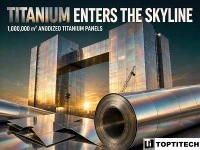
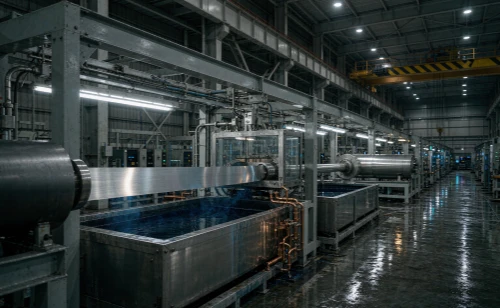
On October 29, 2026, a first-round environmental impact assessment (EIA) notice appeared on the Baoji High-tech Zone government website in Shaanxi Province - easy to miss, hard to overstate. A newly established architectural materials company backed by one of China's top titanium producers will convert an existing plant into three production lines: a sheet processing line, a coil processing line, and a consumer titanium products line, with capacity for 1 million square meters of anodized titanium sheet and coil annually (500,000 m² each) plus 500,000 pieces of consumer titanium tableware and drinkware (350,000 m² equivalent).
For an industry used to reading China's biggest titanium base through the lens of aerospace forgings and deep-sea pressure hulls, the pivot toward titanium curtain walls, standing-seam roofing and retail tableware is a signal worth decoding.
Why now: the sponge titanium arithmetic
Grade 0 titanium sponge fell another RMB 2,000–3,000 per tonne through October to RMB 41,000–43,000/t. Semi-integrated sponge producers are running at roughly -6.5% margin. China's listed titanium mills posted single-digit net margins in H1 2026 - the same story from the top: selling mill products alone no longer pays. Value has migrated downstream, to surface engineering and finished goods.
Anodized titanium: a surface process with real barriers
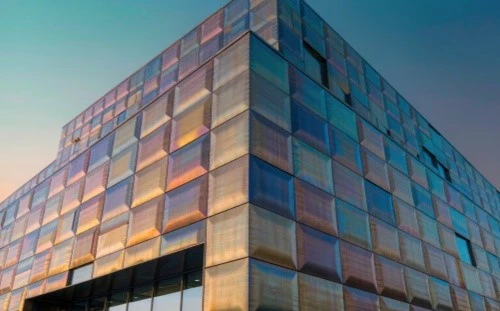
Anodizing titanium grows a dense TiO₂ oxide film tens to hundreds of nanometers thick; film interference - not dyes or coatings - produces the blue, gold and violet tones. For architectural cladding the benefits compound: no paint system to degrade, decades of UV and marine-atmosphere stability, self-healing passivation, and 4.51 g/cm³ density that cuts façade weight over 60% versus stone. Japan, where roughly 15% of titanium demand goes to construction, has anchored the high-end anodized titanium panel market for decades; China's share remains below 3%. The Baoji entrant - integrated from melt through anodizing to finished panel - targets exactly that gap, with a sheet line for bespoke façade cassettes and a coil line for volume standing-seam roofing. Baoji's "Titanium Valley" supply chain, spanning sponge, melting, forging and rolling, is the enabling asset.
Consumer titanium: 500,000 pieces as a channel bet
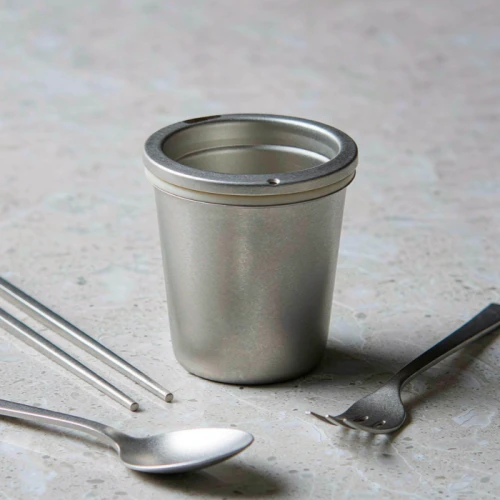
The consumer line's 500,000-piece annual capacity signals a brand-and-distribution play, not an OEM trial. Traceable TA1/TA2 food-contact titanium from the producer's own melt shop undercuts the quality-consistency weakness of the small workshops that currently dominate China's titanium drinkware market, a segment growing at double digits with retail prices of RMB 200–600 per pure-titanium vacuum cup. It is the first time state-level titanium capacity has flowed into tableware at scale.
What it means for the industry
Three takeaways. First, the "China Titanium Valley" playbook is shifting from upstream capacity to downstream applications - architectural titanium, consumer goods, hydrogen-grade porous titanium, additive-manufacturing powders. Second, with 1 million m² of annual anodizing capacity, supply is ready before demand; architectural education, not metallurgy, is now the bottleneck. Third, the market is splitting by certification and channel: some producers convert aero-engine bar qualifications into orders, others build exits into construction and retail, and overseas majors lock in commercial-airframe long-term agreements. Producers without a downstream outlet are the ones truly trapped at the sponge price floor.
FAQ
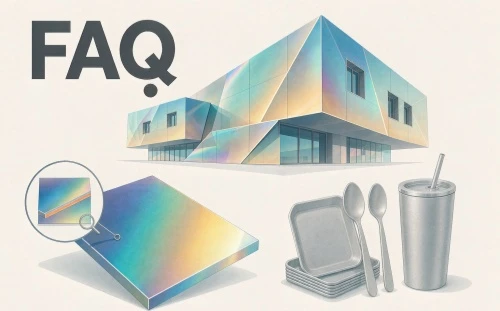
Q: Where is the project located and how big is the capacity?
Q: Why is anodized titanium suited to curtain walls and roofing?
Q: How does titanium cladding cost compare to alternatives?