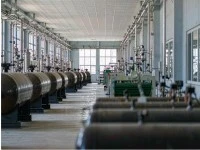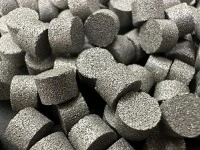

Product introduction of titanium rod filter element:
Titanium rod filter is also called filter element. It uses 304, 316L stainless steel as the shell. The inner
filter element is a titanium tube. It is a hollow filter tube made of titanium powder by high temperature
sintering and powder metallurgy. This series of products has compact structure and beautiful
appearance. The titanium rod filter element adopts titanium rod microporous sintered filter
element. The filter element is a hollow tubular filter element made of titanium metal powder by
powder metallurgy technology and sintered at high temperature, which belongs to depth filtration.
But, do you know how it works?
How is the titanium rod filter works:
When the filter medium enters the filter cartridge from the liquid inlet, the impurities are first
intercepted by the surface of the titanium rod, and a dense filter layer with gaps is formed on the
surface of the titanium rod. This cake layer can also be filtered.
At the same time, particles smaller than the pore diameter of the titanium rod enter the micropores on
the wall of the titanium rod. Since there are countless curved channels on the pipe wall, the channels
are curved and elongated, and the particles are easily intercepted after entering. The particles are
tightly attached to the pore walls due to squeezing and collisions caused by the flow of fluid. This kind
of filtration is carried out inside the titanium rod and belongs to deep filtration.
Impurities are trapped on the outer surface of the titanium rod and the inner wall of the titanium rod.
The filtered clean material flows out from the water outlet. When impurities build up in the filter
element, the pressure on the filter increases. When it reaches 0.3MPa, it will be filtered. Titanium rods
need to be regenerated.
Titanium is very stable in air at room temperature. When heated to 400-550°C, a strong oxide film
forms on the surface to prevent further oxidation. Titanium has a strong ability to absorb oxygen,
nitrogen and hydrogen. This gas is an impurity that is very harmful to the titanium metal. Even a small
amount (0.01% to 0.005%) will seriously affect its mechanical properties. Among titanium compounds,
titanium dioxide (TiO2) has the greatest practical value. TiO2 is inert to the human body, non-toxic,
and has a series of excellent optical properties. TiO2 is opaque, has high gloss and whiteness, high
refractive index and scattering ability, strong hiding power and good dispersion. The pigment
produced is a white powder, commonly known as titanium dioxide, which is widely used. The
appearance of titanium rods is very similar to that of steel. The density is 4.51 g/cm3, which is less than
60% of steel. It is the lowest density metallic element in refractory metals. The mechanical properties
of titanium, generally referred to as mechanical properties, are closely related to purity. High-purity
titanium has excellent machinability, good elongation and shrinkage, but low strength and is not
suitable for structural materials. Industrial pure titanium contains an appropriate amount of impurities,
has high strength and plasticity, and is suitable for making structural materials. Good elongation and
shrinkage, but low strength, not suitable for structural materials. Industrial pure titanium contains an
appropriate amount of impurities, has high strength and plasticity, and is suitable for making structural
materials. Good elongation and shrinkage, but low strength, not suitable for structural materials.
Industrial pure titanium contains an appropriate amount of impurities, has high strength and plasticity,
and is suitable for making structural materials.
Titanium alloys are divided into low strength and high plasticity, medium strength and high strength,
ranging from 200 (low strength) to 1300 (high strength) MPa, but in general, titanium alloys can be
regarded as high strength alloys. They are stronger than aluminum alloys, which are considered
moderate strength, and can completely replace some types of steel in strength. Compared with the
rapid decline in strength of aluminum alloys above 150 °C, some titanium alloys can still maintain
good strength above 600 °C. Dense metal titanium is highly valued by the aerospace industry because
of its light weight, higher strength than aluminum alloys, and its ability to maintain higher strength
than aluminum at high temperatures. Given that the density of titanium is 57% of that of steel, its
specific strength (strength/weight ratio or strength/density ratio is called specific strength) is high, and
its corrosion resistance, oxidation resistance, and fatigue resistance are very strong. 3/4 of titanium
alloys are used as structural materials represented by aerospace structural alloys, and a quarter of
them are mainly used as corrosion-resistant alloys. Titanium alloys have high strength, low density,
good mechanical properties, toughness and corrosion resistance. In addition, titanium alloys have poor process performance and are difficult to cut. In thermal processing, it is easy to absorb impurities such
as hydrogen, oxygen, nitrogen, and carbon. There is also poor wear resistance and complex production
process. Industrial production of titanium began in 1948. The development of the aviation industry
requires the titanium industry to develop at an average annual growth rate of about 8%. At present,
the annual output of titanium alloy processing materials in the world has reached more than 40,000
tons. There are nearly 30 titanium alloy grades. The most widely used titanium alloys are Ti-6Al-4V
(TC4), Ti-5Al-2.5Sn (TA7) and industrial pure titanium (TA1, TA2 and TA3).
There are three heat treatment processes for titanium rods and titanium alloy rods:
1. Solution treatment and aging
The purpose is to increase its strength. Alpha titanium alloys and stabilized beta titanium alloys cannot be strengthened by heat treatment and are only annealed in production. α+β titanium alloys and metastable β titanium alloys containing a small amount of α phase can be further strengthened by solution treatment and aging.
2. Stress relief annealing
The purpose is to eliminate or reduce the residual stress generated during processing. Prevent chemical attack and reduce deformation in certain corrosive environments.
3. Fully annealed
The purpose is to obtain good toughness, improve processing performance, facilitate reprocessing,
and improve dimensional and structural stability.