

Titanium alloy drilling is a high-risk machining process. This material has low thermal conductivity at about 7 W/m·K. It traps heat in the cutting zone during drilling. The material also has high strength and active chemical properties. These features speed up abrasive wear and adhesive wear on cutting tool edges. Factory workers face a common problem in actual operation. Workers raise cutting parameters to boost production efficiency, but cutting tools wear out quickly. Workers lower parameters to extend tool life, but machining cycle time becomes longer.
People do not need to choose one priority over the other. They only need to balance the two outcomes in a smart way.
Cutting Speed – The Thermal Governor
Cutting speed affects the cutting temperature most in titanium alloy drilling. Steel machining allows higher speeds to lift productivity with minor tool wear. Titanium alloy machining needs strict speed control. Too high cutting speed causes rapid temperature rise in the cutting zone. The workpiece surface will form work hardening layers. The cutting edge will suffer severe flank wear and built-up edge damage in a short time.

Solid carbide tools work well within a stable speed range of 25 to 45 m/min. Drills with TiAlN coating run at low speed values in this range. They show stable wear rules and produce holes with consistent quality. Speed values beyond this range make tool wear increase sharply. Excessive thermal load exceeds the heat dissipation capacity of cutting tools.
Feed Rate – The Chip Formation Variable
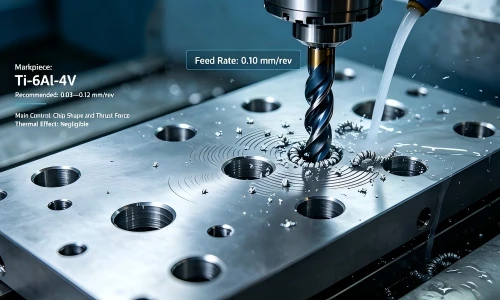
Feed rate controls chip thickness, chip removal state and axial cutting force directly. Feed rate has the biggest impact on hole surface roughness among all machining parameters for Ti-6Al-4V drilling. Low feed rate reduces drilling torque and axial force. But extremely low feed rate will cause titanium surface work hardening. It also fails to break and remove chips effectively. High feed rate helps divide chips into regular segments. But it increases mechanical pressure on the drill tip.
The best feed rate range for conventional drilling is 0.03 to 0.12 mm/rev. Spindle speed and tool tip angle change workpiece temperature in titanium drilling. Feed rate does not create obvious temperature changes. This practical rule tells users clearly. Feed rate optimization mainly improves chip shape and mechanical force conditions. It has little effect on heat control.
Coolant Strategy – The Enabler
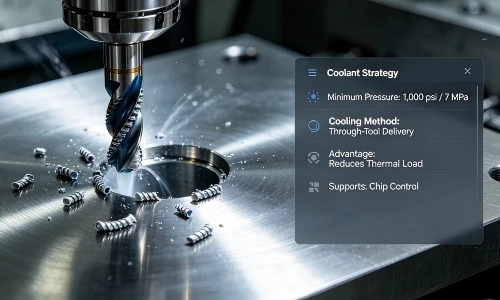
Ordinary flood coolant cannot support efficient titanium alloy drilling. The cutting zone temperature is too high for traditional lubricants to work normally. The tool and chip contact area loses effective thermal protection. High-pressure coolant supply completely improves the machining condition.
Tools with internal coolant channels send high-pressure coolant straight to the cutting edge. This design controls cutting temperature well and keeps chip removal smooth. Professional coolant channel structures deliver four times more coolant under the same pressure. Standard high-pressure pumps reach the minimum effective pressure. This pressure pushes coolant into the tool-chip gap and forms a stable lubricating layer.
High-productivity titanium drilling must use tools with internal high-pressure coolant channels. This configuration is a necessary condition for stable and efficient machining.
Tool Geometry – The Force Multiplier

Parameter optimization cannot work without matched tool geometry. X-shaped thinning design lowers cutting resistance. It also improves hole quality and chip removal efficiency. Double-angle tip designs with 118° and 90° compound angles break chips steadily and guide chip discharge smoothly. Carbide tool substrates with professional coatings provide stable high-temperature hardness and oxidation resistance.
Different tool geometries bring very different machining results. A professional test proves one special wiper tool structure can drill 75 holes at 50 m/min speed and 0.10 mm/rev feed rate. Its service life is three times that of other common tool geometries. Tool geometry plays a key role in performance differences, more than tool coatings and substrates.
The Practical Framework
The following parameter system provides a reliable reference for factories that machine Ti-6Al-4V titanium alloy.
- Cutting speed: 25–45 m/min for solid carbide tools. Choose low speed values for intermittent cutting or unstable machining conditions.
- Feed rate: 0.03–0.12 mm/rev. Use low feed rates for better surface finish. Use high feed rates for better chip breaking performance.
- Coolant: Adopt internal high-pressure coolant supply. The minimum recommended pressure is 1,000 psi (7 MPa).
- Point geometry: 118°–140° tip angle with thinning treatment. Choose double-angle designs for precise chip control.
- Coating: TiAlN PVD coating on fine-grained carbide substrates.
Users can adjust parameter combinations based on actual machining needs. Prioritize low feed rates and moderate speeds if surface finish is the core requirement. Prioritize high-speed machining with high-pressure coolant if production efficiency is the main goal. Intermittent deceleration feed drilling is another effective method. It can improve chip removal efficiency in titanium alloy drilling.